


Maker Faire Rome 2026: Robots, Smart Mushrooms and Maker Ingenuity
A robot handing out pens, an ESP32 looking after mushrooms, and a scrap-metal musician with a bass guitar. Maker Faire Rome 2026 certainly had a few ideas for anyone wondering what to build next.
Our latest wander around the Gazometro Ostiense brought together projects with very different personalities. Arduino's robots were ready to interact, tiny combat machines had an arena to themselves, and a fingerprint reader offered a helping hand with forgotten passwords. Some projects could inspire a quick weekend build. Others might have you clearing rather more space in the workshop!
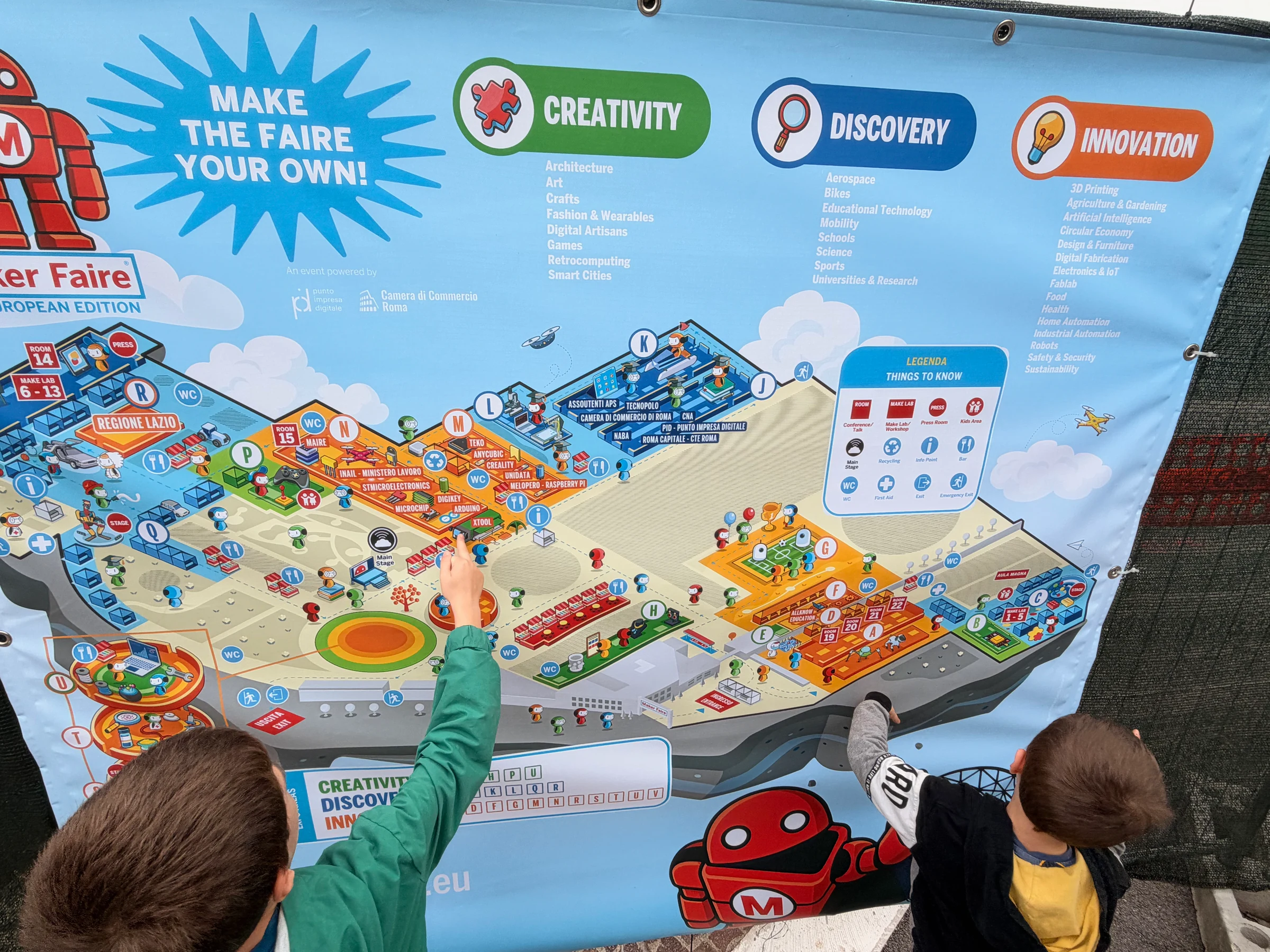
Arduino's robots come out to play
Arduino gave visitors plenty of ways to get acquainted with its robots. There were cameras to look into, gestures to try, and even a pen to collect. The company's lineup brought both UNO Q and VENTUNO Q to Rome, with projects that gave those boards some interesting jobs.
Several of the larger builds used VENTUNO Q, which pairs a Qualcomm Dragonwing IQ8 processor with an STM32H5 microcontroller. That gives developers room for Linux applications and AI processing alongside real-time motor control. In practice, you can give a robot something fairly demanding to think about while its microcontroller gets on with moving the hardware.
Agility A2 gets visitors in on the game
With two white arms stretched into the air, Agility A2 was an easy robot to spot. Developed with STMicroelectronics, the installation combined articulated arms, grippers, cameras, and a tall display down the middle. It looked ready to join in.
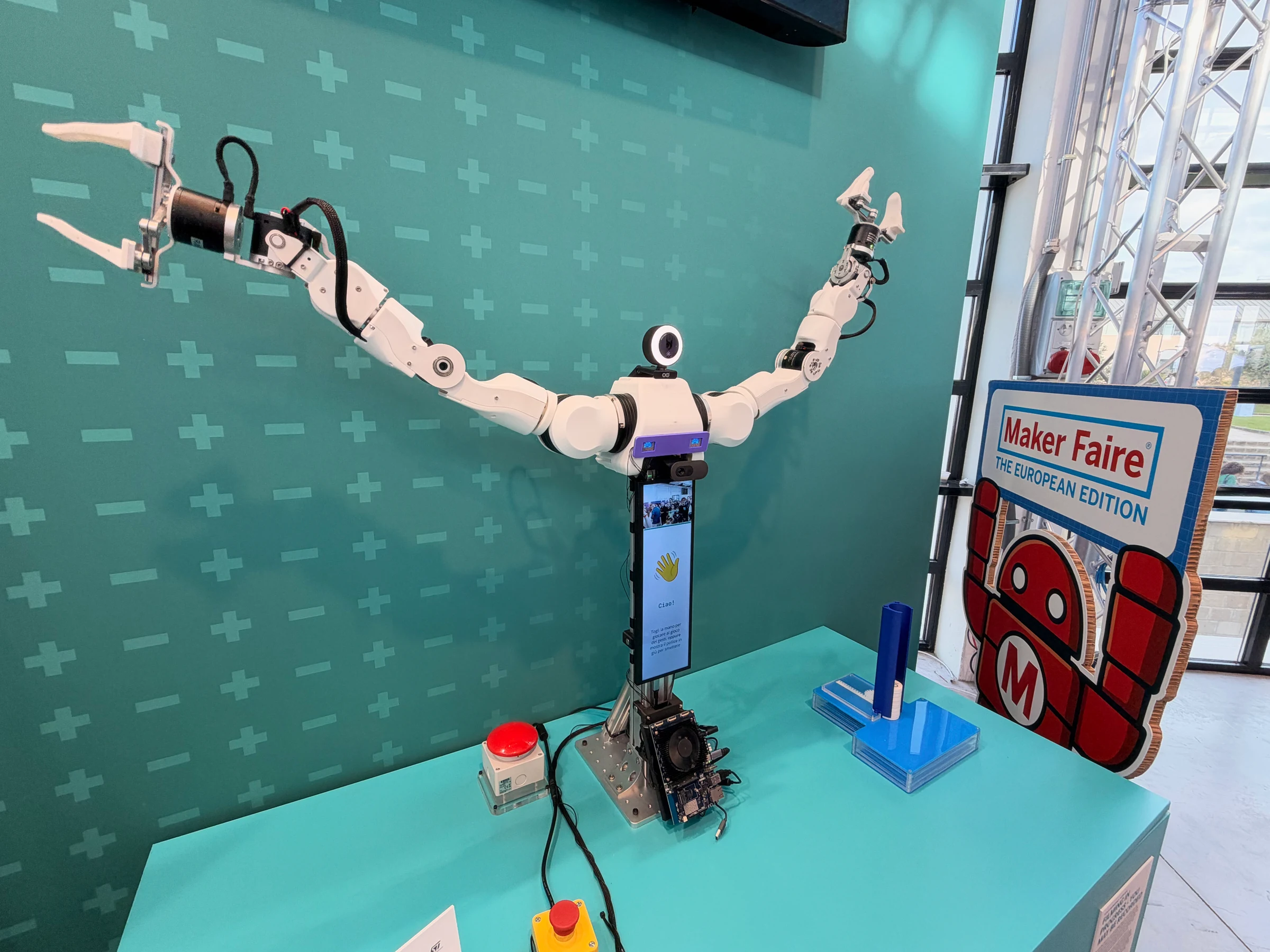
The game brings together VENTUNO Q, CAN bus motors, ROS 2, and MoveIt. Its vision system tracks hand gestures and reads QR codes to trigger tasks, while physical tokens give visitors something to play with. Modulino nodes add feedback along the way.
There is plenty going on behind that friendly introduction. The robot has to interpret what it sees, plan a movement, and coordinate both arms. For anyone who has wrestled with getting a single servo to behave, seeing all those pieces come together is a satisfying reminder of how far a robotics project can grow.
The robot with its brain on show
Luca Di Lorenzo's Desktop AI Humanoid came with animated eyes, a rounded white body, and a rather lovely design choice: you could look straight into its chest and see the VENTUNO Q board. Even with the enclosure fitted, there was still plenty for the electronics enthusiasts to inspect.
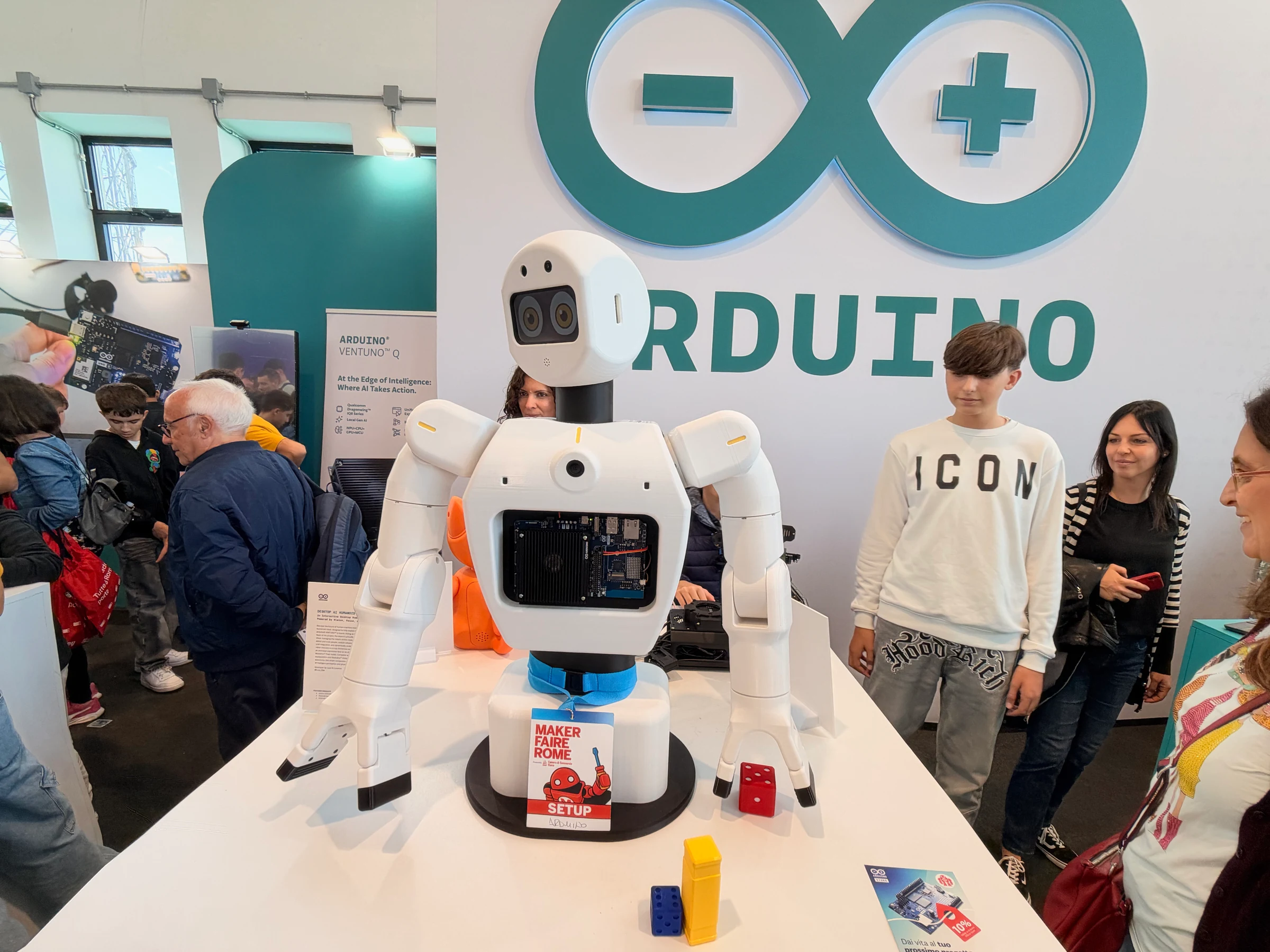
The robot's feature list covered person detection and tracking, voice conversations through LLM integration, gesture recognition, and vision-guided manipulation. Modulino Pixel nodes give its ears reactive lighting, while Modulino Distance sensors help it detect nearby objects.
The face and lighting give all that computing power a way to express itself. If you are building a robot that people are meant to spend time with, a glance, an expression, or a little change in lighting can make the interaction feel much more inviting. This one had plenty of character before you even got to the board in its chest.
Robots ready to roam
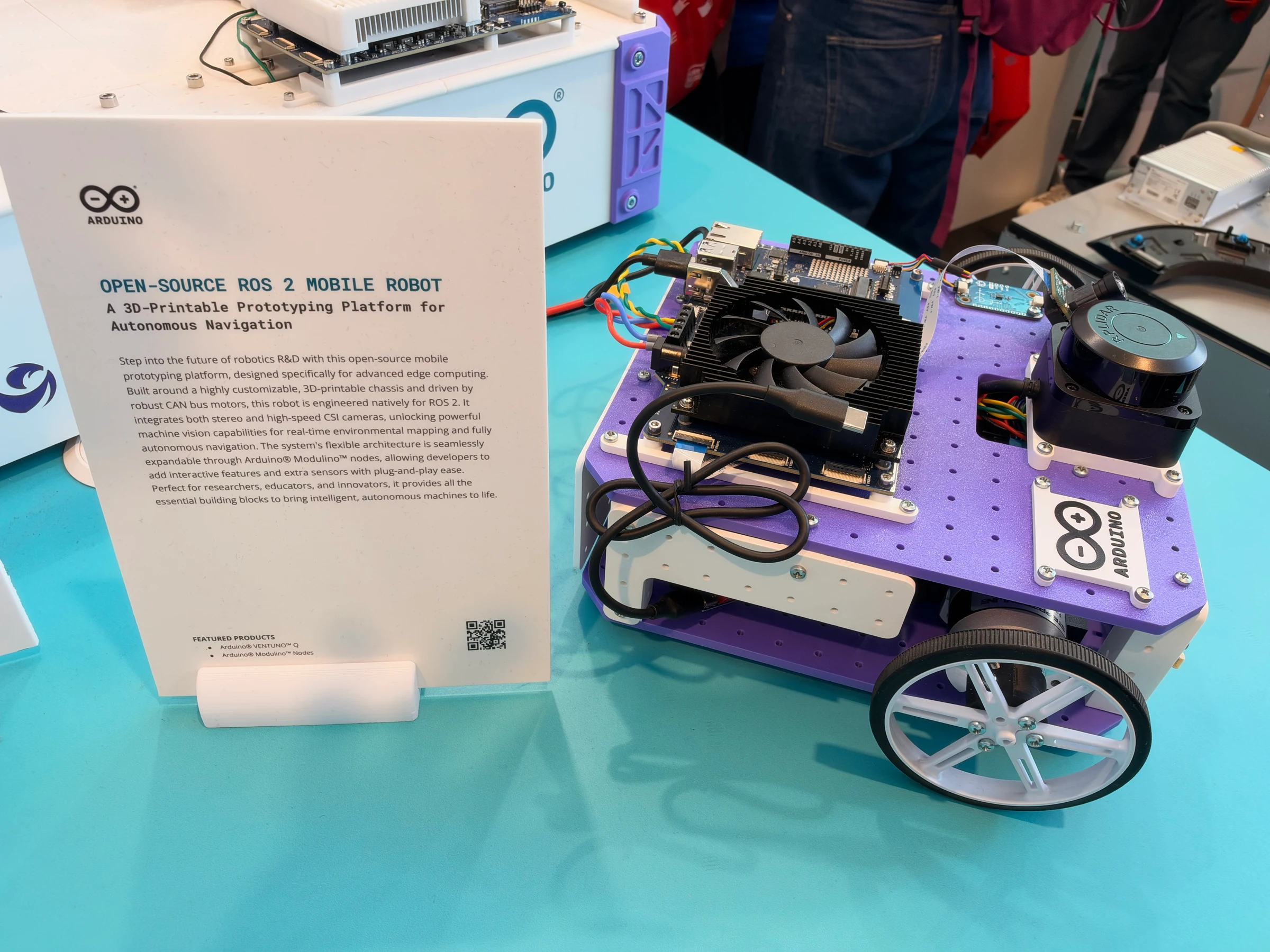
A purple-and-white rover offered the sort of view makers tend to appreciate: boards, wiring, a cooling fan, and a lidar unit all out in the open. The open-source ROS 2 design uses a customizable, 3D-printable chassis and CAN bus motors, with support for stereo and CSI cameras. Modulino nodes provide a route for adding sensors and interactive features.
Nearby, a larger VENTUNO Q mobile robot had brought an arm along for the ride. This separate demonstration explored navigation and manipulation together, using ROS 2 for perception and mapping. CAN bus connects the computing hardware with dedicated motor-control boards and the battery management system.
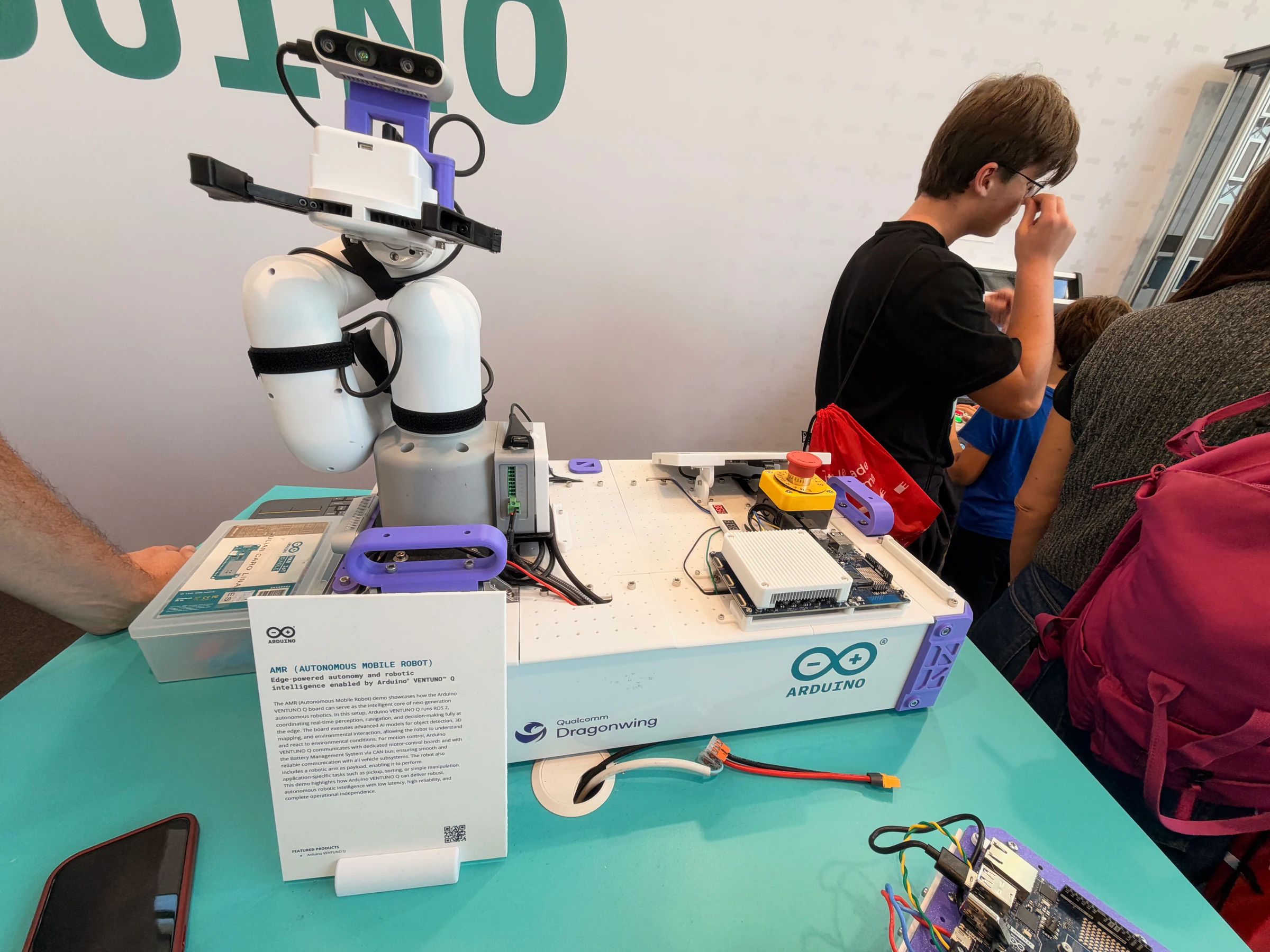
Adding an arm opens up a whole new set of possibilities. Once a robot can find its way around, picking something up or sorting an object gives it a reason to make the trip. Between the compact rover and the larger mobile manipulator, there was plenty of inspiration for builders whose robots are ready to venture beyond the desk.
A pen, delivered by robot
One of the smaller robots had a particularly good way to introduce itself: offer someone a pen. A camera perched above its LED-matrix face, and a circular organizer around the base kept the stationery within reach. A simple idea, and a fun reason to stop for a closer look.
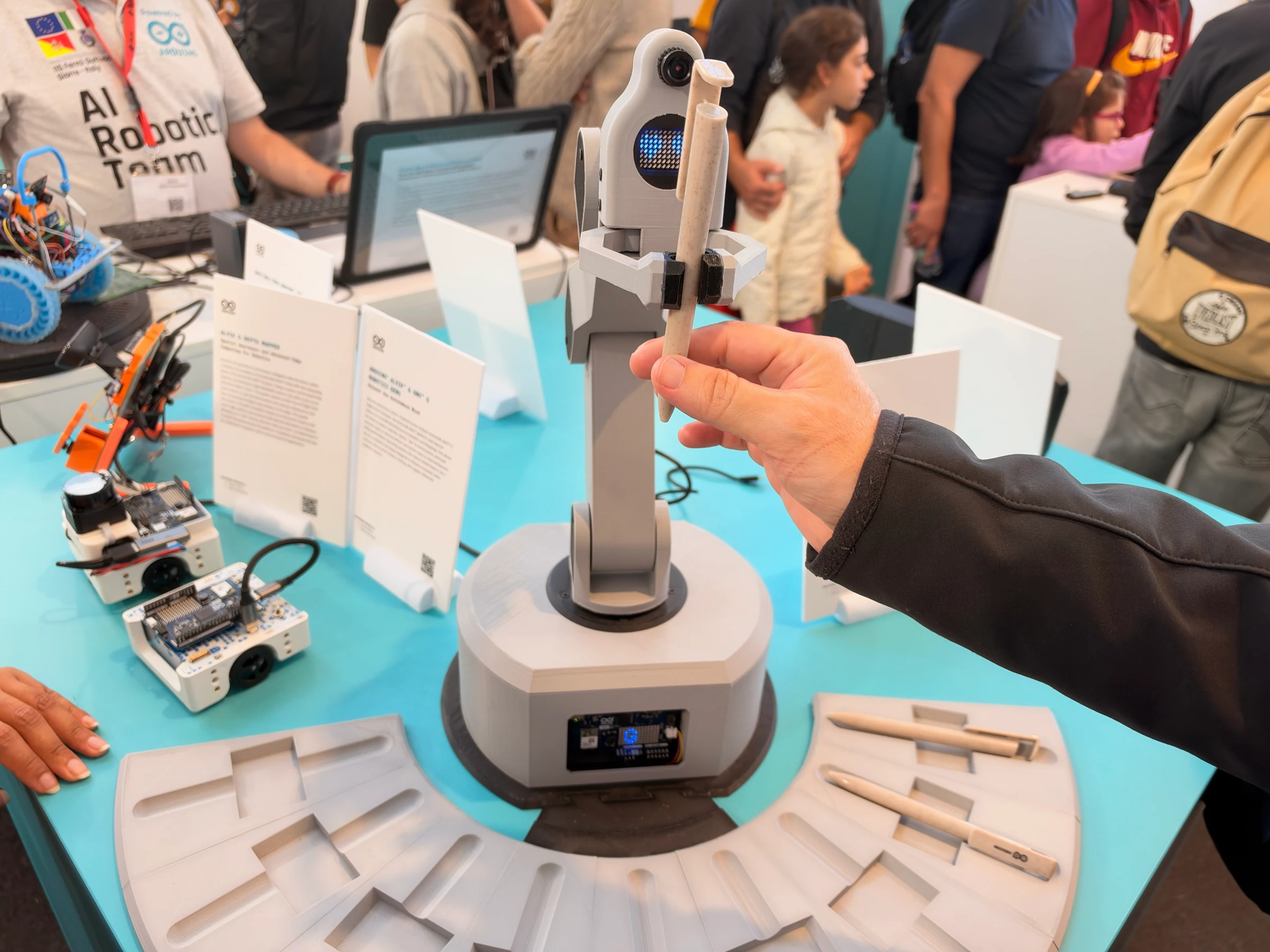
Di Lorenzo's A Robot Arm That Sees You uses an Arduino UNO Q 4GB and a Modulino LED Matrix. Camera-based recognition helps it identify people, while Feetech digital servo motors and a Waveshare control board handle the movement needed to deliver an object.
You can explore the code and 3D-model resources in the project repository. There is a nice progression here for a home build: get the arm moving, teach it where the objects live, then work on recognizing the person waiting for a delivery. Your desk stationery could become surprisingly entertaining.
STARtrace1 has a sidestep up its sleeve
Over at STMicroelectronics, STARtrace1 had a different sort of job in mind. The black-and-blue autonomous mobile robot, developed with Arrow and eInfochips, combined a low chassis, a top-mounted lidar scanner, and a set of mecanum wheels. An architecture diagram beside it let visitors dig into the electronics behind the bodywork.
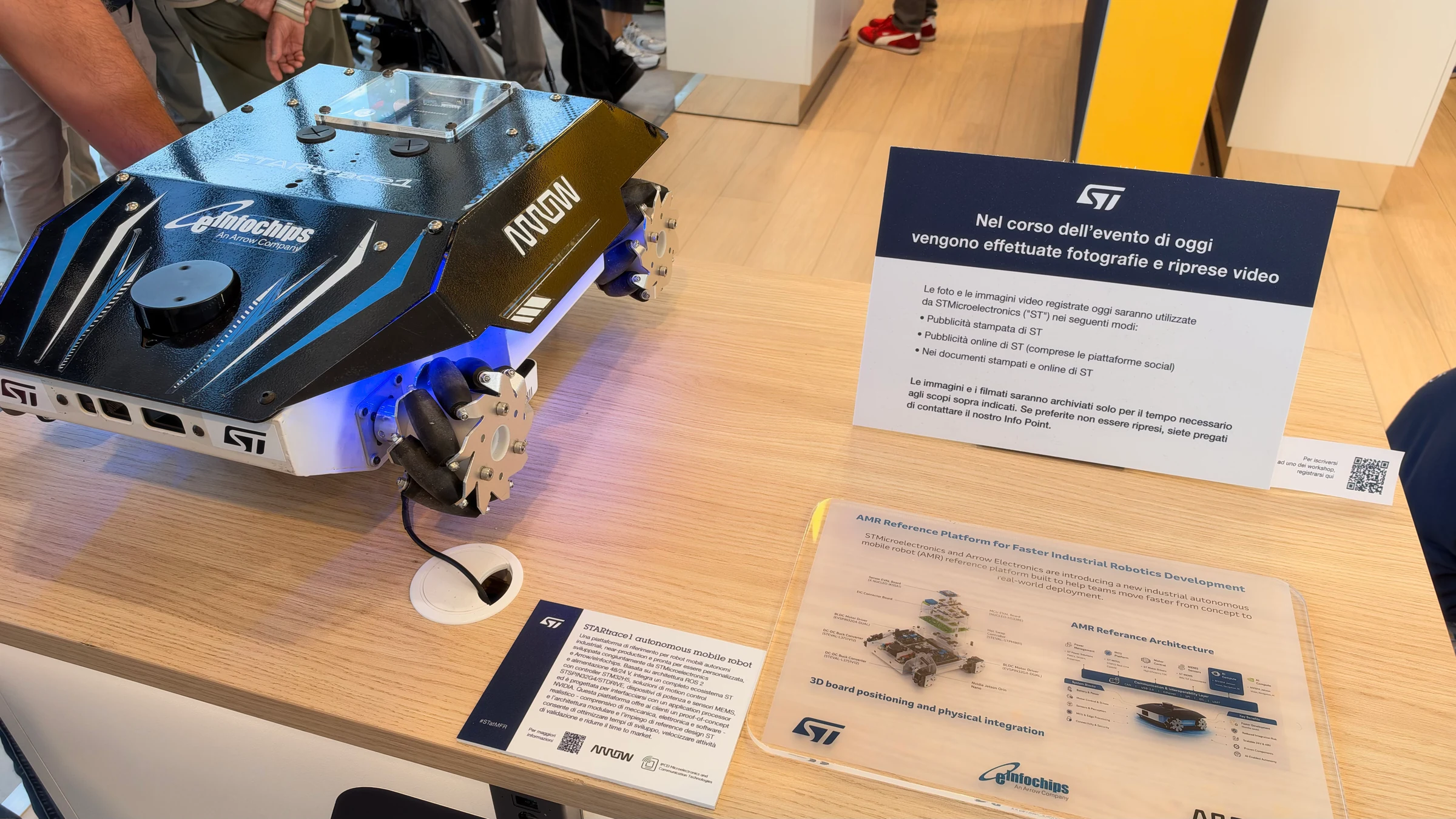
Those wheels are worth a closer look. Their angled rollers allow a correctly controlled robot to travel sideways as well as forward and backward. That is a handy trick in tight indoor spaces, and an appealing challenge if your own rover has so far stuck to driving in a straight line and turning around.
Arrow's platform description brings together NVIDIA Jetson Orin Nano computing, STM32 real-time control, ST motor drives, power management, and MEMS sensing. ROS 2 ties mapping, localization, and navigation together, with lidar and vision supplying information about the surroundings.
A complete mobile robot gives you quite a few things to juggle before the first useful journey: power, motors, sensing, software, and the chassis itself. STARtrace1 offers engineers a working foundation for that integration, with scope to adapt the platform to their own application.
BioPin keeps your passwords close at hand
For anyone who has stared at a login screen trying to remember which password they used, Basil27 had a relatable project. Its red BioPin demonstration unit put a large fingerprint reader beside a small display, with a blue light around the sensor. The message on screen was straightforward: the device was locked and wanted a fingerprint.
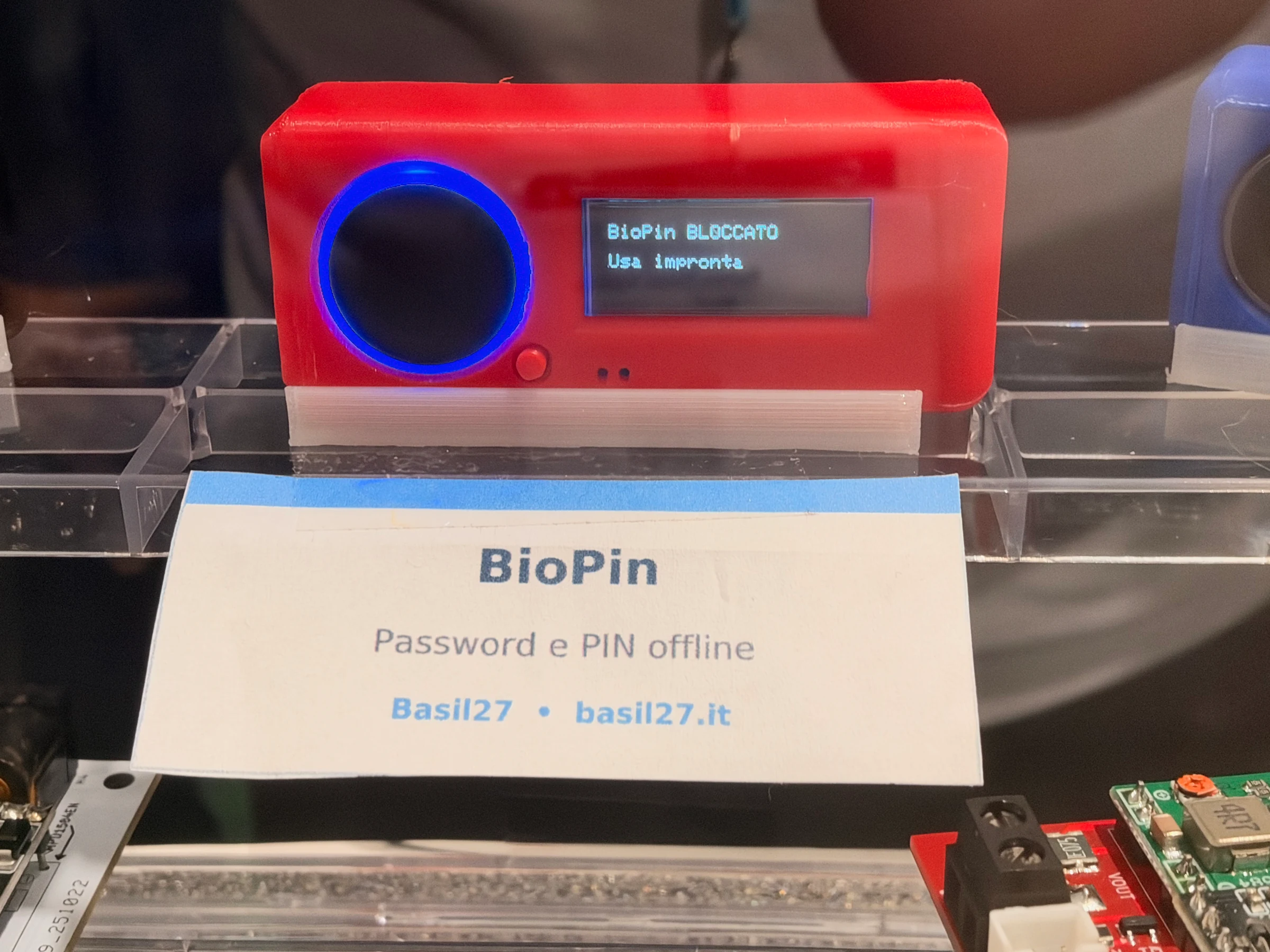
BioPin stores passwords and PINs locally in encrypted form, then shows them on its OLED display after fingerprint recognition. The interaction is easy to follow: touch the capacitive sensor, unlock the device, choose the credential you need, and read it on screen.
The booth also outlined PC-app management and a rechargeable battery with USB-C charging. Retrieving a password happens offline, so you can keep the little device nearby without needing a cloud account to look up your credentials.
The big sensor and small screen give BioPin a clear purpose at a glance. It is the kind of project where the case, controls, and feedback deserve as much attention as the firmware. You want the person picking it up to know what to do without needing a tour of the menus.
VasoVivo gives your ESP32 something to grow
Your next ESP32 project could have mushrooms in it. VasoVivo put a growing cluster inside a clear jar, topped with a white lid, curved ventilation openings, and a brown adjustment knob. Beside it, an open lid revealed the development board, sensor modules, and breadboard wiring that made the jar smart.
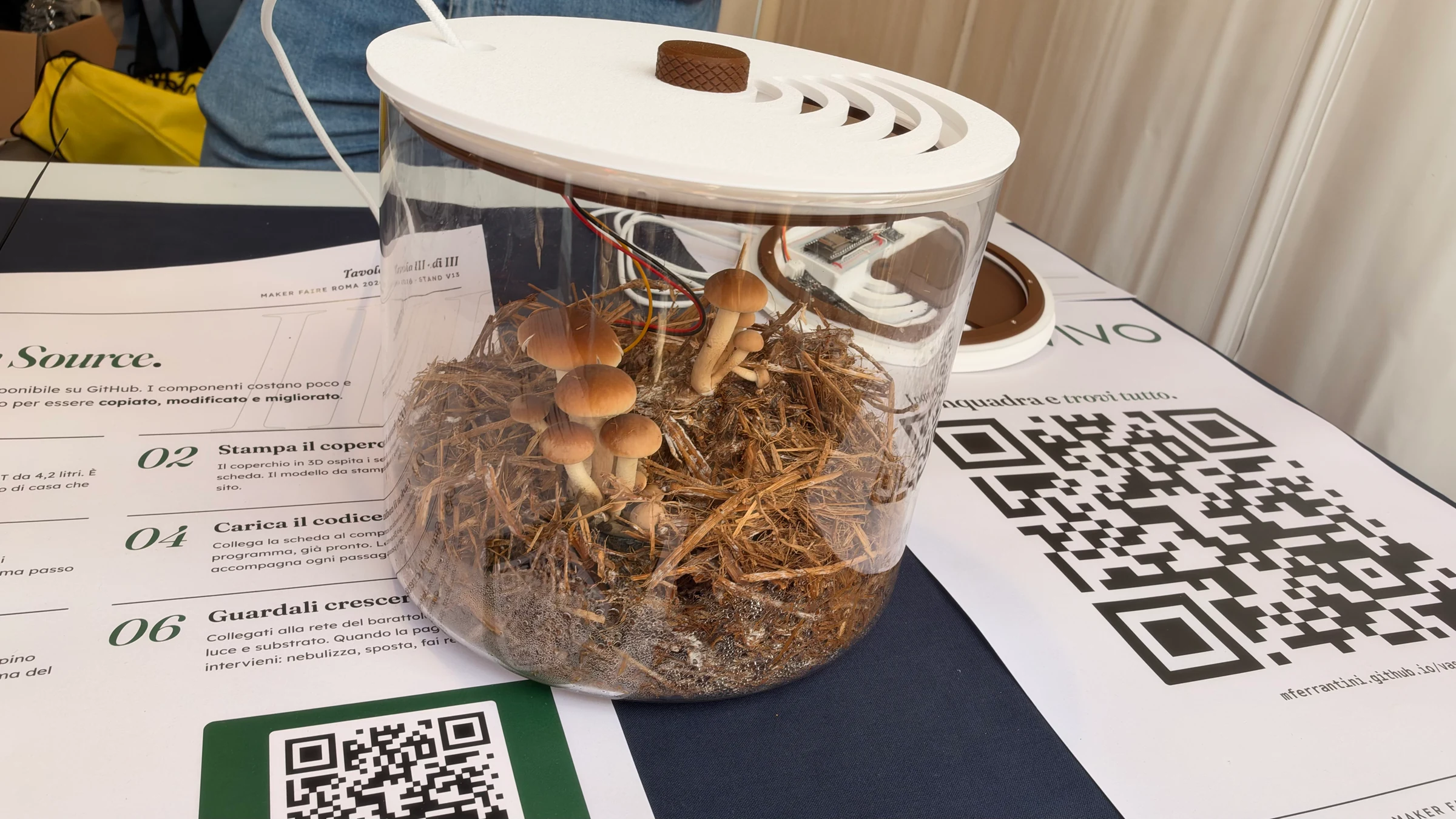
The VasoVivo project keeps track of conditions in a small growing container. It starts with an IKEA EKLATANT jar and adds a 3D-printed lid to hold the electronics. You can watch the mushrooms develop through the glass and check the readings to see what is happening around them.
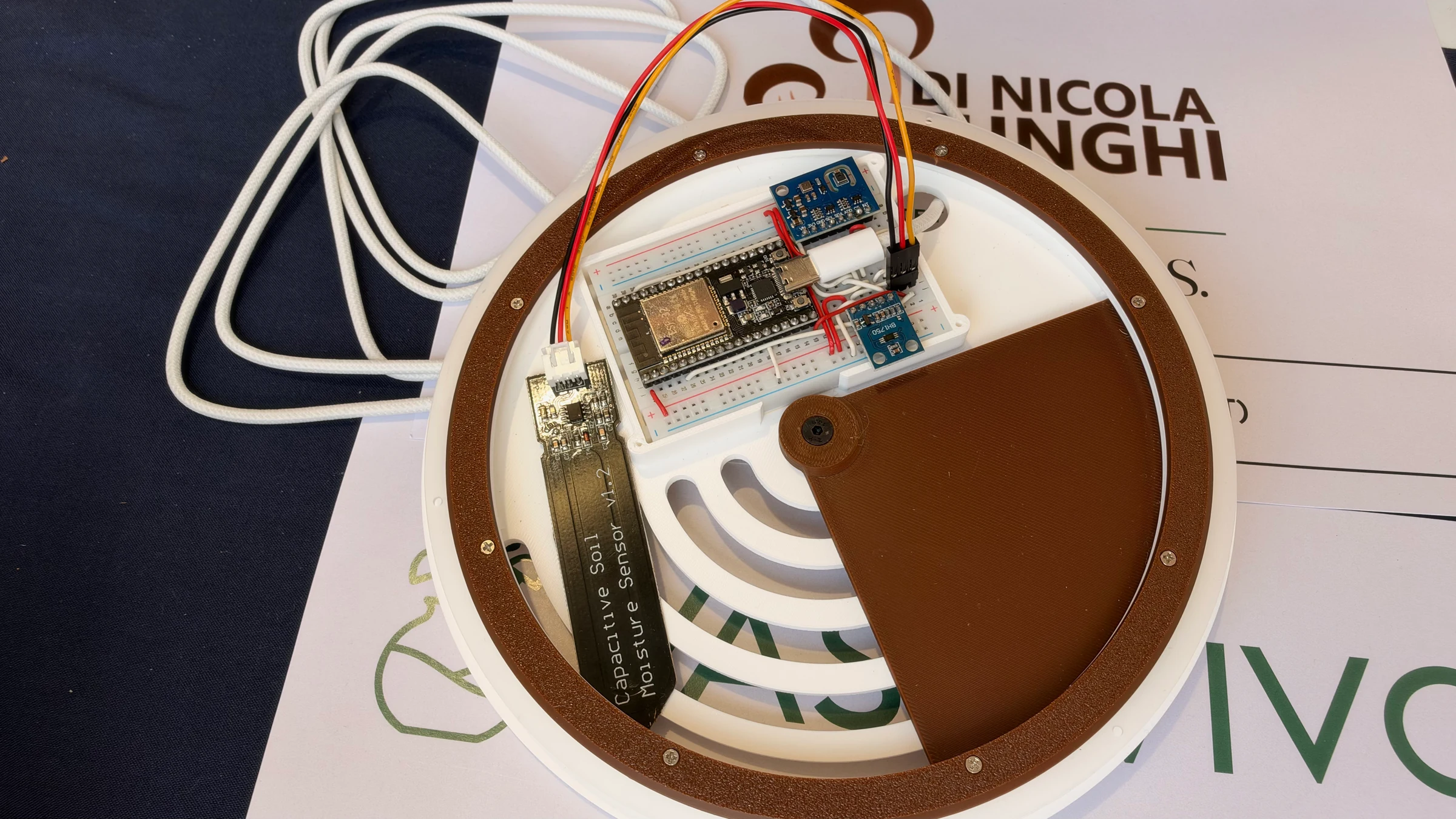
There is plenty of familiar hardware in the public repository. The project documents an ESP32-WROOM-32, ENS160/AHT21 sensing for air quality, temperature, and humidity, a BH1750 light sensor, and a capacitive probe for substrate moisture. The ENS160 provides estimated CO2-equivalent and VOC readings. Other documented sensor options cover substrate temperature and alternative ways to measure air temperature and humidity.
The current complete examples create their own Wi-Fi network and show the readings in a browser. You can pick a simple page, a dashboard of cards, or an illustrated view of the jar. Bluetooth and Telegram examples are still in preparation.
It is a lovely way to give a sensor project something to follow over days and weeks. Check the conditions, watch the growth, and use the readings to help decide when to adjust moisture, ventilation, or where the jar sits. It would make a fun classroom project, too, with something new to look at each time the group checks in.
Small robots, big engineering decisions
The I Robottari stand had small robots, a transparent arena, and an audience ready to see what happened next. The banner above the enclosure carried the CRIC name, short for Combat Robots Italian Competition. Inside, the little machines had a much less sociable agenda than the pen-delivery robot.
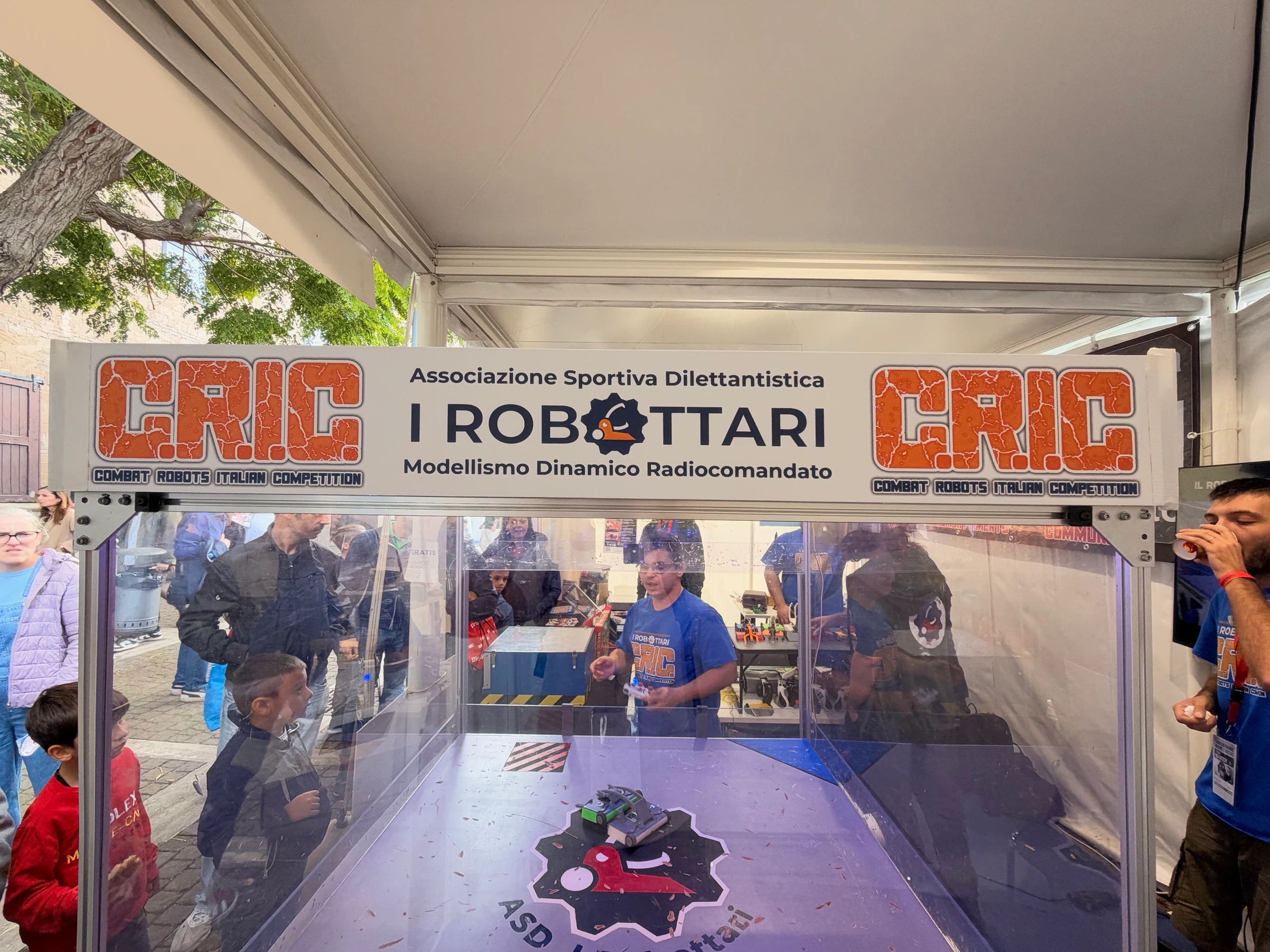
I Robottari runs CRIC and promotes radio-controlled combat robotics in Italy. Its published 2026 tournament description covers the 150-gram antweight class. That does not leave much room for spare material or a conveniently oversized battery.
Building at that scale means making some tough choices. A stronger chassis adds weight. A more powerful mechanism needs energy. The drivetrain still has to put the robot where you want it, and the electronics need to survive the encounter. Suddenly, squeezing everything into a small enclosure becomes a competitive sport.
For spectators, it is easy to get drawn into the action. For builders, it is a design review with collisions. You soon discover which brackets, mounting points, and protective panels deserve a little more attention before the next outing.
The One Love Machine Band gives scrap metal a groove
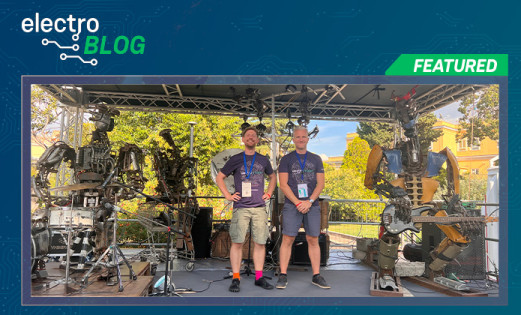
Some robots navigate warehouses. This one had a bass guitar. The towering scrap-metal musician wore blue and yellow panels over a body full of springs, tubing, and welded parts. Its mechanical hand rested over the strings, with a group of metal birds nearby to complete the scene.
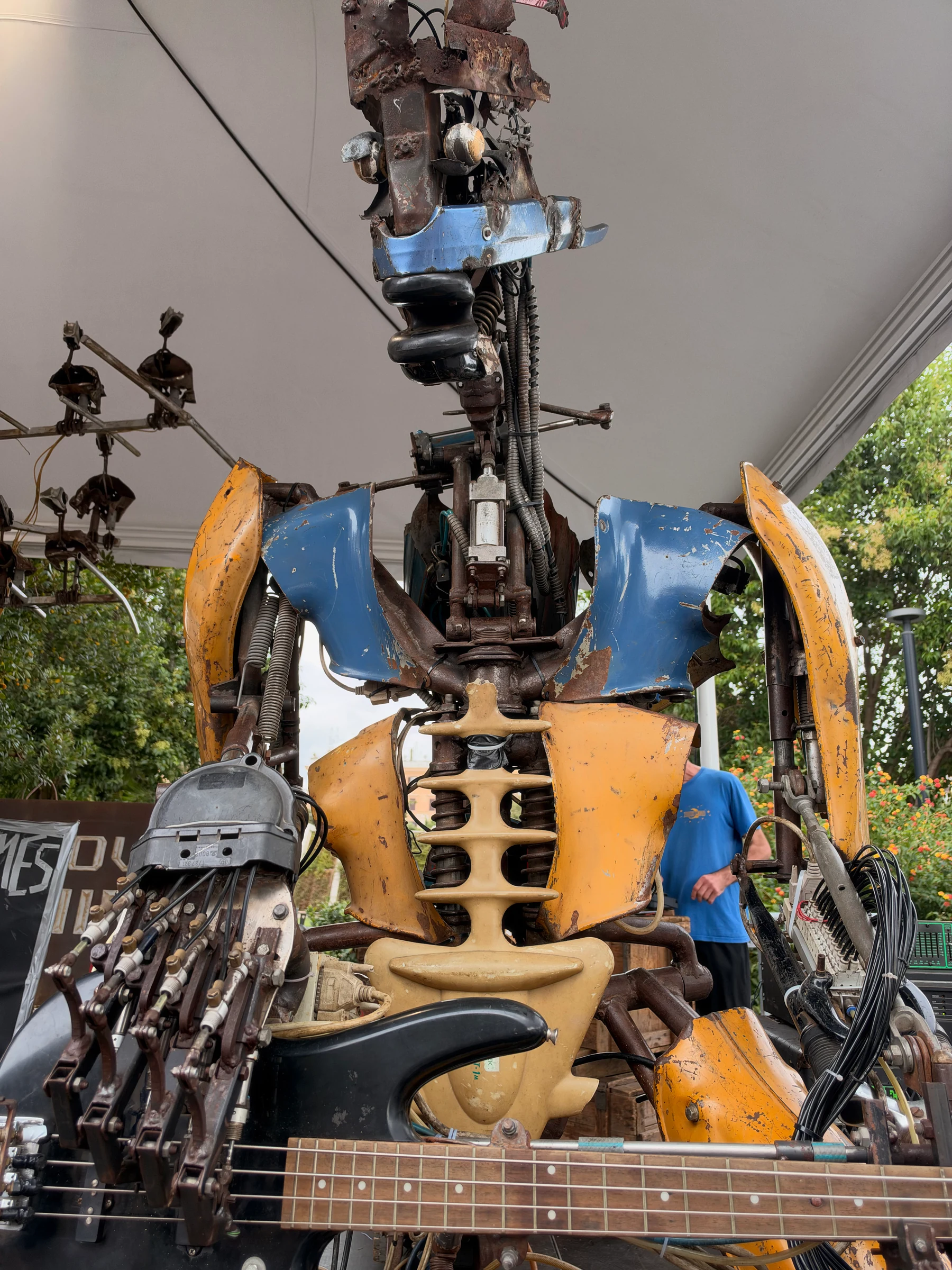
The figure belongs to Kolja Kugler's One Love Machine Band, a collection of pneumatic sculptures that play musical instruments. Compressed air supplies the movement, and reused metal gives each performer its own look.
There is a lot to enjoy up close, especially if you like working out how things move. Follow a linkage, look at the fingers around the instrument, then step back and see how those practical parts become a face, an arm, or a bit of attitude. The odd shapes and weathered panels are a big part of the charm.
It is easy to leave a display like this mentally reclassifying the contents of the scrap bin. That awkward bracket might have a second career. Those springs could be useful after all. You may not have room for a robot band, but a small mechanical musician suddenly feels like a very reasonable project.
Somewhere to build your next idea
After all those projects, the temptation to go home and make something was fairly strong. The FabLab Lazio and Spazio Attivo information pointed toward somewhere to start. FabLab Lazio offers shared spaces where makers, students, designers, and startups can work on prototypes and digital fabrication.
Access to a few tools and people to bounce ideas off can make a big difference when a project is taking shape. Whether you need a bracket for a robot, a lid for a mushroom jar, or help turning a sketch into something you can hold, that is a useful community to have around you.
There is more to explore in our earlier Maker Faire Rome 2026 highlights, including pocket computers, robotic hands, underwater vehicles, and open-source tools. Fair warning: your list of things to build may get a little longer.

Residing on the south coast of England, Rich has spent the last few years building Electomaker.io from the ground up. He is usually found behind a laptop coordinating the rest of the EM team and occasionally finding time to contribute articles to the blog. When not tapping away at a laptop, he can be found either paddleboarding, at the beach, playing golf (badly), or camping with his family.








Leave your feedback...