





Maker Faire Rome 2025: Saturday Interviews with Makers and Startups
Saturday at Maker Faire Rome was all about practical builds and clear engineering. We lined up short interviews spanning student avionics, direct-to-satellite IoT, edge-AI sports wearables, pet health tracking, laptop security, wireless laser power for drones, and open-source e-paper. Each team brought hardware to the table: sensors, radios, displays, and control electronics.
In each interview you’ll learn what they build and why it matters to makers: how student teams wire up flight-ready payloads, how pico-satellites remove ground gateways for simple telemetry, how shinguards compute KPIs on the edge, how laser beams keep drones in the air longer and more!
Sapienza Space Team (Student Rocket Payloads)
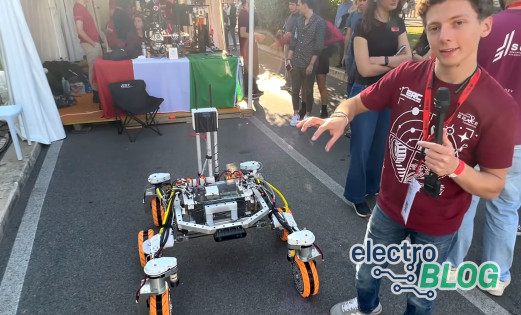
We spoke with Marit Gasperoni from the Sapienza Space Team in Rome about their payload electronics for a US rocketry competition. The team builds the complete avionics stack, balancing years where everything is tightly integrated on a single PCB with years where modules are separated for easier swaps and fault isolation.
The core approach is practical: gather flight data reliably, log and transmit it, and keep power clean under vibration and thermal shifts. Recent builds lean toward a more modular layout to reduce PCB re-spins between seasons and to speed bench testing when a single component needs a change.
- Controller: Mainly Raspberry Pi for on-board processing and data handling, with mission-specific sensor arrays attached.
- Environment sensors: BME280 for temperature and pressure measurements during ascent and descent.
- IMU: MPU-series accelerometers and gyroscopes for attitude, vibration, and event detection.
- Positioning & link: GPS for location and timing; long-range radio for telemetry and ground communications.
- Power & buses: Regulated rails and serial interfaces (e.g., UART/I2C/SPI) for clean, dependable signalling across boards.
Why it matters: The design shows a teachable avionics architecture with clear separation between sensing, telemetry, and power. Makers can replicate the approach using widely available sensors and COTS radios without bespoke hardware.
Abel Space (Direct-to-Satellite IoT Constellation)
We met Stefano from APEGEO Space, a team building a constellation of tiny pico-satellites designed for direct device to satellite links. The platform targets low-throughput IoT, meaning small packets sent infrequently, such as sensor readings or short status messages, rather than high-bandwidth data streams.
The roadmap calls for about one third unit pico-sats with a plan to reach roughly 100 spacecraft by 2027. Ten units have already been launched for on-orbit testing. The goal is to bypass ground gateways so a device can transmit straight to low Earth orbit, which simplifies deployments in places with no terrestrial coverage.
- Platform: Approximately 1/3U satellites with an ambition for ~100 in orbit by 2027 and 10 already launched for trials.
- Objective: Remove dependency on ground infrastructure by enabling device to satellite communication directly.
- Use cases: Ocean and remote asset tracking, container logistics, and basic telemetry for field equipment.
- Booth demo: End-to-end test nodes showing how sensors can post data to the constellation without local gateways.
Why it matters: Direct links offer near-global coverage for simple sensors with far less infrastructure, which reduces cost and complexity for field operations.
DAOS-Connected Startups: Soccerment, Kippy, Keybop
Three consumer-facing devices turn raw sensor data into useful services, covering sports performance, pet wellbeing, and laptop protection. Each pairs embedded hardware with an app layer to turn signals into insights and timely actions.
Soccerment – Smart Shinguards with Edge AI
Soccerment embeds electronics inside the shinguard to keep hardware safe and unobtrusive while an on-device model tracks around ten KPIs during play, such as touches, passes, sprints, and intensity. Data flows into an app for player feedback, and the company also offers performance datasets for club scouting to spot promising talent.
Why it matters: An invisible wearable running models on the edge reduces latency and preserves in-context data without bulky add-ons.
Kippy – Smart Pet Tracker
Kippy began as a “find my pet” tracker and has grown into a health and activity companion that builds long-term behaviour profiles. The app engages owners with status messages and optional in-app purchases, shifting from one-off recovery to ongoing care and insights.
Why it matters: Telemetry becomes a continuous service, offering practical guidance rather than just alerts when something goes wrong.
Keybop – Laptop Alarm for Students
Keybop is a small device that arms a laptop when you step away, sending phone notifications if someone tampers with it—ideal for libraries and shared study spaces. The team, from Politecnico di Milano, is collaborating with DAOS SRL and is planning a first release pending development milestones.
Why it matters: Simple hardware paired with a clear app workflow addresses a common student need with minimal setup.
SunCubes – Wireless Laser Power for Drones
Alberto from SunCubes explained how the company is developing wireless laser power systems for drones and remote sensors. The setup transfers energy without cables by directing a focused laser beam at a receiver that converts light back into electricity, allowing in-flight recharging or continuous operation for distant devices.
The system consists of two main parts: a laser transmitter that uses a Galilean telescope to collimate the beam for distances of up to about one kilometre, and a receiver module fitted to the drone that acts like a solar cell. Sensors constantly monitor and adjust the alignment between the two so the beam stays locked on target, keeping the power flow stable even as the drone moves.
- Transmitter: Laser module with collimation optics creating a parallel beam for long-distance operation.
- Receiver: Photovoltaic-style panel mounted on the drone converts laser light into DC power for recharging.
- Tracking: Feedback sensors control alignment between beam and receiver during flight for consistent power transfer.
- Future targets: Expanding from drones to fixed cameras and environmental sensors requiring long-duration power.
Why it matters: Laser power beaming extends flight time and reduces the need for battery swaps or landing pads. The next challenges lie in safety standards and precision alignment for wider adoption.
Larry Bank – Open-Source e-Paper and Display Optimisation
Larry Bank presented his open-source work on high-resolution e-paper displays, demonstrating how software optimisation and careful hardware choices can dramatically extend battery life. His project, fastEPD, lets makers drive e-reader panels such as the 300 dpi Kindle Paperwhite display using open code and freely available components, without needing to repurpose commercial devices.
The platform integrates a JPEG library for efficient image rendering and runs on open-source PCBs designed by collaborator Martin. Using a low-power Nordic microcontroller, Larry showed a coin-cell-powered clock refreshing every five seconds and lasting for months thanks to aggressive optimisation. A “project creator” tool brings his various libraries together, letting users pick devices, sensors, and displays to build complete examples with minimal setup. Larger displays draw more power but offer higher brightness and front-light options for night use, giving makers flexibility to balance cost, speed, and battery life.
- Project: fastEPD – open-source driver framework for high-resolution e-paper panels.
- Integration: JPEG decoding built into the e-paper library for faster rendering.
- Hardware: Open PCB design (by Martin) with Nordic microcontroller for ultra-low-power demos.
- Example: Coin-cell clock updating every ~5 s, running for months on a single battery.
- Tooling: “Project Creator” combines device, sensor, and display libraries to simplify prototyping.
Why it matters: This work puts premium e-paper technology within reach of hobbyists and shows how thoughtful software and hardware optimisation can cut power use by orders of magnitude.
Final Thoughts
Saturday’s conversations point to a common pattern: make more with less by pairing smart software with focused electronics. Edge AI in wearables, low-power optimisation for displays, and clean avionics stacks all ride on the same foundations—sensors, radios, and power done well. This means you can build systems that are both capable and efficient.

Residing on the south coast of England, Rich has spent the last few years building Electomaker.io from the ground up. He is usually found behind a laptop coordinating the rest of the EM team and occasionally finding time to contribute articles to the blog. When not tapping away at a laptop, he can be found either paddleboarding, at the beach, playing golf (badly), or camping with his family.






Leave your feedback...