


LattePanda Mu Ultra Launches With Up to 115 TOPS for Local AI
LattePanda today, September 9, 2026, launched the LattePanda Mu Ultra, a compact x86 compute module designed to bring local AI workloads into embedded products and custom systems. The new Mu Ultra range combines Intel Core Ultra processors, integrated Arc graphics and a dedicated NPU in the same 69.6 × 60 mm module format used by the wider Mu family. LattePanda says pricing for the range starts at US$599, while developers who want a ready-to-build platform can buy a separate Core Ultra 5 226V development kit.
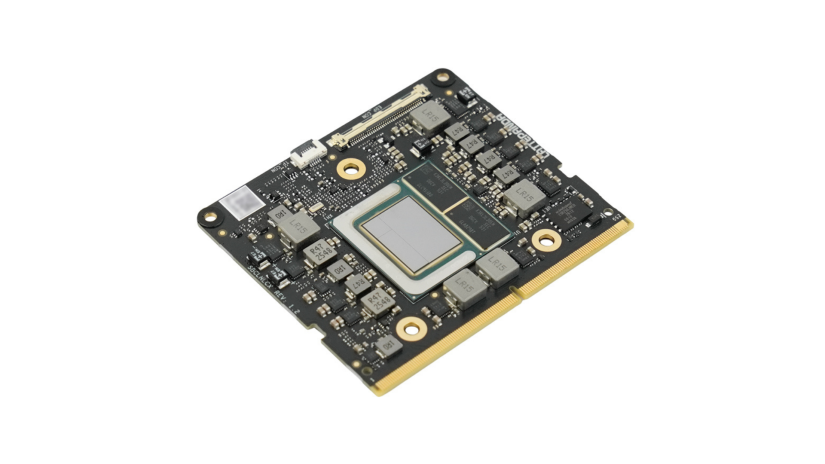
LattePanda Mu Ultra adds Core Ultra AI hardware to the Mu format
The Mu Ultra range launches with two processor options: the Intel Core Ultra 5 226V and Core Ultra 7 256V. Both configurations include 16GB of LPDDR5X-8533 memory. Up to 11.6GB of that system memory can be allocated as shared graphics memory, so it should not be treated as a separate pool of dedicated VRAM.
AI performance also varies by processor. The Core Ultra 5 226V configuration is rated at up to 97 combined peak INT8 TOPS across the CPU, GPU and NPU, including up to 40 NPU TOPS. The Core Ultra 7 256V raises the range maximum to 115 combined peak INT8 TOPS and 47 NPU TOPS. Those combined figures describe heterogeneous compute across several engines, rather than NPU performance alone.
The module exposes PCIe 4.0, USB 3.2 Gen 2, USB 2.0, display outputs, GPIO, UART and I2C through its edge connector. That makes the Mu Ultra a compute module rather than a complete single-board computer. A carrier board provides the physical ports, storage connections and power input needed for a finished development system.
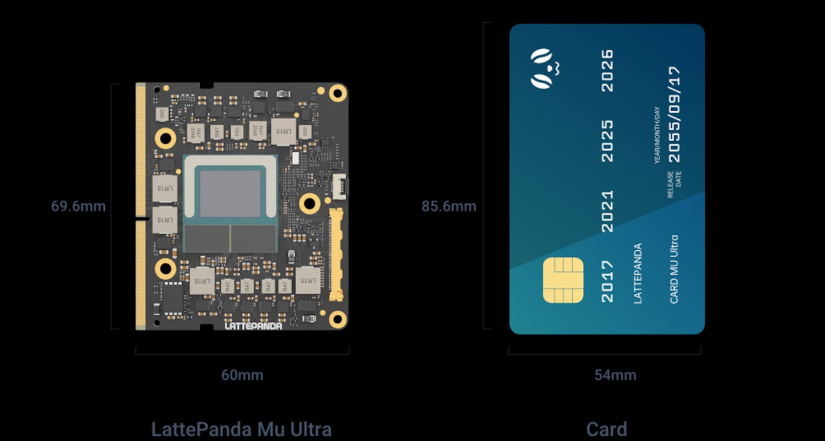
Why x86 support matters for local AI developers
For developers already working with PC software, one of the Mu Ultra's main advantages is its familiar x86 environment. LattePanda lists Windows 11 and Ubuntu 24.04 or later as supported operating systems, alongside AI tools including Intel OpenVINO, llama.cpp and Ollama. Actual acceleration still depends on the model, runtime and execution device, but the platform gives teams a route to combine conventional x86 applications with local inference on the same computer.
LattePanda positions the module for local assistants, portable instruments, robotics and vision systems. A robot could use the CPU for control software while assigning suitable inference tasks to the GPU or NPU. A portable instrument could process measurements locally instead of sending every sample to a remote service. A vision system could combine camera processing, application logic and AI inference in a compact carrier-board design.
LattePanda's own LLM testing reported about 18 tokens per second with Qwen3.5-9B and 55 tokens per second with Qwen3.5-2B. Those tests used INT4 quantization, OpenVINO GenAI and the integrated GPU. LattePanda's public results cover the Mu Ultra family and do not identify those figures as NPU benchmarks or as results from the linked 226V kit alone.
Carrier boards provide the route from module to finished system
The new module keeps the Mu-family form factor and connector, and LattePanda describes it as largely compatible with existing carrier boards. Its migration documentation notes that moving from an earlier Mu design may still require carrier-board changes, so developers should verify compatibility rather than assume a universal drop-in upgrade. LattePanda highlights its 3.5-inch Lite Carrier, Mini Carrier and M.2 M Key Carrier as relevant options. For background on the original format, see Electromaker's introduction to the LattePanda Mu.
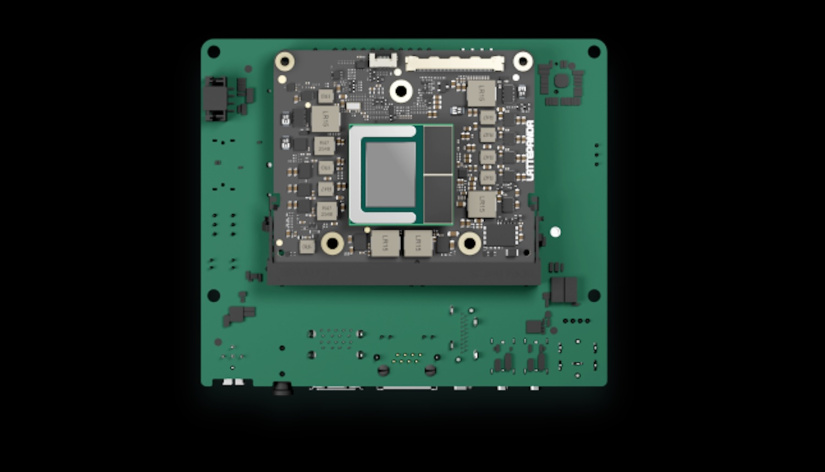
The LattePanda Mu Ultra 226V AI Development Kit is the most direct route for developers who want to start with the Core Ultra 5 version. DFRobot lists SKU DFR1294-1 with the 226V module, Mini Carrier Board and active cooler included. The carrier adds USB-C, USB-A, HDMI 2.0, 2.5Gb Ethernet, M.2 expansion and OCuLink.
Storage and power are separate. The Mu Ultra has no onboard storage, so the kit needs a compatible NVMe SSD. DFRobot also specifies a 12–20V power supply rated at 50W or higher for the Mini Carrier when used with Mu Ultra.
Price and availability
LattePanda says the Mu Ultra range is available through its official store with module pricing starting at US$599. That starting price applies to the range, not the complete development kit.
At the time of publication, DFRobot lists the 226V AI Development Kit at US$643, reduced from US$683 under a 6% offer and limited to one unit per customer. Developers can check the current offer, availability and purchasing details on the official LattePanda Mu Ultra 226V AI Development Kit product page.

Residing on the south coast of England, Rich has spent the last few years building Electomaker.io from the ground up. He is usually found behind a laptop coordinating the rest of the EM team and occasionally finding time to contribute articles to the blog. When not tapping away at a laptop, he can be found either paddleboarding, at the beach, playing golf (badly), or camping with his family.









Leave your feedback...