


DFRobot SEN0654 TDLAS Methane Sensor: Arduino and Raspberry Pi Guide
The DFRobot Gravity SEN0654 laser methane sensor is a digital methane measurement module for experiments and prototypes that operate within a stated range of 3 to 100% LEL. It combines an MH-Z9041A Tunable Diode Laser Absorption Spectroscopy sensor with a DFRobot interface board, a four-pin Gravity connector, selectable I2C or UART communication, and software support for Arduino and Raspberry Pi.
The range is the first specification to check. This is not a trace atmospheric methane sensor. Using a commonly cited methane lower explosive limit of 5% by volume as an illustration, the bottom of the SEN0654 range is about 0.15% methane by volume, or approximately 1,500 ppm. That is far above normal background methane levels and many low-ppm environmental measurements.
Within the right concentration range, the module offers a direct digital reading in %LEL, 0.1% LEL resolution, temperature data, fault reporting, and a manufacturer-stated T90 response of less than 15 seconds. Developers can read it with code or connect it to the Gravity SCI DAQ module for time-stamped CSV logging. This guide explains what those specifications mean, how the development routes differ, and where the SEN0654 does and does not fit.
What is the DFRobot Gravity SEN0654?
SEN0654 is DFRobot's SKU for a Gravity-format laser methane sensor module. The sensing element is identified as the MH-Z9041A, a TDLAS methane sensor produced by Winsen. DFRobot adds a carrier and interface circuit that exposes the sensor through the Gravity ecosystem and provides I2C support in addition to the underlying sensor's UART output.
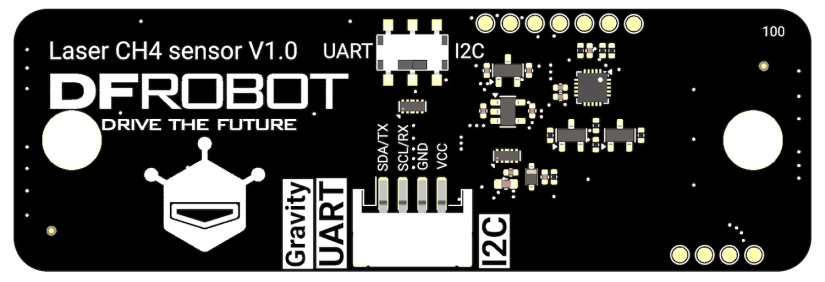
The DFRobot SEN0654 wiki describes the complete Gravity board, its wider supply input, I2C interface, pinout, examples, schematic, and mounting arrangement.
| Feature | Practical meaning |
|---|---|
| TDLAS methane measurement | Uses a narrow optical absorption measurement rather than a broadly responsive heated metal-oxide element. |
| 3 to 100% LEL range | Targets percentage-of-LEL experiments and prototypes, not normal atmospheric or trace-ppm methane monitoring. |
| Factory-calibrated module | Provides a direct digital concentration value, but users still need appropriate validation, calibration records, and quality control. |
| I2C and UART | Supports microcontroller, Linux SBC, and data-acquisition workflows through a selectable interface. |
| Temperature and fault data | Lets a logger preserve operating context and mark invalid or suspect readings instead of recording every value as valid. |
| SCI DAQ support | Adds a no-code route for live viewing and time-stamped CSV export. |
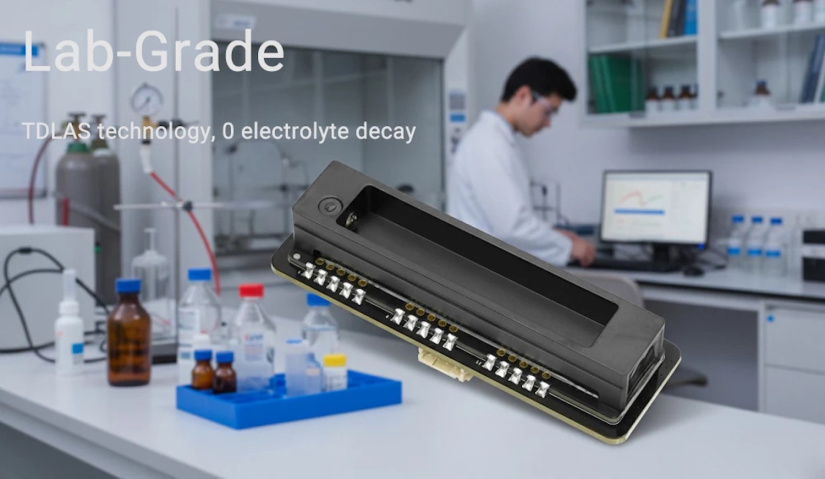
DFRobot positions the module for laboratory research, education, quantitative gas experiments, and engineering prototypes. Its stated features are useful, but descriptions such as "lab-grade," "interference-proof," "journal-ready," and "no drift" are manufacturer marketing claims rather than independent validation. Suitability depends on the range, test arrangement, reference method, uncertainty requirements, and safety controls of the actual project.

How TDLAS methane detection works
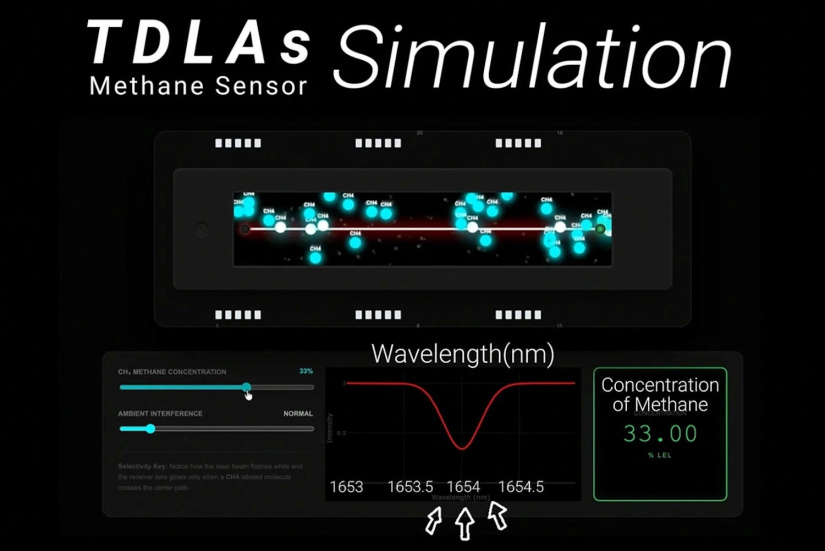
Tunable Diode Laser Absorption Spectroscopy measures how a gas absorbs light at selected wavelengths. Inside the MH-Z9041A, a diode laser scans a narrow spectral region associated with methane. The beam travels through the sampled gas and reaches a detector. Methane molecules absorb some of the light at characteristic points, and the electronics use the resulting signal to estimate concentration.
DFRobot and Winsen describe the sensor as using a dual-pass optical path. Instead of sending the light through the gas only once, the optical arrangement makes the beam traverse the sample path twice. This increases the effective path length without requiring a much longer enclosure, which can strengthen the measurable absorption signal.
The narrow optical target is one reason TDLAS can offer better methane selectivity than a broad-response metal-oxide sensor. It does not mean that every possible gas mixture, contaminant, optical obstruction, pressure change, or environmental condition is irrelevant. DFRobot and Winsen state that the design is methane-selective, resistant to water vapor, and independent of oxygen, but these are manufacturer claims. A project working with complex gas mixtures should validate performance against representative samples and a suitable reference instrument.
Understanding %LEL, %vol, and ppm
The module reports concentration as a percentage of methane's Lower Explosive Limit, written as %LEL. The LEL is the lower concentration boundary at which a fuel-air mixture can ignite under defined conditions. A reading of 100% LEL does not mean the atmosphere is 100% methane. It means the concentration has reached the selected reference value for methane's lower flammability boundary.
The UK Health Security Agency methane incident guide lists methane's lower explosive limit as 5% by volume and its upper explosive limit as 15% by volume. Using 5% by volume only as an illustrative reference:
Methane concentration in %vol = (%LEL / 100) × 5%vol

At 3% LEL:
(3 / 100) × 5%vol = 0.15%vol = approximately 1,500 ppm

At 100% LEL:
(100 / 100) × 5%vol = 5%vol = approximately 50,000 ppm
The conversion from percent by volume to ppm uses 1% by volume = 10,000 ppm. Treat these figures as an example, not a universal sensor calibration equation. The reference LEL can depend on the cited standard, gas composition, temperature, pressure, and test method. For documented work, state the LEL reference and conversion method rather than publishing converted ppm values without context.
| Unit | What it expresses | SEN0654 relevance |
|---|---|---|
| %LEL | Concentration relative to a selected lower explosive limit reference. | This is the output unit stated on DFRobot's product page and Arduino example. |
| %vol | Parts of methane per 100 parts of the gas mixture by volume. | Can be derived only when the relevant LEL reference and assumptions are stated. |
| ppm | Parts of methane per million parts of the gas mixture by volume. | Useful for trace measurements, but the SEN0654's lower limit is far above normal background methane. |
The 3% LEL lower limit is therefore a hard application boundary. If a study expects tens of ppm, single-digit ppm, or sub-ppm methane, choose a sensor or analyzer designed and validated for that range.
Measurement range, accuracy, and response time
DFRobot currently states a 3 to 100% LEL measurement range and 0.1% LEL resolution. The product page lists three accuracy bands at 25 degrees C:
| Concentration band | Stated accuracy at 25 degrees C | Interpretation |
|---|---|---|
| 3 to below 5% LEL | Not separately stated | The range includes these values, but DFRobot does not publish a dedicated accuracy band for them. |
| 5 to 20% LEL | ±2% LEL | A 10% LEL reading is specified within an absolute band of 8 to 12% LEL at the stated condition. |
| 20 to 75% LEL | ±3% LEL | A 50% LEL reading has a stated absolute accuracy band of 47 to 53% LEL at 25 degrees C. |
| 75 to 100% LEL | ±5% LEL | Uncertainty widens toward the top of the specified range. |
The DFRobot page formats both the first and second published bands as including 20% LEL. If the exact boundary matters, ask DFRobot which band governs and obtain the applicable calibration documentation. The upstream Winsen page also publishes different generic MH-Z9041A accuracy options, so use the SEN0654 figures for this DFRobot module and confirm the supplied variant.
Resolution is not accuracy. A 0.1% LEL resolution means the output can change in increments of 0.1% LEL. It does not mean the reading is accurate to ±0.1% LEL. Repeatability, calibration uncertainty, environmental sensitivity, gas mixing, sampling geometry, and the published accuracy band all affect the final result.
Warm-up time is not response time. DFRobot states a 15-second warm-up period after power-up. T90 under 15 seconds describes the time for the output to reach 90% of its final response after a concentration change under the manufacturer's test conditions. Neither value guarantees that an entire chamber, tube, or process has stabilized. Gas transport and mixing can dominate the observed response.
DFRobot SEN0654 technical specifications
The table below uses the current DFRobot product page and wiki as the primary sources. Manufacturer-stated values have not been independently verified by Electromaker.
| Specification | DFRobot-stated value |
|---|---|
| Detection gas | Methane, CH4 |
| Detection method | Tunable Diode Laser Absorption Spectroscopy with a manufacturer-described dual-pass optical path |
| Detection range | 3 to 100% LEL |
| Resolution | 0.1% LEL |
| Warm-up time | 15 seconds |
| Response time | T90 <15 seconds |
| Supply voltage | 3.3 to 5 V conservative operating range. The wiki pinout separately says 3.3 to 5.5 V. |
| Operating current | <300 mA |
| Operating temperature | -13 to +58 degrees C |
| Operating humidity | 0 to 95% RH, non-condensing |
| Operating pressure | 80 to 115 kPa on DFRobot's current product page |
| Interfaces | I2C or UART through the four-pin Gravity connector |
| Reported data | Methane concentration, temperature, source data, and sensor fault state through the official libraries |
| Manufacturer-stated life | More than 10 years |
| Board footprint | DFRobot's drawing identifies an approximately 82 × 27 mm PCB with standoff mounting holes |
| Included items | SEN0654 module and Gravity four-pin sensor cable |
The less-than-300 mA current specification deserves attention in portable and long-duration systems. Do not assume a small microcontroller regulator, weak USB port, or battery interface can supply the module reliably. Budget for startup and operating current, keep the supply stable, and log power-related resets as data-quality events.
I2C, UART, and the Gravity interface
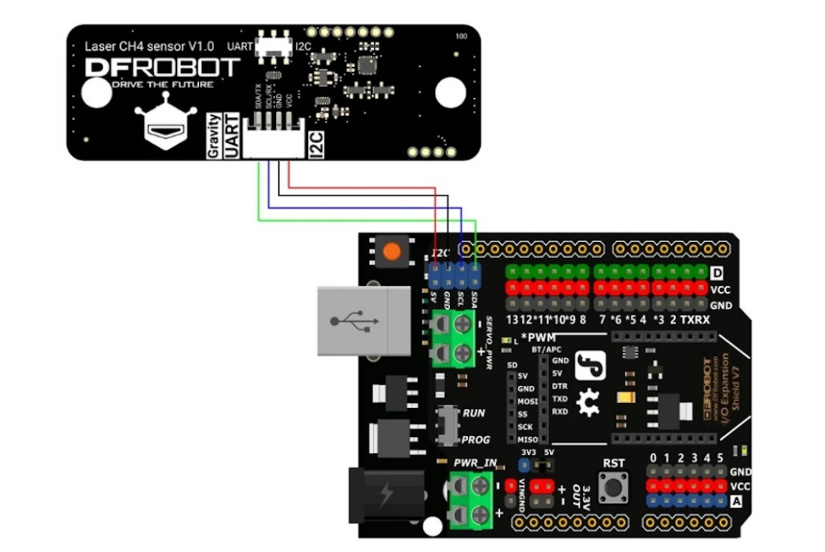
The four-pin connector carries VCC, GND, and two signal lines. A switch selects whether those lines operate as I2C clock/data or UART transmit/receive. Set the switch before powering or initializing the module, and make sure the code matches the selected position.
| Interface | Best fit | Important details |
|---|---|---|
| I2C | Short local connections, shared sensor buses, Arduino, and Raspberry Pi prototypes | The current Arduino tutorial constructs the device at 0x34. The library exposes device IDs from 0x03 to 0x7F. |
| UART | Point-to-point connections, controllers with spare serial ports, and systems that prefer streamed data | DFRobot's examples initialize UART at 115200 bps. Verify the current library and module settings before writing a custom parser. |
Documentation discrepancy checked July 23, 2026: DFRobot's Arduino wiki example uses I2C address 0x34, while the repository's Raspberry Pi concentration example uses 0x14. The Python API documentation also labels the concentration return as %VOL, but the same example prints it as LEL and DFRobot's product specification states %LEL. Scan the bus or query the device ID, confirm the address for the supplied module, and preserve %LEL as the raw logged unit unless DFRobot confirms otherwise for your hardware and library revision.
The official library supports active and passive reporting modes, device ID functions, reset, raw or source data, temperature, concentration, and fault status. The repository comments around active/passive mode values are not fully consistent, so use the named library constants and a tested official example rather than hard-coding numeric mode values.
Fault codes and invalid data handling
A quantitative logger should record the fault code with every sample. A displayed number is not automatically valid, and a zero should not be used as shorthand for a communication failure. The official library currently defines these sensor fault states:
| Code | Library meaning | Logging action |
|---|---|---|
| 0x00 | Sensor operating normally | Store the value with its timestamp and operating context. |
| 0x01 | Temperature-control error | Mark the concentration invalid or suspect and investigate the module. |
| 0x02 | Ambient-temperature error | Check the environment and keep the error with the sample. |
| 0x03 | Ambient-temperature and temperature-control errors | Reject or quarantine the reading pending investigation. |
| 0x04 | Weak laser signal | Check condensation, contamination, alignment-related damage, and module condition. |
| 0x06 | Ambient-temperature error and weak laser signal | Mark invalid and stop using the value for decisions. |
| 0x10 | Laser signal error | Treat the measurement as invalid and service or replace the module as appropriate. |
| 0x12 | Ambient-temperature and laser-signal errors | Treat the measurement as invalid. |
Also distinguish transport failures from sensor-reported faults. A missing I2C acknowledgment, serial timeout, malformed frame, or disconnected cable is a communications error. A responsive module returning 0 with a normal fault code is different, but because the specified range begins at 3% LEL, zero still does not prove that methane is absent. Store a status field such as valid, below_range, sensor_fault, or communication_error alongside the numeric value.
Arduino, Raspberry Pi, and SCI DAQ workflows
There are three practical development routes. Arduino provides direct embedded control, Raspberry Pi supports Linux-based logging and dashboards, and SCI DAQ provides code-free collection. The right choice depends on whether the project needs custom control logic, local analysis, or the shortest route to a CSV file.
| Route | Required hardware and software | Best use |
|---|---|---|
| Arduino | SEN0654, compatible Arduino-class board, suitable power, cable or breakout, Arduino IDE, and DFRobot_MHZ9041A library | Standalone loggers, SD-card recording, control experiments, and embedded nodes |
| Raspberry Pi | SEN0654, Raspberry Pi, appropriate wiring and power, enabled I2C or UART, Python, and the official repository | CSV or database logging, dashboards, network services, and local analysis |
| Gravity SCI DAQ | SEN0654, DFR0999 SCI DAQ, included cable, storage, and SCI DAQ firmware 1.0.5 or later | Live viewing and time-stamped CSV logging without writing code |
Using the SEN0654 with Arduino
The official DFRobot_MHZ9041A library lists Arduino Uno, Mega 2560, Leonardo, FireBeetle ESP8266, FireBeetle ESP32, and FireBeetle M0 as working. Micro:bit is listed with UART unsupported. Install the library through Arduino Library Manager or download it from GitHub.
For the I2C route, set the module switch to I2C, connect VCC and GND, then connect SCL and SDA to the controller's I2C pins. Use a stable supply within the conservative 3.3 to 5 V range. The following short example is based on DFRobot's current I2C API and its documented 0x34 Arduino address. It separates startup communication failure from sensor fault status and keeps a zero reading from being mistaken for a disconnected device.
#include <Wire.h>
#include "DFRobot_MHZ9041A.h"

DFRobot_MHZ9041A_I2C methane(&Wire, 0x34);

void setup() {
  Serial.begin(115200);
  Wire.begin();

  while (!methane.begin()) {
    Serial.println("status=communication_error");
    delay(1000);
  }

  methane.setMode(ePassivityMode);
  delay(15000);
}

void loop() {
  if (!methane.begin()) {
    Serial.println("status=communication_error");
    delay(1000);
    return;
  }

  float lel = methane.getCH4Concentration();
  float temperatureC = methane.getTemperature();
  eFaultCode_t fault = methane.getErrorMsg();

  if (fault != eSensorNormal) {
    Serial.print("status=sensor_fault,fault=");
    Serial.println((int)fault);
  } else {
    if (lel < 3.0f) {
      Serial.print("status=below_range,ch4_percent_lel=");
    } else {
      Serial.print("status=valid,ch4_percent_lel=");
    }
    Serial.print(lel, 1);
    Serial.print(",temperature_c=");
    Serial.println(temperatureC, 1);
  }

  delay(1000);
}
For experimental logging, add a real-time clock or synchronized host timestamp, write concentration, temperature, fault code, transport status, and configuration to each record, and document the library version. If the sensor reports below its 3% LEL lower limit, label the result as below range rather than claiming a quantitative zero.
Using the SEN0654 with Raspberry Pi
DFRobot's Python repository includes I2C and UART classes plus examples for concentration, temperature, source data, active data, error status, and device ID. Its compatibility table explicitly lists Raspberry Pi 2, 3, and 4 with Python 2 and Python 3. Use Python 3 for a new project. Raspberry Pi 5 is not listed as tested in the current repository, so compatibility should be treated as unverified rather than assumed.
Clone the official repository, enable the chosen interface in Raspberry Pi configuration, set the SEN0654 switch to the same interface, and confirm power and logic requirements before connecting. Run the supplied concentration example first. Because the current Pi example uses I2C address 0x14 while the Arduino example uses 0x34, check the actual module address with an I2C scan or the library's device ID function and update the example accordingly.
For an unattended logger, store UTC timestamps, concentration in the original %LEL unit, temperature, fault code, communication state, application version, and device ID. Add service restart behavior, disk-space limits, file rotation, and a clear missing-data policy. Do not silently convert the library's failure return into a genuine zero concentration.
Code-free logging with Gravity SCI DAQ
The Gravity SCI DAQ module provides the shortest route to live viewing and time-stamped logging. DFRobot's SEN0654 tutorial requires SCI DAQ firmware version 1.0.5 or later. After updating the firmware, connect the sensor with the supplied compatible four-pin cable and confirm that SCI DAQ identifies it and displays a live reading.
SCI DAQ exports time-stamped .csv data. A CSV can be opened in Excel, imported into MATLAB with functions such as readtable, or analyzed with Python, R, and other tools. The module does not need to create native XLSX or MAT files for those workflows. Preserve the original CSV, record the SCI DAQ firmware version and logging interval, and make analysis in a separate working file.
Data quality and experimental design
A factory-calibrated digital output reduces integration work, but it does not make the surrounding experiment valid automatically. The gas source, delivery path, chamber, reference concentration, environmental conditions, and data-processing rules can introduce more uncertainty than the displayed resolution.
| Issue | Why it matters | Good practice |
|---|---|---|
| Gas mixing and reference | A poorly known input concentration makes sensor accuracy impossible to assess. | Use an appropriate traceable reference and document gas composition, uncertainty, and expiry where applicable. |
| Chamber and tubing | Leaks, dead volume, adsorption, diffusion, and poor mixing alter the concentration reaching the sensor. | Document materials, volume, seals, flow path, sensor location, and mixing method. |
| Airflow and sampling interval | Transport delay can be longer than the sensor's stated T90 response. | Choose a sample interval that reflects the process dynamics and characterize the complete system response. |
| Temperature, humidity, and pressure | Compensation has limits, and the accuracy bands are stated at 25 degrees C. | Keep conditions within specification and log environmental data alongside methane. |
| Condensation | The humidity rating explicitly excludes condensation, which can affect the optical path and electronics. | Control moisture and prevent liquid water from reaching the module. |
| Warm-up and stabilization | The 15-second warm-up does not prove the apparatus or gas mixture is stable. | Define and validate a stabilization rule for the actual setup. |
| Faults and missing data | Replacing faults with zero creates false concentration events. | Store status fields and use explicit missing or invalid markers. |
| Clock and file integrity | Clock drift, resets, duplicate rows, or lost power can distort long experiments. | Synchronize time, log restarts, rotate files safely, and retain raw records. |
DFRobot sells the SEN0654 as factory calibrated. Winsen's general support note says its module is calibrated before leaving the factory, while also recommending aging and calibration after transport and storage according to the final use. For serious quantitative work, request the available calibration report, record the module serial identity and calibration status, perform checks appropriate to the method, and report uncertainty honestly.
The OSHA guidance for direct-reading gas monitors explains that calibration relates an instrument to a known traceable gas concentration and recommends documented testing and calibration procedures. Although the SEN0654 is not presented here as a workplace safety monitor, the measurement principles remain useful: known references, representative environmental conditions, records, and explicit validation matter.
Real-world research and developer use cases
The most suitable projects are those that genuinely operate inside the 3 to 100% LEL range and can use a non-certified development module. Match the expected concentration, sampling method, uncertainty target, and safety classification before choosing the hardware.
| Project | Potential fit | Main design questions |
|---|---|---|
| Bench-scale anaerobic digester or biogas trend monitor | Potentially suitable when the sampled methane concentration stays within range. | Moisture, condensation, gas conditioning, mixture effects, reference method, and safe sampling. |
| Adsorbent breakthrough experiment | Useful for logging when methane begins to rise downstream of a material. | Known inlet concentration, flow control, tubing delay, sensor T90, repeated trials, and uncertainty. |
| Catalyst or conversion experiment | Potentially useful if all concentrations and gas mixtures have been validated. | Cross-gas validation, pressure and temperature control, reference analysis, and sampling geometry. |
| Arduino methane data logger | Good developer project for SD-card or network logging. | Power budget, timestamps, error states, range labels, and recovery after resets. |
| Raspberry Pi laboratory dashboard | Good fit for databases, plots, and remote access in a controlled setup. | I2C address verification, service reliability, file integrity, access control, and fault visualization. |
| Teaching laboratory | Useful for teaching optical sensing, digital interfaces, response curves, and uncertainty under trained supervision. | Approved gas handling, ventilation, ignition control, and institutional safety procedures. |
| Atmospheric or agricultural flux monitoring | Generally unsuitable for normal background and low-ppm work. | The expected concentration is below the module's 3% LEL lower limit. |
| Residential, industrial, or hazardous-area protection | Not suitable as the sole protective device. | Requires appropriately certified equipment, installation, testing, maintenance, and qualified oversight. |
For broader context on gas-sensor selection, see Electromaker's DFRobot Gravity sensors guide and complete guide to air-quality sensors. The DFRobot electronic-nose demonstration also shows how arrays of broadly responsive sensors support classification tasks, which is a different goal from a single quantitative methane channel.
SEN0654 vs MQ-series, catalytic bead, and NDIR sensors
No sensing method is universally superior. The useful comparison is whether the method fits the target gas, concentration range, required selectivity, power budget, calibration plan, operating environment, and certification needs.
| Method | Strengths | Tradeoffs | When it may fit |
|---|---|---|---|
| TDLAS, SEN0654 | Direct digital value, narrow optical methane target, short stated warm-up, temperature and fault data | 3% LEL lower limit, environmental and optical-path constraints, higher integration cost than a basic MQ element, no stated safety certification | Quantitative developer and research logging within the documented range |
| MQ-4 or MQ-2 metal oxide | Low component cost, simple analog experiments, broad availability | Heater power, stabilization, broad cross-sensitivity, environmental dependence, and substantial calibration work for quantitative results | Educational detection experiments and relative-change sensing where high selectivity is not required |
| Catalytic bead | Established combustible-gas method with many certified instrument implementations | Requires combustion at a heated element, typically depends on oxygen, consumes power, and can be affected by poisons or inhibitors | Combustible-gas instruments where the chosen complete device has the required approvals and maintenance program |
| NDIR methane | Optical, non-consumptive measurement with product options across several ranges | Selectivity, optical path, range, response, size, and cost depend heavily on the implementation | Applications where a specific NDIR module's range and validation fit better than TDLAS |
| Electrochemical | Widely used for many toxic gases with compact, low-power cells | Methane is not commonly measured with a standard consumable electrochemical cell, and cell life and cross-sensitivity vary by gas | Usually relevant to other target gases rather than as a direct SEN0654 replacement |
Safety, certification, and application limits
Methane is extremely flammable and can create an explosive atmosphere. Do not use this developer module as an invitation to generate, concentrate, release, or test methane without an approved facility and procedure. Work involving methane requires trained supervision, suitable ventilation and gas handling, ignition control, risk assessment, and compliance with the rules that apply to the location and activity.
DFRobot lists RoHS and REACH documents for SEN0654. Those documents address substance restrictions and chemical-registration obligations. They do not establish that this module is explosion-proof, intrinsically safe, approved for hazardous locations, or certified as a residential or industrial gas alarm.
Do not use the SEN0654 as the sole protection for people, buildings, machinery, confined spaces, or regulated processes. Life-safety, workplace-safety, and hazardous-area applications require certified equipment selected, installed, calibrated, bump-tested, maintained, and audited by qualified professionals. A prototype alarm threshold in code is not a certified safety system.
The same boundary applies to research claims. Factory calibration and a digital result do not guarantee acceptance for publication, regulatory reporting, medical use, emissions compliance, or a particular uncertainty target. A methods section should record the module identity, calibration information, interface and software versions, range, environment, reference method, validation checks, sampling arrangement, error handling, and uncertainty analysis.
Who should choose the SEN0654?
Choose the SEN0654 when the expected methane concentration is genuinely within 3 to 100% LEL, a digital %LEL reading is useful, and the project benefits from I2C, UART, Arduino, Raspberry Pi, or SCI DAQ integration. It is a strong candidate for controlled developer experiments, teaching setups, bench-scale process studies, and prototype data loggers that can accommodate its power and environmental requirements.
Choose another instrument when the target is atmospheric background methane, low-ppm flux, open-path leak localization, a certified residential alarm, workplace protection, a hazardous location, regulatory reporting, or any system where one sensor failure could endanger people or property. Also look elsewhere if the project requires a documented accuracy guarantee between 3 and below 5% LEL, since DFRobot does not currently publish a separate accuracy band there.
Documentation and developer resources
Use the latest official files when designing the interface or documenting an experiment:
- DFRobot SEN0654 product page and current specifications
- DFRobot SEN0654 wiki, pinout, and downloadable resources
- DFRobot_MHZ9041A Arduino and Raspberry Pi library
- Official Arduino wiring and concentration example
- Official SCI DAQ time-stamped CSV example
- SEN0654 mechanical dimensions
- SEN0654 schematic
- Gravity SCI DAQ product page
- Winsen MH-Z9041A upstream sensor reference
No verified Electromaker product URL was supplied for SEN0654, so this article links to DFRobot for product details rather than inventing a store address.
Frequently asked questions
These questions cover the main range, integration, data, and safety decisions for the DFRobot laser methane sensor.
What is the difference between DFRobot SEN0654 and MH-Z9041A?
MH-Z9041A is the underlying TDLAS methane sensor. SEN0654 is DFRobot's Gravity module built around it, adding a developer-oriented carrier, selectable I2C or UART communication, a four-pin connector, software libraries, examples, and mounting features.
What methane range does the SEN0654 measure?
DFRobot states a range of 3 to 100% LEL with 0.1% LEL resolution. It does not publish a separate accuracy band from 3 to below 5% LEL, so projects near the bottom of the range should obtain clarification and validate the module.
Can the SEN0654 measure atmospheric methane?
No, not at normal background levels. Using a 5% by-volume methane LEL reference, 3% LEL is approximately 1,500 ppm, which is far above normal background and many environmental measurements.
Does 0.1% LEL resolution mean ±0.1% LEL accuracy?
No. Resolution is the output increment. DFRobot's stated accuracy at 25 degrees C is ±2% LEL from 5 to 20% LEL, ±3% LEL from 20 to 75% LEL, and ±5% LEL from 75 to 100% LEL.
What is the difference between the 15-second warm-up and T90 response?
Warm-up is the stated time after power-on before measurement. T90 is the time required to reach 90% of the final response after a concentration change under specified test conditions. Neither value includes all gas transport, chamber mixing, or experimental stabilization delays.
Can I use the SEN0654 with Arduino and Raspberry Pi?
Yes. DFRobot provides an Arduino library and a Python implementation. The current documentation lists several Arduino boards and Raspberry Pi 2, 3, and 4. Raspberry Pi 5 is not listed as tested. Verify the I2C address because current Arduino and Raspberry Pi examples use different values.
What file format does Gravity SCI DAQ export?
DFRobot states that SCI DAQ exports time-stamped CSV data. The CSV can be opened in Excel or imported into MATLAB, Python, R, and other analysis tools. SEN0654 support requires SCI DAQ firmware 1.0.5 or later.
Can the SEN0654 be used as a certified methane alarm?
Do not use it as the sole life-safety, workplace-safety, or hazardous-area device. RoHS and REACH do not establish alarm, intrinsic-safety, explosion-proof, or hazardous-location approval. Use properly certified equipment and qualified procedures for protective applications.

Residing on the south coast of England, Rich has spent the last few years building Electomaker.io from the ground up. He is usually found behind a laptop coordinating the rest of the EM team and occasionally finding time to contribute articles to the blog. When not tapping away at a laptop, he can be found either paddleboarding, at the beach, playing golf (badly), or camping with his family.












Leave your feedback...