





Gravity Voice Recognition Sensor: Offline Control Made Simple
At first glance, the Gravity Voice Recognition Sensor might look like just another small module in the toolkit, but don’t be fooled, this little board packs far more potential than its simple appearance suggests. While its marketing material might undersell it, the reality is that it offers features usually reserved for much larger, more complex systems.
With the ability to understand 121 built-in commands right out of the box, plus the flexibility to learn 17 custom sounds, the module goes well beyond standard voice control. Whether you want it to respond to everyday words, a whistle, or even the snap of your fingers, the Gravity sensor makes it possible, all without needing an internet connection.
Want to get your hands on one? We’re giving away a Gravity Voice Recognition Sensor to one lucky viewer. Just leave a comment on the YouTube video above and tell us what you’d build with it. From interactive robots to secure, sound-based locks, we want to hear your ideas.
Built-in Commands and Custom Sounds
The Gravity Voice Recognition Sensor is far more than a simple microphone-on-a-board. It comes loaded with 121 pre-programmed phrases that allow it to perform tasks right out of the box. But where it really shines is in its ability to learn 17 additional custom commands, opening up creative possibilities that go well beyond standard speech input.
These custom slots don’t need to be traditional words at all. You can train the sensor to recognise unique sounds such as a whistle, a finger snap, or even the meow of your cat. This flexibility makes the module highly adaptable for projects where conventional voice commands aren’t practical or where you want a personalised control experience.
“Train it to respond to your voice — or even your cat’s meow.”

Universal Microcontroller Support
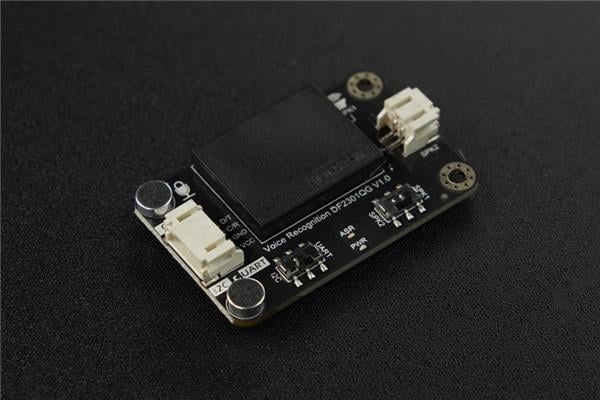
One of the most appealing aspects of the Gravity Voice Recognition Sensor is just how easy it is to integrate into existing projects. With support for both I2C (address 0x64) and UART (RX/TX) interfaces, the module can connect seamlessly to a wide variety of platforms including Arduino, ESP32, Raspberry Pi, and micro:bit. This flexibility makes it suitable for beginners working on small-scale builds as well as advanced developers designing complex systems.
The module operates across a voltage range of 3.3V to 5V, ensuring broad compatibility with most microcontrollers and development boards. Connection is also refreshingly simple: just four wires, two for power and two for communication, are all that’s needed to bring the module to life.
Offline Learning and Privacy Benefits
What sets the Gravity Voice Recognition Sensor apart from typical voice assistants is that it works entirely offline. All recognition and training take place locally on the module, meaning there’s no need for cloud services or internet connectivity. This not only simplifies setup but also provides a major advantage in terms of privacy and security.
Because nothing is ever transmitted online, your data stays completely private. Unlike consumer smart speakers such as Alexa or Google Home, this sensor doesn’t eavesdrop or log conversations; it simply listens for the commands you’ve trained it to understand.
The onboard dual microphone system ensures accurate detection even in noisier environments, while a built-in speaker (or optional external connector) provides real-time audio feedback. This makes the module suitable for applications where confirmation tones or spoken responses are essential.
For projects that demand higher security, multiple commands can be chained together to act as a unique voice-based passcode. This creates a simple yet effective method of securing devices, storage, or even access points, all without relying on external servers.
Inside the Gravity Voice Sensor
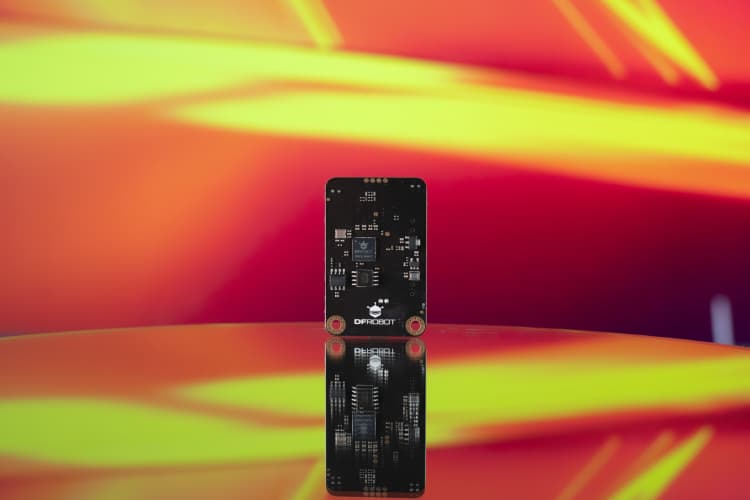
Despite its small footprint, the Gravity Voice Recognition Sensor is packed with thoughtful hardware features that make it both powerful and practical. Below is a breakdown of the key specifications that define the module:
| Feature | Spec |
|---|---|
| Built-in Commands | 121 |
| Custom Commands | 17 (trainable with sounds or words) |
| Interface | I2C (0x64), UART (TX/RX) |
| Operating Voltage | 3.3V–5V |
| Current | ≤ 370 mA @ 5V |
| Onboard Hardware | Dual mic, speaker connector |
| Dimensions | 49 × 32 mm |
The module has already seen improvements since its first release. Version 1.0, launched in March 2023, introduced the concept of offline learning with built-in hardware. Version 1.1, updated in May 2025, refined the design by replacing the onboard speaker with a detachable connector and adding two mounting holes for easier integration into custom enclosures and projects.
Simple Connections and Wake Word Control
The Gravity Voice Recognition Sensor is designed to keep integration as straightforward as possible. Alongside its simple four-wire setup, it also features an intelligent wake word system. A default wake word is provided out of the box, but you can also train your own, giving you extra flexibility in how you activate the module.
Thanks to a microphone sensitivity of -28 dB, the sensor can be triggered from a distance without needing to shout or position it directly in front of you. This makes it suitable for use in rooms, workshops, or embedded systems where precise positioning isn’t always possible.
To save energy and prevent unnecessary processing, the module can be put into a sleep mode, waking only when the designated word or sound is detected. Combined with its compact dimensions of just 49 × 32 mm, the Gravity Voice Recognition Sensor ensures that your projects remain efficient, responsive, and tidy.
Where the Gravity Sensor Shines
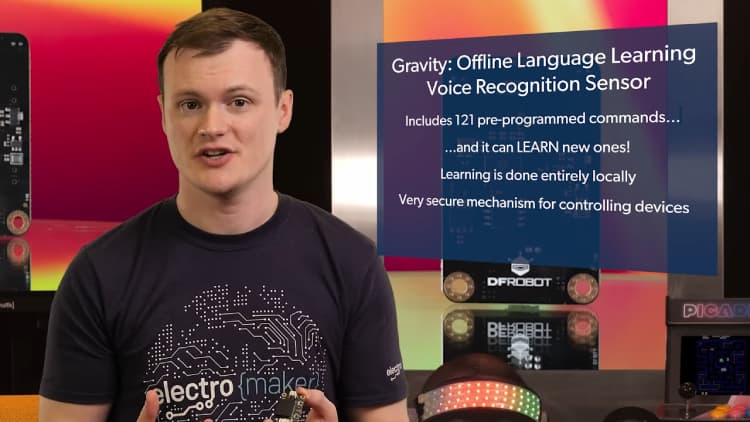
Before diving into specific applications, it’s worth noting why the Gravity Voice Recognition Sensor stands out as a building block for so many different types of projects. Its blend of offline training, customisable commands, and universal compatibility means that it isn’t restricted to a single use case. Instead, it provides a foundation for creativity, whether you’re designing hobbyist experiments, professional prototypes, or classroom demonstrations. This versatility is what makes it such a valuable addition to a maker’s toolkit, offering both practical functionality and room for innovation.
Robotics & Automation
The Gravity Voice Recognition Sensor is a natural fit for robotics projects. Its ability to issue commands directly to microcontrollers makes it ideal for controlling robot arms, servo systems, and workshop assistants. Imagine a robot that fetches tools, clears workspaces, or reacts to your spoken instructions in real time, all without cloud connectivity.
IoT & Privacy-First Systems
For smart home and IoT projects, the module provides voice control without cloud reliance. From lighting systems to connected appliances, it ensures that every spoken command stays local. This makes it particularly attractive for users who want the convenience of voice interfaces without sacrificing privacy or security.
Voice Password Systems
With support for layered sound-based commands, the Gravity sensor can function as a unique security tool. Developers can combine multiple trained sounds or phrases into a sequence that acts as a passcode. Whether securing access to a device, locking away valuables, or simply adding an extra layer of novelty to a project, this feature demonstrates the module’s versatility.
Education & Prototyping
As a breadboard-friendly module, the Gravity Voice Recognition Sensor integrates smoothly with platforms like Arduino and micro:bit. Its simplicity makes it perfect for classrooms, coding bootcamps, and makerspaces, helping learners focus on logic and interaction design instead of wiring complexity.
Create a smart workshop assistant that responds to commands like “light on,” “fan off,” and “tool tray,” while adding a custom whistle or clap sequence as a secure override. The result is a practical, privacy-friendly control system powered by the Gravity Voice Recognition Sensor.
Getting Started with Arduino and Micro:bit
Developers will find the Gravity Voice Recognition Sensor refreshingly straightforward to work with. For Arduino users, DFRobot provides the official DFRobot_DF2301Q library, which makes it easy to initialise the module and begin responding to commands right away.
The library includes simple functions such as:
getCMDID()– retrieve the ID of the detected commandsetVolume()– adjust the output audio volumedeleteCommand()– clear stored custom commands when needed
For younger learners and rapid prototyping, the sensor is also supported in MakeCode for the micro:bit. This extension allows beginners to drag and drop visual code blocks, making it possible to experiment with offline voice recognition without needing prior programming experience.
Best of all, setup is minimal: connect power and communication lines, load the library or extension, and you’re ready to start coding. Whether using Arduino or micro:bit, the Gravity Voice Recognition Sensor integrates smoothly into your workflow with very little overhead.
A Voice Module Worth Adding to Your Toolkit
The Gravity Voice Recognition Sensor proves that powerful technology doesn’t need to be complicated. By combining offline learning, privacy-first operation, and broad compatibility, it offers makers and developers a compact yet capable solution for adding voice interaction to projects. Its blend of 121 built-in commands, 17 trainable custom slots, dual microphones, and speaker support makes it a flexible tool for robotics, IoT, education, and secure systems alike.
What makes this module particularly appealing is that everything you need is already onboard, no external microphones, no cloud processing, and no hidden data collection. With simple four-wire connections and a voltage range that works with almost any microcontroller, it’s easy to drop into new builds or retrofit into existing ones.
If you want to try it for yourself, don’t forget to leave a comment on the YouTube video and tell us what you’d create with the Gravity Voice Recognition Sensor. And when you’re ready to add it to your own toolkit, head over to the Electromaker Store to get started.

Residing on the south coast of England, Rich has spent the last few years building Electomaker.io from the ground up. He is usually found behind a laptop coordinating the rest of the EM team and occasionally finding time to contribute articles to the blog. When not tapping away at a laptop, he can be found either paddleboarding, at the beach, playing golf (badly), or camping with his family.










Leave your feedback...