





Infineon Demonstrates Radar, AI, and Sensor-Powered Humanoid Robot at Embedded World 2026
At Embedded World 2026, Infineon demonstrated a humanoid robot designed to showcase how multiple sensing technologies can work together to help machines understand their surroundings and interact with people. The platform combines radar sensors, time-of-flight cameras, AI processing, and motion control hardware to detect nearby humans, map the environment, and move safely. By bringing several sensing systems into a single demonstration, the robot highlights how modern robotics platforms rely on a combination of perception technologies rather than a single sensor type.
Radar Sensors Enable 360-Degree Human Detection
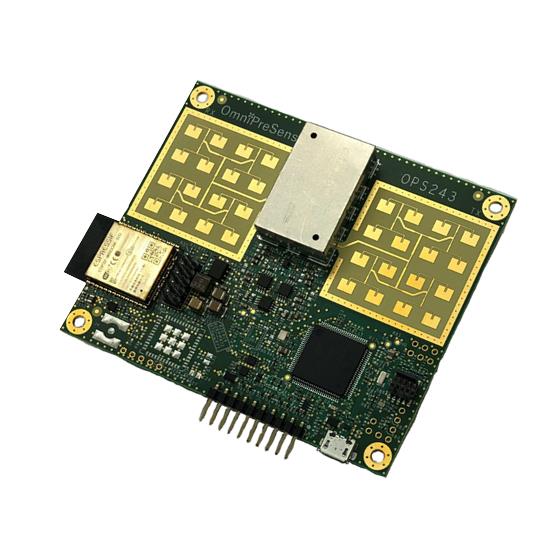
One of the key sensing technologies used in the robot is radar. The platform uses three Infineon radar devices arranged around the body of the robot, with each sensor covering roughly 120 degrees. Together they provide full 360-degree awareness, allowing the robot to detect people and movement around it regardless of which direction they approach from.
Radar sensing offers advantages that complement other perception systems. It can detect moving targets even in low-light conditions and can identify nearby objects or people that may not be visible to cameras alone. This makes radar useful for robotics applications that require continuous awareness of the environment, including service robots, industrial automation systems, and autonomous platforms.
Time-of-Flight Cameras Create a 3D View of the Environment
Alongside radar sensing, the robot uses two time-of-flight cameras to capture depth information. These sensors measure the distance to objects using infrared light, allowing the system to build a depth map of its surroundings. The resulting data can be used to generate a 3D view of the environment directly in front of the robot.
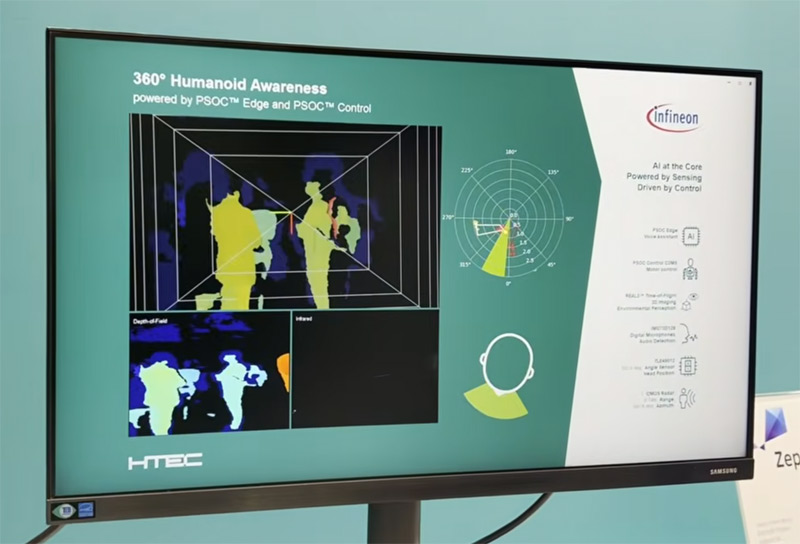
This type of sensing technology is commonly used in robotics systems that need spatial awareness. Depth cameras help robots recognize faces, detect obstacles, and map indoor environments. Similar technology is already used in devices such as robotic vacuum cleaners that build maps of homes as they move through rooms.
AI Processing and Voice Interaction
The robot demonstration also included AI processing to interpret sensor data and respond to human interaction. In addition to tracking people around it, the system could accept voice commands and adjust its behaviour accordingly. This allows the robot to respond to simple spoken instructions in real time.
During the demonstration, a voice command was used to change the color of the robot’s LEDs. After receiving the command, the system processed the instruction and updated the lighting. This type of interaction illustrates how robotics platforms increasingly combine sensing hardware with AI software to enable more natural communication between humans and machines.
Sensors and Motor Control Working Together
Beyond perception and interaction, the robot also integrates motion sensing and motor control hardware. Magnetic sensors monitor rotational movement, allowing the system to track the position and orientation of moving parts. This information helps the robot understand how its joints are moving and supports more accurate control.
Motor control components drive the robot’s mechanical systems and allow it to move in response to sensor input. By combining radar detection, depth sensing, motion tracking, and motor control, the platform demonstrates how different hardware technologies can work together to power the next generation of robotic systems.
Make sure you subscribe to The Electromaker Show for similar content and subscribe to our monthly newsletter!













Leave your feedback...