





Texas Instruments Demonstrates Compact Robotic Motor Control Designs at Embedded World 2026
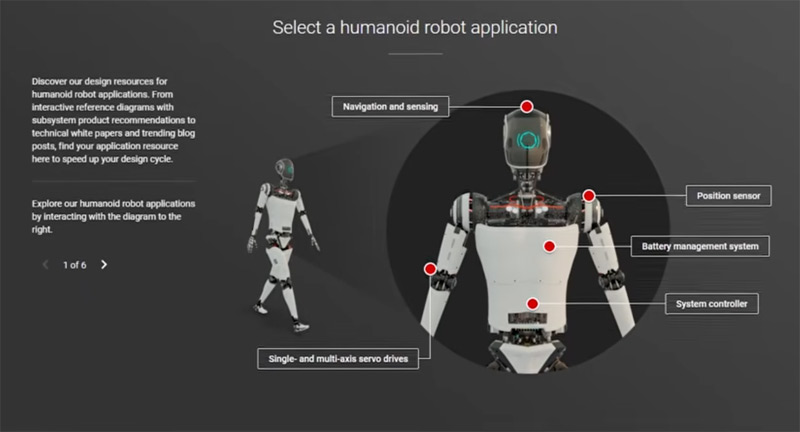
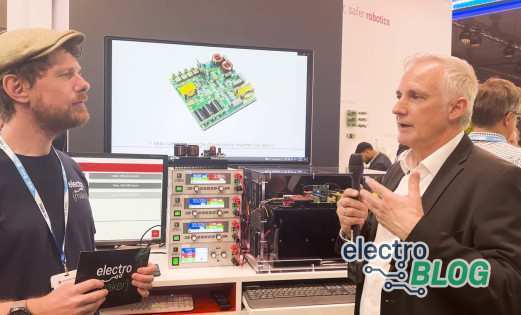
At Embedded World 2026, Texas Instruments demonstrated how modern robotic systems are being built around highly integrated motor control electronics and real-time communication. The demo featured a compact robotic arm and multi-axis robotic hand powered by TI processors, power electronics, and reference designs aimed at simplifying development. By combining high-efficiency power stages, precision sensing, real-time Ethernet communication, and embedded AI capabilities, the system highlights how developers can design smaller, more efficient robotic joints and actuators without sacrificing performance.
Designing Efficient Robotic Joint Motor Controllers
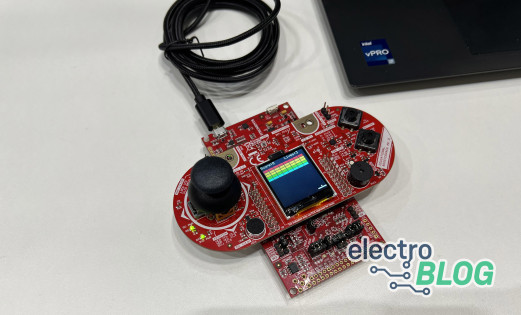
The first part of the demonstration focuses on a robotic arm joint built around a TI reference design known as TIDA-010979. Reference designs from Texas Instruments provide engineers with complete design files, including schematics, layout files, and measurement results. In this case, the design integrates the power stage, current sensing, encoder interfaces, and real-time communication required for precision motor control in robotics.
The system uses GaN FETs (gallium nitride field-effect transistors) in the motor power stage. Compared with traditional silicon devices, GaN transistors can operate at higher switching speeds and offer improved power density. This allows engineers to reduce the size of components such as DC-link capacitors and overall power electronics. For robotic joints where space and thermal management are critical, this approach helps create compact motor drivers capable of delivering high performance while minimizing heat and board size.
Multi-Axis Motor Control for Robotic Hands
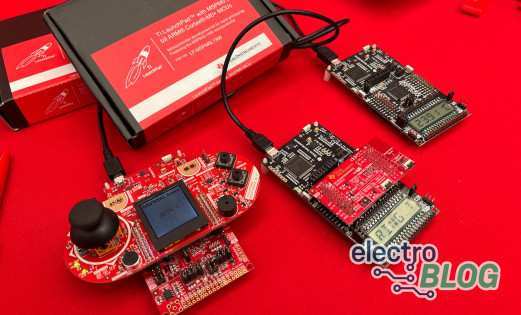
The second feature expands on this idea with a robotic hand that requires several motors to operate simultaneously. Instead of controlling each motor with a separate controller, the design uses a single C2000 digital signal processor to manage six motors at once. This multi-axis motor control architecture allows robotic systems to coordinate multiple joints with precise timing.
The robotic hand uses SPI-based encoders for position feedback, although the platform can support several encoder interface types depending on the motor design. By supporting different encoder technologies, TI processors such as the AM261 and F28P65 families allow developers to adapt their motor control systems to various industrial or robotic configurations. This flexibility is useful for robotics manufacturers who often need to support different sensors and actuator technologies across product lines.
Real-Time Communication in Robotic Systems
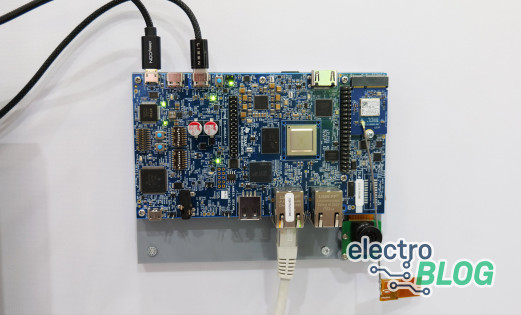
Robotic systems require reliable and deterministic communication between the central controller and individual motor nodes. In the TI demo, the motor control boards communicate over Ethernet using EtherCAT, a widely used industrial protocol designed for real-time automation networks. EtherCAT allows systems to transmit control data with low latency and minimal jitter, which is essential for synchronized movement across multiple axes.
Developers designing robotic systems must decide where different control loops should run within the system. Torque, speed, and position loops can be executed locally at the motor controller or centrally within a higher-level processor. The architecture shown in the demo supports both approaches, giving designers flexibility when balancing performance, bandwidth, and system complexity.
Local Processing and TinyEngine™ NPU for Robotics
Another aspect of the demonstration is the use of small neural network engines integrated into TI processors. These lightweight AI accelerators enable what TI refers to as TinyEngine™ NPU, where machine learning models run close to the hardware collecting the data. Instead of sending large streams of raw sensor data to a central processor, local AI engines can process information directly at the motor node.
This approach is particularly useful for robotics applications that require additional sensing capabilities such as torque estimation or tactile feedback. By performing data processing locally, systems can reduce communication bandwidth while still delivering useful information to the main controller. TI processors used in the demo also support functional safety standards up to SIL2 or SIL3, which is important for industrial robots and collaborative robotic systems that operate near humans.

Residing on the south coast of England, Rich has spent the last few years building Electomaker.io from the ground up. He is usually found behind a laptop coordinating the rest of the EM team and occasionally finding time to contribute articles to the blog. When not tapping away at a laptop, he can be found either paddleboarding, at the beach, playing golf (badly), or camping with his family.












Leave your feedback...