





Edge AI with Neuton Models and Axon NPU at Embedded World 2026
At Embedded World 2026, Nordic Semiconductor demonstrated two complementary approaches to running artificial intelligence directly on low-power wireless devices. The demos showed how AI workloads can be executed locally on Nordic hardware using either ultra-compact Neuton models running on the CPU or a dedicated neural processing unit called Axon. Together, these technologies allow developers to deploy edge AI on devices such as Bluetooth sensors and embedded IoT hardware without relying on cloud processing, keeping data local while improving responsiveness and energy efficiency.
Running Edge AI Directly on Nordic SoCs
Edge AI refers to running machine learning inference directly on the device that collects the data rather than sending that data to the cloud for processing. For embedded systems and IoT devices, this approach reduces latency and improves privacy because sensitive information can remain on the device. It can also significantly reduce energy consumption, since transmitting raw sensor data over wireless networks often consumes more power than performing local computation.
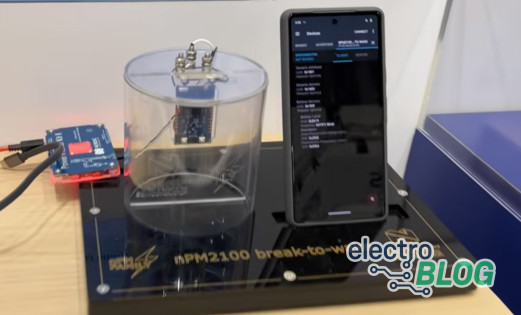
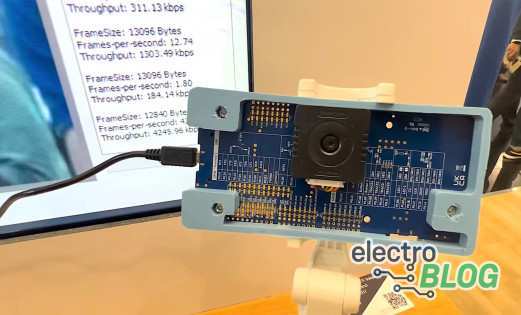
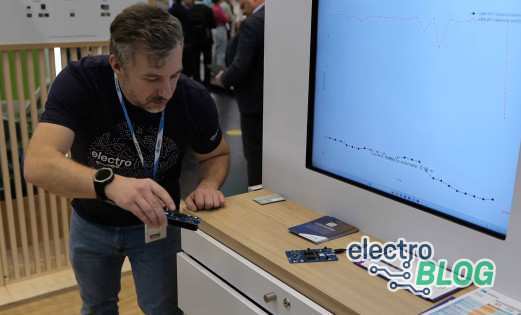
Nordic’s approach focuses on enabling these workloads within the constraints of low-power wireless hardware. In the demonstration, an nRF54L15 development board used onboard accelerometer data to recognize gestures such as circular motions, swipes, and double taps. All AI inference was performed directly on the Bluetooth SoC, and the device transmitted only the classification result over Bluetooth rather than streaming the raw motion data.
Neuton Models for Ultra-Small AI Workloads
The first technology demonstrated was Nordic’s support for Neuton models, which are designed for extremely small machine learning deployments. These models are typically only a few kilobytes in size and can run directly on the CPU of a microcontroller or wireless SoC. Because of their compact architecture, they can execute much faster and use significantly less energy than larger machine learning models designed for more powerful processors.

Developers generate these models using Nordic’s Edge AI Lab platform. By uploading labeled training data, the system automatically constructs a model optimized for the target device without requiring developers to manually design neural network architectures. The resulting models can interpret sensor signals such as accelerometer data, making them suitable for tasks like motion recognition, anomaly detection, or activity classification in low-power embedded systems.
Axon NPU for More Advanced AI Tasks
While Neuton models are optimized for small workloads, Nordic also demonstrated a second approach designed for more demanding AI tasks. The nRF54LM20B variant includes a dedicated neural processing unit known as Axon, which accelerates machine learning inference using specialized hardware. This architecture allows the device to handle larger models and higher data rates than would be practical on the main CPU alone.
The Axon NPU supports models built with standard machine learning frameworks such as TensorFlow Lite. This makes it suitable for workloads like keyword spotting, audio processing, or low-resolution image recognition. In the demonstration, a voice-controlled application waited for a wake word before accepting commands such as directional inputs, illustrating how more complex edge AI tasks can be performed locally on embedded hardware.
Performance Gains and Developer Tools
To illustrate the difference between CPU and NPU execution, Nordic compared the same keyword spotting algorithm running on the CPU and on the Axon NPU. When processed on the CPU, the inference took roughly 73 milliseconds and consumed about 185 microcoulombs of charge. Running the same workload on the NPU reduced inference time to around 6.5 milliseconds while using less than 20 microcoulombs of energy.
Developers can begin working with both technologies using tools available through Nordic’s development ecosystem. The Edge AI Lab platform allows engineers to train and export Neuton models, while the Edge AI add-on for the nRF Connect SDK provides drivers, inference libraries, and compilers needed to run models on the Axon NPU. Together, these tools provide a path for building edge AI applications that run entirely on-device within Nordic’s low-power wireless platforms.
Make sure you subscribe to The Electromaker Show for similar content and subscribe to our monthly newsletter!

Residing on the south coast of England, Rich has spent the last few years building Electomaker.io from the ground up. He is usually found behind a laptop coordinating the rest of the EM team and occasionally finding time to contribute articles to the blog. When not tapping away at a laptop, he can be found either paddleboarding, at the beach, playing golf (badly), or camping with his family.











Leave your feedback...