


Hailo-8 vs Hailo-8L vs Hailo-10H: Performance, Compatibility and Use Cases
Hailo now offers three accelerator families that can look deceptively similar on a product page. Hailo-8, Hailo-8L and Hailo-10H all put a Hailo neural processing unit into compact edge systems, but they do not target the same job. Hailo-8L is the lower-cost vision option, Hailo-8 offers more INT8 vision throughput, and Hailo-10H adds on-module memory and generative AI support.
If you are new to dedicated inference hardware, Electromaker's guide, What is an AI accelerator?, explains the main processor types and selection criteria.
Choosing only by the largest TOPS number can lead to the wrong purchase. Hailo rates Hailo-8L and Hailo-8 at 13 and 26 TOPS using INT8 arithmetic. Hailo-10H's headline 40 TOPS figure uses INT4, while its INT8 figure is 20 TOPS. Precision, model compilation, host preprocessing, PCIe bandwidth, memory, batch size and cooling all influence useful performance.
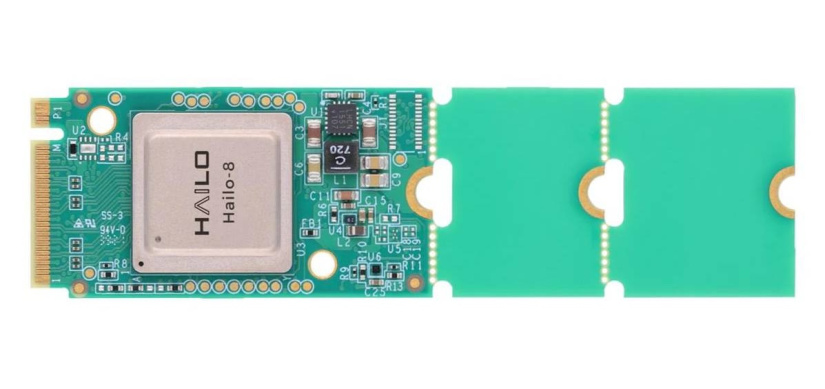
Hailo-8 vs Hailo-8L vs Hailo-10H at a glance
| Feature | Hailo-8L | Hailo-8 | Hailo-10H |
|---|---|---|---|
| Manufacturer-rated peak compute | 13 TOPS INT8 | 26 TOPS INT8 | 40 TOPS INT4, 20 TOPS INT8 |
| Architecture | First-generation Hailo dataflow architecture | First-generation Hailo dataflow architecture | Second-generation neural core with direct external DDR interface |
| Memory on M.2 module | No on-module external DRAM listed | No on-module external DRAM listed | 4GB or 8GB LPDDR4/4X, depending on module |
| Electromaker-listed M.2 choices | A+E 2230 or B+M 2280, PCIe Gen3 x2 | A+E 2230 or B+M 2280 at PCIe Gen3 x2, M-key 2242/2280 at x4 | M-key 2242 or 2280, PCIe Gen3 x4 |
| Best fit | Cost-sensitive object detection and moderate edge vision | Higher-throughput vision, multiple streams and parallel models | Supported local LLMs, VLMs and vision on one accelerator |
| Main limitation | Less vision headroom than Hailo-8 | Not designed for local LLM or VLM execution | More expensive, memory capacity matters, and 40 TOPS is not comparable to 26 TOPS at INT8 |
Short answer: Buy Hailo-8L when 13 TOPS is enough and cost or power is the priority. Buy Hailo-8 for demanding computer vision. Buy Hailo-10H when supported local generative AI is a requirement, or when its newer architecture and onboard memory match your deployment.
Hailo-8 explained
Hailo's current Hailo-8 datasheet specifies up to 26 TOPS at INT8. Its dataflow architecture distributes compute and memory resources across the chip, with an interconnect that Hailo's compiler configures for each network. Hardware-assisted tensor manipulation and post-processing, including non-maximum suppression, can keep common vision stages off the host CPU.
Hailo-8 is principally a computer vision accelerator. Object detection, classification, segmentation, pose estimation, depth tasks and multi-camera analytics are its natural territory. M-key modules can expose PCIe Gen3 x4, while A+E and B+M versions use x2. That makes the M-key version the strongest general choice when the host has four usable lanes, though model execution and host data movement determine whether all four matter.
Hailo-8L explained
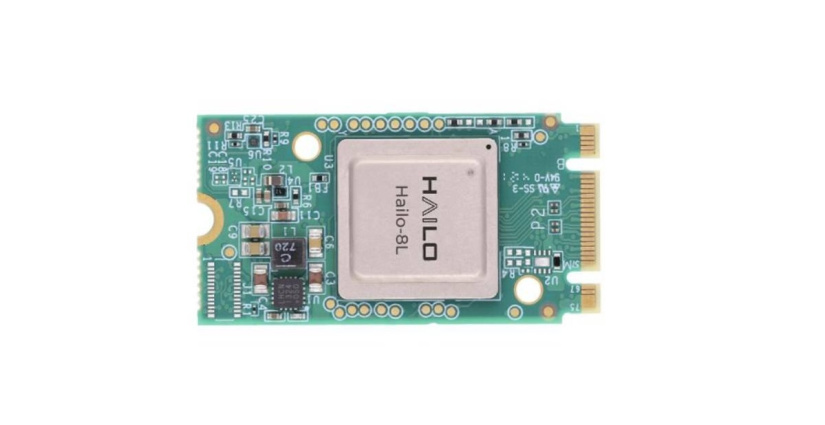
Hailo-8L uses the same broad dataflow approach at a lower 13 TOPS INT8 performance point. It is positioned for lighter, cost-sensitive edge inference rather than as a different kind of processor. It supports the same major model interchange and training ecosystems through Hailo's tools, including TensorFlow, TensorFlow Lite, Keras, PyTorch and ONNX workflows.
The practical benefit is efficiency and price. Hailo-8L is often enough for one or several modest vision pipelines, especially when inference does not run on every video frame. The tradeoff is less room for larger networks, higher input resolutions, more cameras or concurrent models. A Hailo-8 deployment is therefore not automatically oversized just because Hailo-8L can run the same model family.
Hailo-10H explained
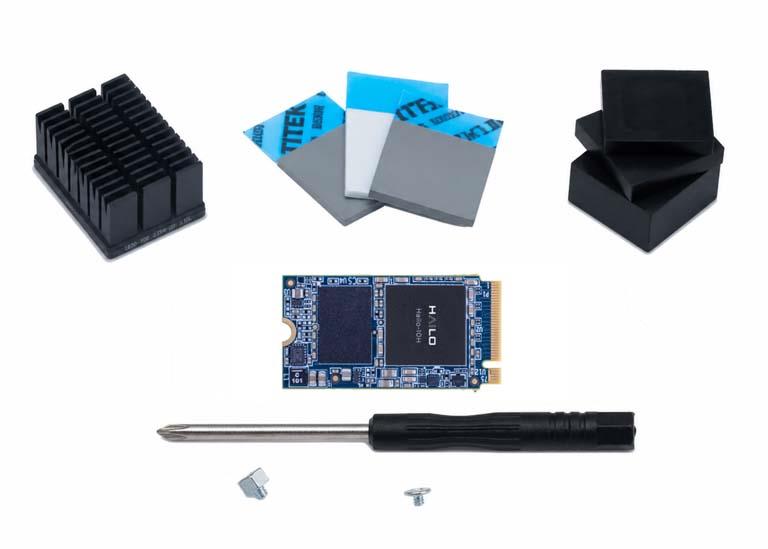
Hailo-10H M.2 modules pair Hailo's second-generation neural core with 4GB or 8GB of LPDDR4/4X memory. Hailo specifies 40 TOPS at INT4 and 20 TOPS at INT8, delivered through an M-key 2242 or 2280 module with PCIe Gen3 x4.
The onboard memory and direct DDR interface are the important differences. They let supported language and vision-language models keep weights close to the accelerator instead of treating host memory and PCIe as the only storage path. Hailo-10H also handles vision, but its value is not simply a larger TOPS number. It is the member of this group built to add generative AI workloads to an edge platform.
The onboard memory and direct DDR interface are the important differences. They let supported language and vision-language models keep weights close to the accelerator instead of treating host memory and PCIe as the only storage path. Hailo-10H also handles vision, but its value is not simply a larger TOPS number. It is the member of this group built to add generative AI workloads to an edge platform.
Computer vision performance and workloads
For conventional vision, Hailo-8 gives the most predictable step up from Hailo-8L. Hailo's own April 2026 datasheets report 140 FPS for YOLOv8m on Hailo-8 and 87 FPS on Hailo-8L, both at batch 8. For YOLOv11m, Hailo reports 101 FPS and 58 FPS. These are manufacturer benchmarks from Hailo's software environment, not independent complete-system measurements, but they illustrate why 26 versus 13 TOPS does not produce a universal twofold speed increase.
Real application throughput also includes camera capture, video decoding, image resize and color conversion, result post-processing, storage and application logic. A Raspberry Pi, an x86 NVR and an industrial ARM computer can produce different end-to-end results with the same M.2 AI accelerator. Latency at batch 1 can also matter more than peak batched throughput in robotics.
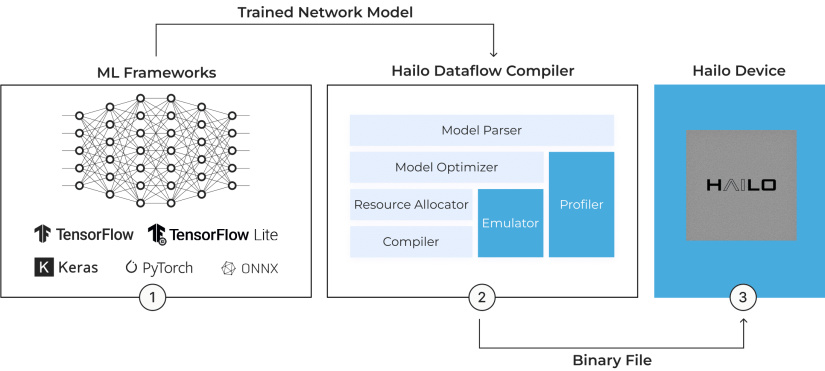
Model compatibility is another gate. Hailo's Dataflow Compiler converts, optimizes and quantizes a trained model into a Hailo Executable Format file. HailoRT loads and schedules that compiled network. Supported operations, input shapes, quantization accuracy and the HEF's target architecture should be checked before hardware selection. Hailo's software suite provides C/C++, Python, GStreamer and ONNX Runtime paths, plus model zoos, but it does not mean every unmodified model will run.
Local LLM and generative AI workloads
Hailo-10H changes the comparison because Hailo-8 and Hailo-8L are vision-first accelerators without the local memory architecture intended for LLMs and VLMs. Hailo-10H's memory and second-generation core support Hailo's GenAI software, model zoo and an API layer compatible with common Ollama and OpenAI-style application patterns.
Memory capacity should come before TOPS when choosing a Hailo-10H module. A 4GB card can only hold a smaller model and working set than an 8GB card. Raspberry Pi's 8GB AI HAT+ 2 is documented for supported LLMs and VLMs up to about six billion parameters, but that statement must not be transferred to Electromaker's 4GB Hailo-10H starter kits. Model architecture, quantization, context length and software release support all affect what fits and how quickly it generates.
Raspberry Pi compatibility
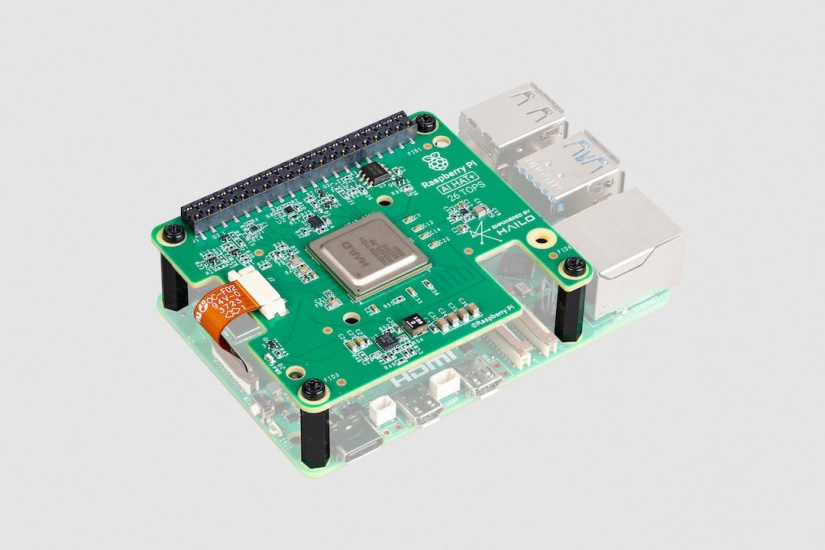
For a Raspberry Pi 5, the official AI HAT family is the simplest route. The 13 TOPS Raspberry Pi AI HAT+ uses Hailo-8L, while the 26 TOPS AI HAT+ uses Hailo-8. Raspberry Pi OS can detect these boards, and supported tasks can integrate with rpicam-apps and Picamera2. The older AI Kit is functionally equivalent to the 13 TOPS board, but Raspberry Pi says it is no longer in production.
The AI HAT+ 2 uses Hailo-10H with 8GB onboard memory for vision plus supported local LLM and VLM workloads. Electromaker did not show an AI HAT+ 2 listing when this guide was checked, although it did list bare 4GB Hailo-10H starter kits.
A bare module is not a drop-in substitute for an official AI HAT. The Raspberry Pi M.2 HAT+ accepts M-key 2230 and 2242 PCIe devices and supplies a single PCIe 2.0 lane with a stated 500MB/s peak. It cannot mechanically take the 2230 A+E or 2280 modules in this comparison, and its one host lane cannot expose a card's x4 link. Check carrier support, mounting length, software image and power before assembling a custom stack.
M.2 interfaces, power and host requirements
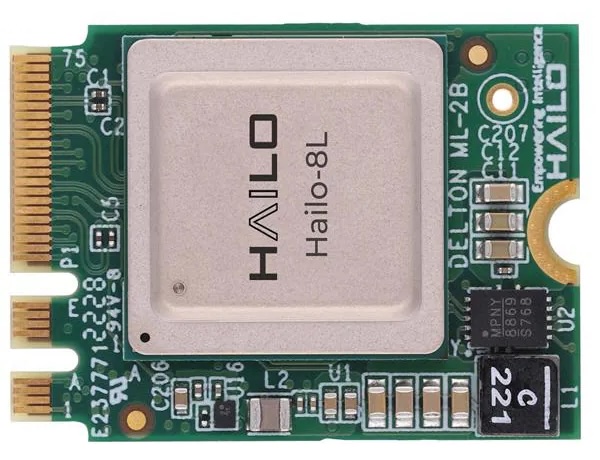
M.2 describes both a connector family and board dimensions. The final two digits in 2230, 2242 and 2280 indicate 30mm, 42mm and 80mm lengths. Key M, B+M and M.2 A+E key cards use different notch patterns. The slot must have the right key, provide PCIe rather than only SATA or USB, support the card length, expose enough lanes and supply adequate 3.3V power.
- Hailo-8 M-key: PCIe Gen3 x4, with Electromaker listings in 2242 and 2280.
- Hailo-8 B+M and A+E: PCIe Gen3 x2, listed as 2280 and 2230 respectively.
- Hailo-8L B+M and A+E: PCIe Gen3 x2, listed as 2280 and 2230 respectively.
- Hailo-10H M-key: PCIe Gen3 x4 in 2242 or 2280, with 4GB or 8GB onboard memory variants.
Power figures also need context. Hailo gives workload-specific typical figures below maximum module power. Current module documents list up to 8.25W for several Hailo-8 M.2 variants and up to 6.6W for the Hailo-8L A+E and B+M modules. Hailo states 2.5W typical for Hailo-10H, not a universal maximum. Sustained load, ambient temperature and enclosure airflow determine the cooling requirement. Hailo-8 starter kits include thermal-management parts. Check the supplied cooling parts for a Hailo-10H kit. Raspberry Pi recommends an Active Cooler for Pi 5 and the supplied HAT heatsink for intensive AI HAT+ 2 use.
Which Hailo accelerator should you buy?
Raspberry Pi
Choose the official 13 TOPS AI HAT+ for moderate vision at the lowest board cost, or the 26 TOPS model for larger networks and more parallel work. Choose AI HAT+ 2 if local LLMs or VLMs are required. All three target Raspberry Pi 5, not earlier Pi boards.
Frigate and NVR
Choose Hailo-8L for a cost-sensitive, moderate detection load, or Hailo-8 for more camera, model or detect-rate headroom. Current Frigate detector documentation explicitly lists Hailo-8 and Hailo-8L. It does not list Hailo-10H, so do not buy the newer card for Frigate without first confirming current plugin and HEF support.
Robotics
Hailo-8L fits a focused detector or classifier. Hailo-8 is safer when low latency, segmentation, pose, several cameras or concurrent networks are involved. Evaluate batch-1 latency and host preprocessing, not only FPS.
Industrial vision
Hailo-8 offers the strongest established vision capacity here, and Electromaker carries extended-temperature module part numbers. Validate the exact module's environmental rating, lifecycle, carrier, cooling and certification needs as part of the complete system.
Lowest-cost edge inference
At the checked Electromaker price of $85, a bare Hailo-8L module is the value choice if the host already has a compatible A+E or B+M PCIe slot and 13 TOPS meets the workload.
Local LLMs and VLMs
Choose Hailo-10H. Select memory capacity based on the supported model and context size. Neither Hailo-8 nor Hailo-8L is a substitute just because its INT8 TOPS figure looks competitive.
Higher-performance embedded vision
Choose Hailo-8, preferably M-key x4 when the host exposes four lanes. Compare Hailo-10H only if you also need its GenAI features or have a benchmark for your exact vision model.
Hailo accelerators available from Electromaker
The following US dollar prices and availability were shown in the Electromaker accelerator-card category on September 9, 2026. Stock and pricing can change. Hailo-8 starter kits add thermal-management hardware and installation accessories. Check each Hailo-10H kit page for its supplied parts.
| Chip | Electromaker product | Interface and form factor | Price and availability |
|---|---|---|---|
| Hailo-8L |
Hailo-8L M.2 Key B+M 2280 AI Acceleration Module, HM21LB1C2LAE |
PCIe Gen3 x2, B+M, 2280 | $85.00, 18 in stock |
| Hailo-8L |
Hailo-8L M.2 Key A+E 2230 AI Acceleration Module, HM21LB1C2KAE |
PCIe Gen3 x2, A+E, 2230 | $85.00, back order |
| Hailo-8 |
Hailo-8 M.2 Key M 2242 AI Acceleration Module, HM218B1C2HAE |
PCIe Gen3 x4, M-key, 2242 | $169.00, 27 in stock |
| Hailo-8 |
Hailo-8 M.2 Key M 2280 AI Acceleration Module, HM218B1C2FAE |
PCIe Gen3 x4, M-key, 2280 | $169.00, 96 in stock |
| Hailo-8 |
Hailo-8 M.2 Key B+M 2280 AI Acceleration Module, HM218B1C2LAE |
PCIe Gen3 x2, B+M, 2280 | $169.00, 87 in stock |
| Hailo-8 |
Hailo-8 M.2 Key A+E 2230 AI Acceleration Module, HM218B1C2KAE |
PCIe Gen3 x2, A+E, 2230 | $169.00, 21 in stock |
| Hailo-8 |
Hailo-8 M.2 Key M 2280 AI Acceleration Module Starter Kit, HM218B1C2XAE |
PCIe Gen3 x4, M-key, 2280 | $191.25, 27 in stock |
| Hailo-8 |
Hailo-8 M.2 Key B+M 2280 AI Acceleration Module Starter Kit, HM218B1C2ZAE |
PCIe Gen3 x2, B+M, 2280 | $191.25, 10 in stock |
| Hailo-8 |
Hailo-8 M.2 Key A+E 2230 AI Acceleration Module Starter Kit, HM218B1C2YAE |
PCIe Gen3 x2, A+E, 2230 | $191.25, 5 in stock |
| Hailo-10H |
Hailo-10H M.2 Key M 2242 4GB AI Acceleration Module Starter Kit, HM22HB2C2XBE |
PCIe Gen3 x4, M-key, 2242, 4GB | $212.50, 1 in stock |
| Hailo-10H |
Hailo-10H M.2 Key M 2280 4GB AI Acceleration Module Starter Kit, HM22HB2C2XAE |
PCIe Gen3 x4, M-key, 2280, 4GB | $212.50, back order |
| Hailo-8L |
Raspberry Pi AI HAT+ 13 TOPS, SC1785 |
Raspberry Pi 5 AI HAT+, PCIe | $70.00, out of stock |
| Hailo-8 |
Raspberry Pi AI HAT+ 26 TOPS, SC1791 |
Raspberry Pi 5 AI HAT+, PCIe | $110.00, 159 in stock |
The M.2 category therefore gives buyers two Hailo-8L bare modules, seven Hailo-8 bare or starter-kit choices and two 4GB Hailo-10H starter kits. The Pi-specific HATs provide an easier supported route for Raspberry Pi 5 vision projects.
FAQs
Is Hailo-8 twice as fast as Hailo-8L?
No. Its peak INT8 rating is twice as high, but model FPS and latency do not scale uniformly with TOPS. Hailo's own YOLO examples show different ratios, and host work can narrow the system-level gap.
Is Hailo-10H faster than Hailo-8?
Not as a universal statement. Hailo-10H is rated at 40 TOPS INT4 and 20 TOPS INT8, while Hailo-8 is rated at 26 TOPS INT8. Use model-specific results at the required precision. Hailo-10H's clear advantage is its architecture for supported GenAI plus vision.
Can Hailo-8 or Hailo-8L run local LLMs?
They are not the intended or officially supported choice for local LLM and VLM inference. Hailo-10H adds the memory and GenAI software path required for those workloads.
Which Hailo accelerator works with Raspberry Pi 5?
Raspberry Pi provides official AI HAT+ boards using Hailo-8L or Hailo-8, plus AI HAT+ 2 using Hailo-10H. Bare M.2 cards require a compatible carrier and are constrained by the Pi 5's exposed PCIe link.
Does Frigate support Hailo-10H?
Frigate's current detector documentation names Hailo-8 and Hailo-8L, but not Hailo-10H. Check the current Frigate release before assuming support.
Will a Hailo card work in any M.2 slot?
No. Match the physical key, board length, PCIe protocol, lane count, power budget and operating-system driver. A card fitting mechanically does not prove electrical or software compatibility.
Do Hailo M.2 accelerators need cooling?
Plan for thermal management under sustained workloads. Required cooling depends on the model, duty cycle, ambient temperature and enclosure. Use the module's thermal guide and monitor for throttling in the final system.

Residing on the south coast of England, Rich has spent the last few years building Electomaker.io from the ground up. He is usually found behind a laptop coordinating the rest of the EM team and occasionally finding time to contribute articles to the blog. When not tapping away at a laptop, he can be found either paddleboarding, at the beach, playing golf (badly), or camping with his family.








Leave your feedback...