





PocketBeagle 2: Compact Single Board Computer for Real-Time Control
Some single board computers try to be everything at once. Others are built with a much clearer purpose in mind. The PocketBeagle 2 firmly belongs in the second category. At a glance, it is almost disarmingly small, but that compact footprint hides a level of capability that places it well beyond novelty hardware.
As the latest evolution of the original PocketBeagle, this BeagleBoard single board computer builds on a design philosophy that prioritises control, flexibility, and real-world hardware access. Rather than chasing higher headline specifications for their own sake, PocketBeagle 2 focuses on delivering the features engineers actually need when working close to the hardware, where timing, I/O, and determinism matter just as much as raw processing power.
Designed with developers, students, and makers in mind, PocketBeagle 2 sits comfortably between traditional microcontrollers and larger desktop-style SBCs. It offers a Linux-capable compute platform while retaining the low-level access and extensive I/O required for serious hardware projects. For anyone looking for a compact SBC for hardware projects that values capability over convenience, PocketBeagle 2 makes a strong and deliberate case.

What Is the PocketBeagle 2?

The PocketBeagle 2 is an ultra-compact, low-cost single board computer designed for developers who need direct, reliable access to hardware without the overhead of a full-sized system. It is not intended to replace a desktop computer or serve as a general-purpose media platform. Instead, it fills the space between traditional microcontrollers and larger SBCs, offering a Linux-capable environment alongside the kind of low-level control normally reserved for embedded hardware.
Rather than prioritising consumer-facing features or headline specifications, PocketBeagle 2 is engineered around I/O density, deterministic behaviour, and real-time control. These priorities make it especially well suited to hardware-centric projects where precise timing and predictable responses are critical. It is best understood not as an alternative to mainstream SBCs, but as a purpose-built platform for engineers, students, and makers who value control, openness, and reliability in compact hardware.
Why PocketBeagle 2 Is Built for Engineers
In many hardware-focused projects, the limitations of mainstream single board computers become apparent very quickly. While they often offer generous amounts of memory and graphical capability, they tend to fall short where it matters most for embedded work. Access to pins is limited, timing can be unpredictable, and real-time control is often an afterthought rather than a design priority.
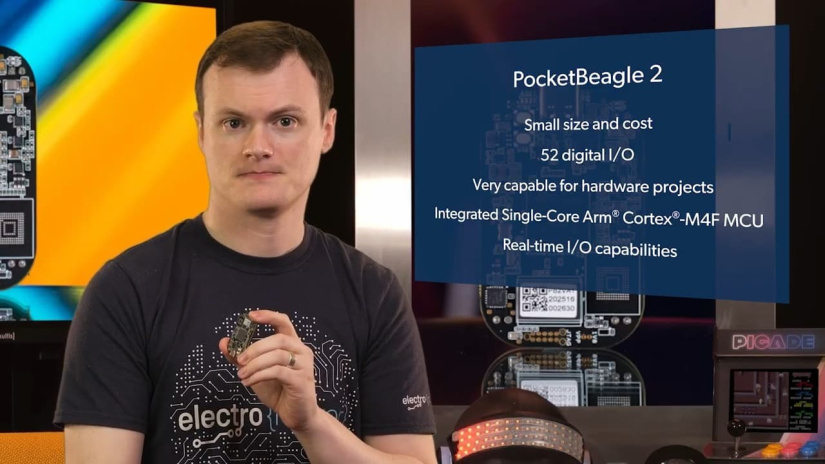
The PocketBeagle 2 takes a different approach. Instead of treating I/O as a secondary feature, it places hardware access at the centre of the design. With 52 digital I/O lines available on a board small enough to fit almost anywhere, it provides the flexibility required to interface directly with sensors, actuators, and external hardware without compromise. This level of access is difficult to achieve on more consumer-oriented SBCs without additional expansion hardware.
For engineering applications, deterministic behaviour and precise timing are often more valuable than extra RAM or a powerful GPU. Tasks such as motion control, signal generation, or low-latency data acquisition depend on predictable responses rather than raw processing throughput. PocketBeagle 2 is built to meet those requirements, offering real-time I/O capabilities that allow software and hardware to work together reliably. The result is a platform that feels less like a general-purpose computer and more like a purpose-built tool for serious embedded development.
Core System Architecture

At the core of the PocketBeagle 2 is a system-on-chip chosen for reliability, efficiency, and suitability for embedded workloads. Rather than chasing peak consumer performance, the architecture focuses on predictable behaviour and long-term stability, which are critical in engineering and industrial environments.
- System-on-chip: Texas Instruments AM6254, a platform designed specifically for embedded and industrial applications, offering long-term availability and robust documentation
- Main processor: Quad-core 64-bit ARM Cortex-A53 running at up to 1.4 GHz, providing enough performance to run Linux-based applications, user interfaces, and services without unnecessary overhead
- Cache architecture: Integrated L1 and L2 caches that improve efficiency and responsiveness, helping maintain consistent performance under mixed workloads
- Memory protection: Support for ECC memory, which helps detect and correct data corruption, an important consideration in systems expected to run continuously or operate in electrically noisy environments
Together, these design choices reflect a focus on dependable operation rather than short-term benchmark results. For embedded systems that must behave consistently over long periods, this kind of architectural balance is often far more valuable than raw processing power alone.
Real-Time Processing and Secondary Cores
One of the most important ways the PocketBeagle 2 differentiates itself is through its support for true real-time processing. While the main ARM Cortex-A53 cores are well suited to running embedded Linux, user interfaces, and higher-level applications, they are not designed to guarantee precise timing. For many engineering tasks, that limitation is simply not acceptable.
To address this, PocketBeagle 2 includes a dedicated ARM Cortex-M4F microcontroller running at 400 MHz. This secondary core is designed specifically for deterministic, low-latency tasks where timing accuracy matters. It can handle time-critical operations independently of the Linux environment, ensuring that control loops and hardware interactions remain stable even when the main system is under load.
Alongside the MCU, the board also features a dual-core PRU subsystem running at 333 MHz. These Programmable Real-time Units are purpose-built for direct, high-speed hardware interfacing. They excel at tasks that require precise signal timing and predictable responses, making them ideal for PRU-based hardware control in demanding applications.
This separation of responsibilities allows PocketBeagle 2 to function as a true real-time SBC. Linux handles complex logic, networking, and user interaction, while the MCU and PRUs manage deterministic I/O tasks. In practice, this architecture is well suited to applications such as motion control, robotics, CNC systems, and machinery control, where reliable timing and low latency are essential for safe and accurate operation.
Memory and Storage
The PocketBeagle 2 is equipped with 512 MB of LPDDR4 RAM, a capacity that is well matched to its intended role as an embedded computing platform. Rather than aiming to support heavy multitasking or desktop-style workloads, this memory configuration is optimised for running embedded Linux, control applications, and lightweight user interfaces with predictable performance and low power consumption.
For many embedded systems, efficiency and reliability matter far more than sheer memory capacity. Keeping memory requirements modest helps reduce complexity, improve stability, and ensure consistent behaviour over long runtimes. This makes the PocketBeagle 2 particularly suitable for systems that are expected to operate continuously or in constrained environments.
Storage is handled via a microSD card slot, allowing developers to choose capacity and performance based on the needs of their project. This approach keeps the board flexible and cost-effective, while making it easy to update, replace, or customise system images during development and deployment. Combined with its efficient memory design, the PocketBeagle 2 provides a balanced foundation for embedded workloads without unnecessary overhead.
I/O, Expansion, and Power
Connectivity to the physical world is where the PocketBeagle 2 truly stands out. Its compact size does not come at the expense of expansion, making it well suited to projects that demand extensive hardware integration within tight space constraints.
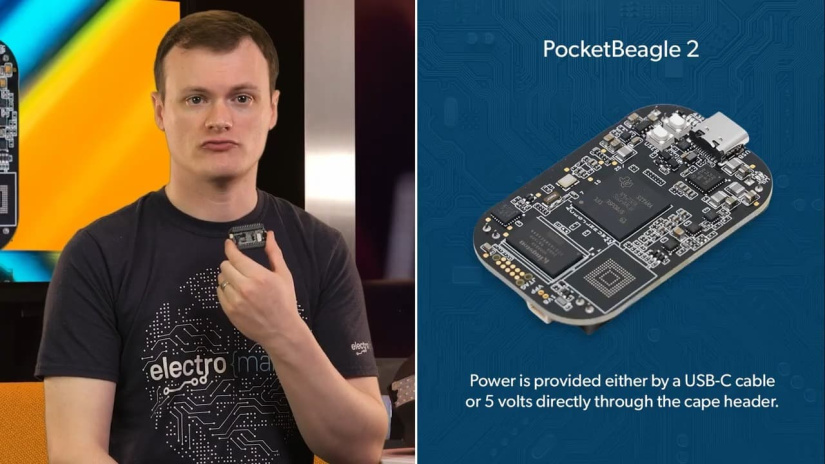
- Expansion and I/O: A total of 72 expansion pins, including 52 digital I/O lines and 8 analogue inputs, provide broad support for sensors, actuators, and custom hardware interfaces
- Power input options: USB-C power input for straightforward development and testing, alongside 5 V power via the cape header for embedded and production designs
- Battery support: Dedicated battery input lines that enable portable and battery-powered applications without additional power management hardware
This flexible power and I/O arrangement makes the PocketBeagle 2 particularly attractive for embedded deployments and custom products. Whether it is installed inside a bespoke enclosure, integrated into machinery, or used as the core of a portable device, the board is designed to adapt to real-world power and hardware requirements rather than imposing artificial constraints.
Debugging and Developer Features
Effective debugging is a fundamental requirement in professional embedded development, and the PocketBeagle 2 provides the tools needed to diagnose and refine systems at every stage of a project. Rather than relying solely on software-level logging, it offers direct hardware access for deeper inspection and control.
A dedicated UART debug port allows developers to monitor boot processes, capture system output, and troubleshoot issues at a low level, even when the main operating system is not fully running. This is especially valuable during early development or when working with custom system configurations.
For more advanced use cases, the inclusion of a 10-pin JTAG connector enables full hardware debugging of both the main processor and auxiliary cores. This level of access is essential in production-oriented workflows, where understanding system behaviour at the hardware level can significantly reduce development time and improve reliability. Together, these features reinforce the PocketBeagle 2’s position as a serious tool for engineers rather than a simplified development board.
Physical Design and User Features
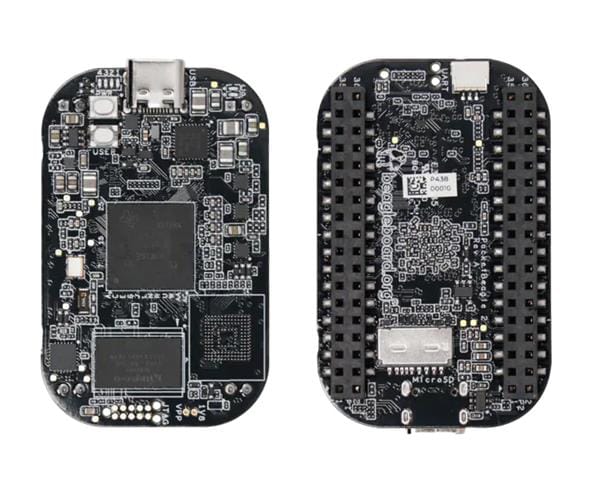
The PocketBeagle 2 is designed to disappear into a project without demanding unnecessary space. Measuring just 55 x 35 mm and weighing 12.7 g, it is small enough to fit comfortably into compact enclosures while still providing the connectivity and features expected of a capable embedded platform.
Despite its size, the board includes several practical touches that improve usability during both development and deployment. Dedicated power and boot buttons make it easier to manage startup behaviour and recovery without external tools, which can be especially useful when working with custom images or debugging boot issues.
Status feedback is handled through a set of onboard LED indicators, including a power LED, a battery charging indicator, and four user-controllable LEDs. These provide immediate visual feedback for system state, application status, or debugging signals, reducing reliance on external displays or serial consoles. Together, these features make the PocketBeagle 2 easy to work with in the lab and dependable once integrated into a finished system.
When PocketBeagle 2 Makes More Sense Than a Raspberry Pi
There are many situations where a Raspberry Pi is an excellent choice, particularly for general-purpose computing, multimedia projects, and rapid prototyping with a familiar software ecosystem. However, not every project benefits from that style of platform, and this is where the PocketBeagle 2 often proves to be a better fit.
In applications with tight space constraints, the PocketBeagle 2’s compact form factor can be a decisive advantage. Its small footprint makes it easier to integrate into custom enclosures, machinery, or portable devices without the compromises that larger boards can introduce.
Projects that depend on deterministic I/O and precise timing also favour the PocketBeagle 2’s architecture. The presence of dedicated real-time cores allows it to handle low-latency hardware tasks reliably, something that can be difficult to guarantee on platforms primarily designed for general-purpose computing.
Power efficiency is another important consideration in embedded systems. By focusing on essential features rather than multimedia capability, PocketBeagle 2 avoids unnecessary power draw and complexity. For developers who value direct hardware control over graphics and video performance, it offers a more appropriate balance of features for embedded and industrial workloads.
Quick Specifications Recap
| Specification | Details |
|---|---|
| Processor | Texas Instruments AM6254, quad-core 64-bit ARM Cortex-A53 up to 1.4 GHz |
| Real-time cores | Single-core ARM Cortex-M4F at 400 MHz and dual-core PRU subsystem at 333 MHz |
| Memory | 512 MB LPDDR4 RAM |
| I/O | 72 expansion pins, including 52 digital I/O and 8 analogue inputs |
| Power options | USB-C power input, 5 V via cape header, battery input lines |
| Physical size | 55 x 35 mm, 12.7 g |
Final Thoughts
The PocketBeagle 2 is a clear example of what happens when an embedded platform is designed with intent rather than excess. It does not attempt to be a general-purpose computer or a multimedia device, and that focus is precisely what makes it effective. By prioritising control, flexibility, and real-time capability, it delivers the features that engineers and hardware-focused makers actually rely on.

Robin Mitchell is an electronic engineer who has been involved in electronics since the age of 13. After completing a BEng at the University of Warwick, Robin moved into the field of online content creation developing articles, news pieces, and projects aimed at professionals and makers alike. Currently, Robin runs a small electronics business, MitchElectronics, which produces educational kits and resources.












Leave your feedback...