





Octavo Systems OSD62-PM-BRK: Industrial-Grade Power in a Small Footprint
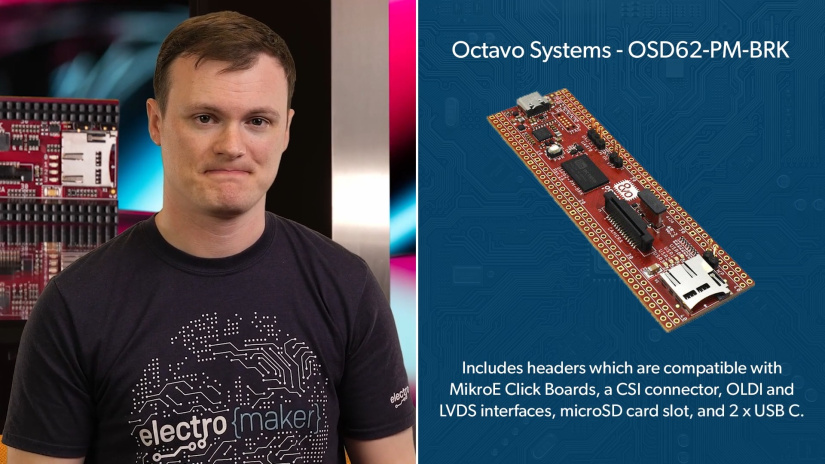
Every so often, a piece of hardware appears that sparks ideas the moment you see it, the kind that makes you start sketching projects before you’ve even finished reading the spec sheet. The OSD62-PM-BRK from Octavo Systems is one of those rare finds. It’s built around the company’s powerful OSD62x-PM System-in-Package (SiP), a tiny module that wraps a full embedded computing platform into a footprint smaller than a postage stamp.
? WIN an OSD62-PM-BRK! Tell us in the YouTube comments below what you’d build with this board , and subscribe to our channel for your chance to win. The winner will be announced on September 2nd!
For engineers, this breakout board is a shortcut to harnessing serious processing power without wrestling with high-speed PCB design. For makers, it’s an invitation to dive straight into prototyping, experimenting, and building, no custom board layout required. In short, the OSD62-PM-BRK gives both professionals and hobbyists direct, hands-on access to an industrial-grade SiP in a format that’s compact, friendly, and ready for whatever ideas you throw at it.
From SiP to Breakout – Why This Matters
A System-in-Package, or SiP, is like a tiny apartment block for electronics, except instead of tenants, it’s packed with processors, memory, and all the supporting components they need to live happily together. The OSD62x-PM takes this idea to the extreme, combining a Texas Instruments AM62 processor, DDR4 memory, and the essential passives into a single, neatly packaged module.
For anyone who’s ever wrestled with DDR routing, the appeal is immediate: no more painstaking trace tuning or hair-pulling signal integrity checks. The memory is already integrated inside the SiP, along with the required passives, meaning your board design can skip one of the most headache-inducing parts of high-speed PCB work. It’s the “double data headache” problem solved before you even start.
At just 9 mm × 14 mm, the OSD62x-PM packs serious performance into a space so small you might lose it on a messy workbench. The OSD62-PM-BRK breakout board takes this power and makes it accessible to anyone, no custom PCB required, just plug in your peripherals, power it up, and you’re ready to start turning ideas into working prototypes.

Inside the OSD62-PM-BRK – Features & Specs
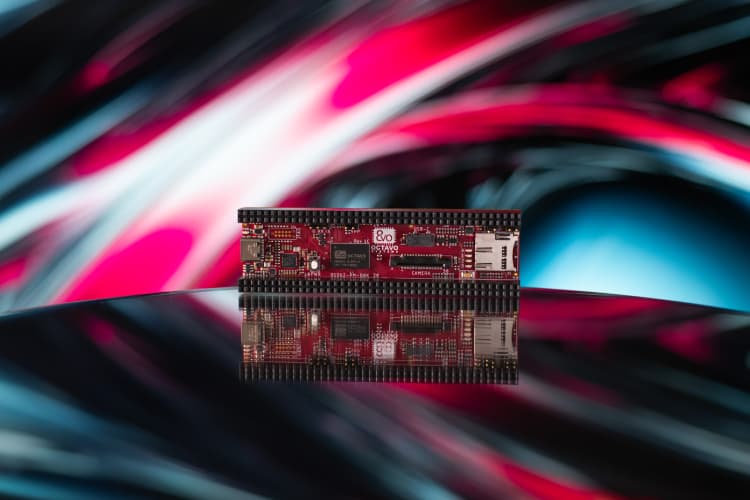
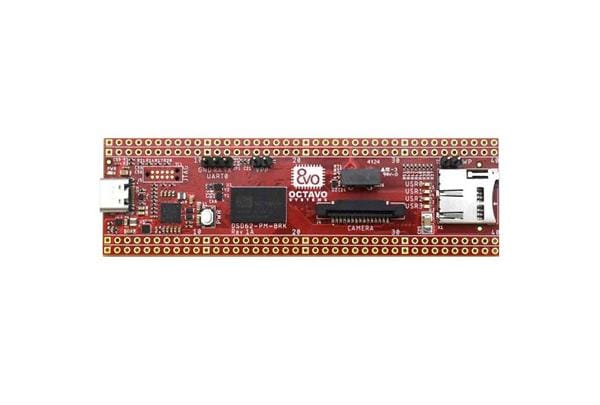
Compact and production-friendly, it provides direct access to every high-performance interface while keeping things easy to prototype and integrate.
| Feature | Details |
|---|---|
| Processor | Texas Instruments AM6254 – Quad ARM Cortex-A53 @ 1.4 GHz + Cortex-M4F |
| Onboard Memory | 1 GB DDR4 integrated inside the SiP |
| Power Management | TPS65219 PMIC, powered via USB-C |
| USB Ports | Dual USB-C (data + power) |
| Storage | microSD card slot, eMMC support |
| I/O Interfaces | Gigabit Ethernet, MIPI-CSI, USB 2.0, UART, SPI, I²C, PWM, CAN-FD, TSN, MCASP, eMMC, SDIO |
| Header Compatibility | MikroE Click boards |
| Board Dimensions | 4" × 1.2" (101.6 mm × 30.48 mm) |
| Resources | Open-source schematics, BOM, layout files, and Yocto Linux layers |
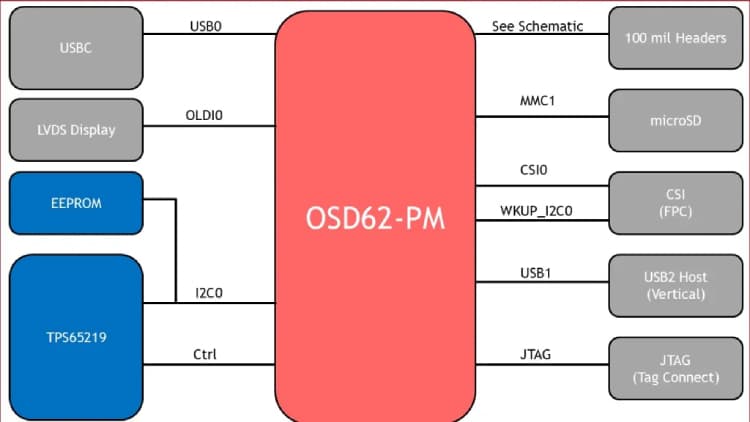
Block diagram of the OSD62-PM SiP showing key interfaces, onboard components, and peripheral connectivity.
Why Developers Should Care – Practical Advantages
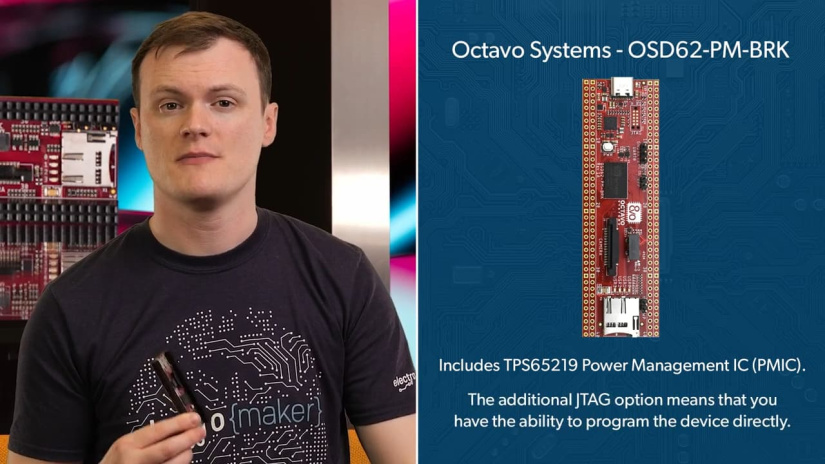
If you’ve ever spent days (or weeks) coaxing a new board to life, you’ll appreciate how quickly the OSD62-PM-BRK gets you from “unboxing” to “blinking LEDs.” With Linux support ready to go, including prebuilt Yocto images, bring-up is as close to plug-and-play as it gets in the embedded world.
Its compact footprint makes it a natural fit for projects where space is at a premium, whether that’s squeezing into a custom enclosure or embedding it in a piece of industrial equipment. Despite its size, it’s built for tough environments, rated to operate from −40 °C to +85 °C without breaking a sweat.
Need advanced graphics? The AM6254 processor at the heart of the SiP supports OpenGL ES 3.1 and Vulkan 1.2, making it ideal for smooth, responsive user interfaces. You can even drive dual displays for complex HMIs or data dashboards without tacking on extra graphics hardware.
For networking, the inclusion of CAN-FD and Time-Sensitive Networking (TSN) means you can build systems that communicate reliably and deterministically, perfect for robotics, automation, and other time-critical applications. Whether you treat it as a “microcontroller on steroids” or a compact Linux powerhouse, the OSD62-PM-BRK gives you a head start on turning ideas into working hardware.
Use Cases – Where the Board Excels
The OSD62-PM-BRK’s combination of high-performance processing, industrial-grade connectivity, and flexible development options makes it suitable for a wide range of applications. Here are three examples that show where it truly shines:
-
Industrial Control & HMI
Problem: Modern industrial environments demand real-time control, robust communication between devices, and operator interfaces that can present complex data without lag. Traditional PLCs or generic SBCs often require extra modules or compromise on speed and reliability.
Solution with OSD62-PM-BRK: With built-in Time-Sensitive Networking (TSN) and CAN-FD, this board enables deterministic communication between controllers and sensors. The ability to drive dual displays allows for sophisticated HMIs where operators can monitor data and control machinery simultaneously.
Why it’s better: Unlike a Raspberry Pi, which needs extra hardware for industrial-grade networking, the OSD62-PM-BRK integrates these features on day one, reducing complexity and ensuring reliability in harsh environments.
-
Custom Linux Boards
Problem: Off-the-shelf single-board computers often carry unnecessary components and software bloat, consuming more power and limiting optimization potential.
Solution with OSD62-PM-BRK: As a compact breakout for the OSD62x-PM SiP, it can run a streamlined Linux build tailored to your specific application. You get all the connectivity you need without the baggage of unused ports or drivers.
Why it’s better: Compared to generic SBCs, this board lets you strip away what you don’t need, making your system leaner, more efficient, and easier to maintain over the long term.
-
High-Performance Microcontroller Projects
Problem: Some applications need microcontroller-level responsiveness but with more processing power than typical MCUs can provide, such as precision measurement, high-speed data logging, or advanced robotics.
Solution with OSD62-PM-BRK: Even though it supports Linux, you can program the board in a bare-metal environment. This gives you the real-time responsiveness of a microcontroller combined with the computational muscle of a quad-core ARM processor.
Why it’s better: Traditional microcontrollers can’t match this board’s combination of speed, memory, and I/O capabilities. It’s like having a microcontroller on steroids, powerful, fast, and ready for demanding workloads.
Developer Experience
The OSD62-PM-BRK is built to help you get started quickly, whether your approach is software-first or hardware-first. Out of the box, you can boot into open-source Linux environments using the provided Yocto layers and prebuilt reference images, letting you focus on writing code and testing features instead of wrestling with board bring-up.
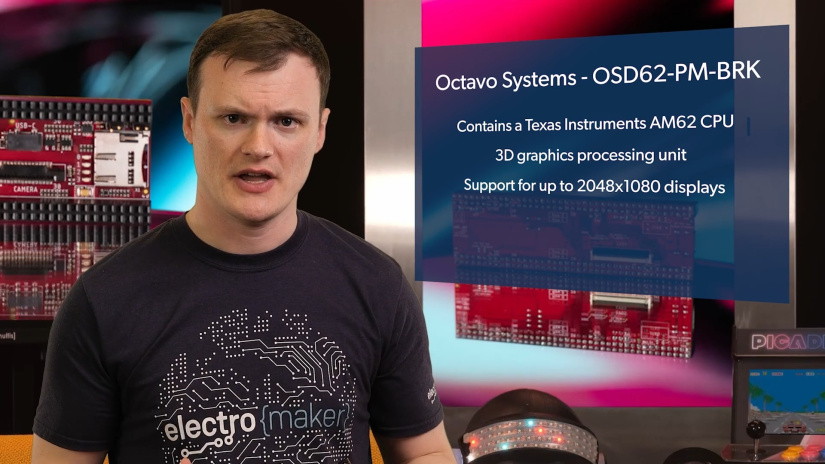
For those who prefer to start with hardware tinkering, breadboard-friendly adapters make it easy to integrate the board into existing prototypes without spinning a custom PCB. And if you want to get even closer to the metal, the JTAG header offers direct programming access for low-level development and debugging.
When your project is ready to move beyond prototyping, you’re not left guessing. Octavo Systems provides full open-source schematics, BOM, and layout files, making it straightforward to transition from proof-of-concept to production hardware. It’s a development experience designed to get you building faster, with fewer roadblocks between idea and finished product.
OSD62-PM-BRK - Final Thoughts
The OSD62-PM-BRK takes the impressive integration of the OSD62x-PM SiP and wraps it in a format that’s friendly, flexible, and ready for action. By removing the headaches of high-speed PCB design and putting industrial-grade processing power at your fingertips, it opens the door to projects that are both ambitious and achievable — whether you’re building a custom Linux device, a real-time industrial controller, or something entirely unexpected.
What would you create with it? We’d love to hear your ideas, share your concepts in the comments and join the conversation with other makers and engineers exploring what this compact powerhouse can do.
Make sure you subscribe to The Electromaker Show for similar content and subscribe to our monthly newsletter !

Residing on the south coast of England, Rich has spent the last few years building Electomaker.io from the ground up. He is usually found behind a laptop coordinating the rest of the EM team and occasionally finding time to contribute articles to the blog. When not tapping away at a laptop, he can be found either paddleboarding, at the beach, playing golf (badly), or camping with his family.






Leave your feedback...