


PicoScope Comparison: Which USB Oscilloscope Should You Buy?
PicoScope Comparison: Which USB Oscilloscope Should You Buy?
A microcontroller keeps resetting. A sensor output looks noisy. A serial bus works until another device switches on. Each problem calls for an oscilloscope, but not necessarily the same one. Start with a PicoScope 2000 for learning and basic electronics, a 3000E for faster embedded debugging, or a 5000E when small voltage changes matter alongside fast events.
A PicoScope combines measurement hardware with your computer. The instrument captures the signals, while software provides the display, controls and analysis. This Universal Serial Bus (USB) oscilloscope approach keeps the bench compact and makes saving waveforms straightforward.
The right choice comes down to signal speed, voltage detail, capture duration, input type and channel count. This PicoScope comparison explains the families offered through Electromaker, where their capabilities overlap, and which upgrades are worth considering for your projects.
PicoScope comparison at a glance
Series numbers are not a simple good, better, best ladder. A lower-bandwidth precision instrument can be more useful than a faster scope if your job is measuring a small analog signal. Family links below open a representative Electromaker model or kit.
| Family | Analog inputs | Bandwidth and hardware resolution | Strongest fit | Important limitation |
|---|---|---|---|---|
| 2000 | 2 or 4 | 10–100 MHz, 8-bit | Learning and compact troubleshooting | Entry A models have much smaller buffers than B models |
| 3000D | 2 or 4 | 50–200 MHz, 8-bit | General embedded development | Less sampling and memory headroom than 3000E |
| 3000E | 4 | 100–500 MHz in 8-bit mode, 10-bit operation with bandwidth limits up to 200 MHz | Faster signals and deep captures | Highest bandwidth and sampling rate are not available in every mode |
| 4000A | 2, 4 or 8 | Up to 20 MHz, 12-bit. Lowest ranges: 10 MHz | Several analog signals on one timebase | Not the choice for high-bandwidth digital edges |
| 4262 | 2 | 5 MHz, 16-bit | Lower-frequency, low-distortion analog work | Limited bandwidth and channel count |
| 4444 | 4 differential | Up to 20 MHz, probe-dependent. Selectable 12/14-bit, range-dependent | Differential signals and suitable power measurements | Probe selection determines the usable measurement setup |
| 5000D | 2 or 4 | 60–200 MHz, FlexRes 8–16-bit | Switching between speed and resolution | 16-bit mode limits bandwidth to 60 MHz and analog acquisition to one channel |
| 5000E, standard models | 4 | 60, 100 or 200 MHz, native 16-bit | Small analog detail and faster events | Sampling rate still changes with enabled inputs |
| 6000E | 4 or 8 | Model-specific bandwidth, 8-bit or FlexRes 8/10/12-bit | Specialist high-speed development | 12-bit mode supports at most two analog channels |
These are family distinctions, not a promise that every maximum operates simultaneously. Start with the 2000 range for everyday learning, compare 3000E and 5000E for a more capable development bench, and consider the precision families when their input design or extra channels solve a specific problem.
What matters when choosing a PicoScope?
Before choosing a model, write down what you need to see. A useful specification answers a measurement question, such as whether you can resolve an edge or capture an entire startup sequence.
Bandwidth: can the input preserve the signal?
Bandwidth describes the analog input response. The quoted limit is normally the frequency where a sine wave is already attenuated by about 3 dB. Digital signals contain faster edge detail than their repetition rate suggests. A scope that shows a pulse train may not reveal its overshoot accurately. Pico's bandwidth explanation is useful when sizing this margin.
Sample rate and memory: how much detail, for how long?
Sample rate tells you how often the scope records a value. MS/s means millions of samples per second, while GS/s means billions. Check the rate with your intended channels and resolution enabled.
Capture memory determines how many of those samples the instrument can retain. As an illustrative calculation, one channel recording 10 million samples at 100 MS/s covers 0.1 seconds. That assumes the full buffer is available to that channel. Shared memory, software limits and enabled digital inputs can change the result.
Block capture uses the scope's acquisition buffer. Continuous USB streaming transfers data to the computer under different limits. More computer storage does not make the scope's fastest single-shot capture unlimited. Pico's oscilloscope selection guide explains this relationship.
Resolution and channels: what information do you need?
Vertical resolution describes the available digitization levels. More hardware bits can help distinguish small voltage changes, but they do not automatically guarantee better accuracy. Input range, noise, bandwidth and probing still matter. Software resolution enhancement is not the same as a higher-resolution acquisition circuit.
Analog channels show voltage waveforms. Mixed-signal oscilloscope, or MSO, inputs add digital logic states. Use analog inputs to investigate ringing or a noisy supply. Use digital inputs when you need to track several control lines without using up your analog channels.
PicoScope 2000 Series: choosing your first scope
The 2000 Series is the natural starting point for learning waveform measurements, checking pulse-width modulation (PWM), and exploring modest-speed microcontroller circuits. The important choice is not simply 10 MHz versus 25 MHz. Capture memory changes substantially when you move to a B model.
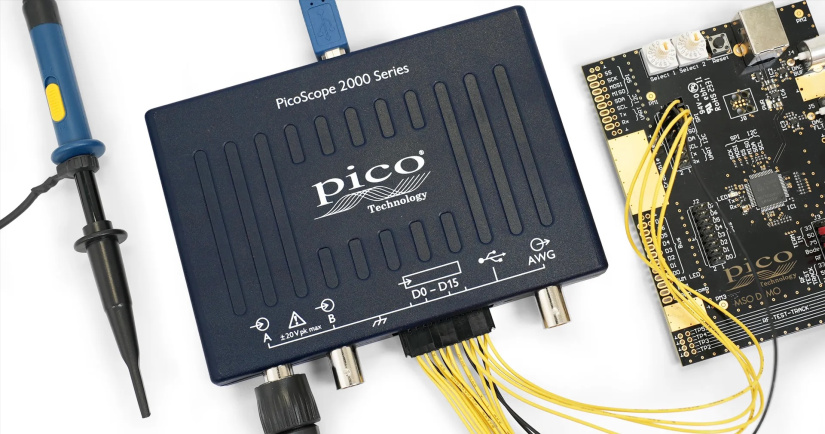
The table compares standard two-channel models, all with 8-bit hardware resolution. Their MSO counterparts have different acquisition specifications.
| Model | Bandwidth | Maximum real-time sampling | Shared block memory |
|---|---|---|---|
| 2204A with probes | 10 MHz | 100 MS/s with one channel, 50 MS/s per channel with both | 8 kS |
| 2205A with probes | 25 MHz | 200 MS/s with channel A alone, 100 MS/s per channel with both | 16 kS |
| 2206B | 50 MHz | 500 MS/s with one channel, 250 MS/s per channel with both | 32 MS |
Source: Pico's 2000 Series datasheet. Here, kS and MS describe thousands and millions of samples, not bytes.
The 2204A suits short captures of basic circuits. The 2205A adds bandwidth and sampling headroom while keeping the same compact approach. Neither has the deep buffer of the 2206B. If you want to record a longer event and then zoom into individual pulses, the B model deserves a closer look.
Channel count is a separate decision. A PicoScope 2406B provides four analog inputs for comparing a supply, reset line and two other signals. Two-channel MSO variants instead add 16 digital inputs. The standard 2000 Series uses USB 2.0, even when plugged into a USB 3 port.
For a walkthrough of the smaller model, see our PicoScope 2205A setup and practical projects guide.
PicoScope 3000D vs 3000E for embedded development
Choose a 3000E when faster acquisition and longer detailed captures solve a problem your entry scope cannot handle. A 3000D remains worth comparing when its bandwidth, memory and input count already meet your requirements.
The 3000D family provides 8-bit acquisition, two or four analog channels, and bandwidths from 50 to 200 MHz. MSO versions add 16 digital inputs. The family's maximum real-time sample rate is 1 GS/s, with configuration-dependent sharing.
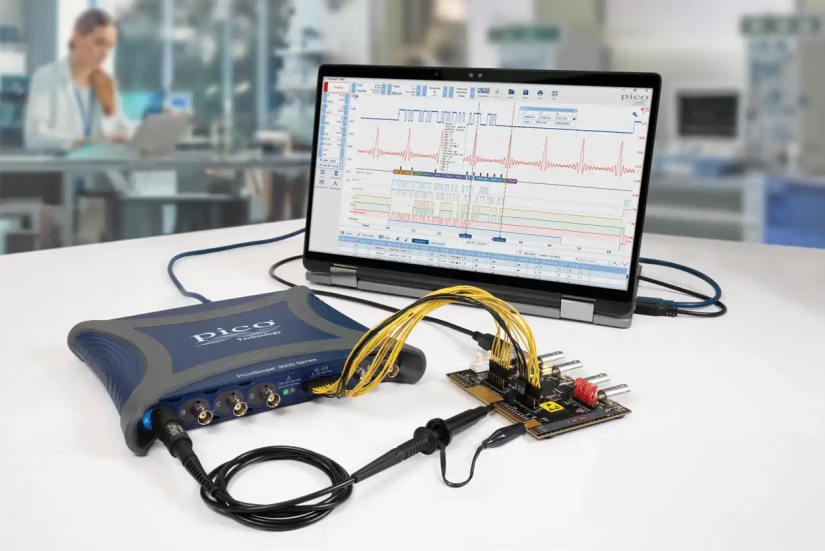
The 3000E moves to four analog channels, 8/10-bit operation and deeper memory. Consider the 100 MHz PicoScope 3415E with probes, or the 200 MHz PicoScope 3416E MSO with probes if you also need digital connections.
Read the 3000E specification table alongside the headline figures. The 5 GS/s maximum uses one analog channel in 8-bit mode. Four analog channels reach 1.25 GS/s each at 8 bits or 625 MS/s each at 10 bits, with digital ports disabled. Memory is shared, with up to 2 GS in 8-bit mode or 1 GS at 10 bits. Enabling digital ports changes resource sharing.
For an intermittent communications fault, that extra capture depth can help you keep the surrounding activity, then inspect the event. An MSO lets you watch control lines alongside analog supply behavior.
PicoScope 4000A, 4262 and 4444: three different precision jobs
These instruments address different measurement needs. Choose between them by channel count, analog performance and input design, rather than treating them as three versions of the same scope.
4000A: several analog signals at once
The 4000A family combines up to 20 MHz bandwidth, 12-bit hardware resolution and 256 MS of shared capture memory. Bandwidth drops to 10 MHz on its two smallest input ranges. Its two-, four- and eight-channel options suit measurements where several signals need to be compared over time.
The eight-input PicoScope 4824A is worth considering for multiple sensor outputs, control voltages or power-up sequencing. Eight analog inputs tell you more about voltage shape than eight logic channels. The trade-off is bandwidth. Extra inputs do not make this a fast-edge specialist.
4262: lower-frequency analog detail
The two-channel PicoScope 4262 with probes takes a different approach: 16-bit resolution and 5 MHz bandwidth, with a design focused on low noise and distortion.
That makes it a candidate for audio circuits, vibration signals and suitable sensor front ends. For example, comparing a filter's input and output is a different job from inspecting a fast processor clock. Pico's 4262 overview explains the analog emphasis. Do not choose it simply because 16 bits sounds better than 12.
4444: differential inputs and the right probes
The PicoScope 4444 Standard Kit centers on four differential inputs. The scope measures the voltage between two input connections, useful for balanced signals or a bridge sensor without treating one measurement point as an ordinary scope ground.
The instrument offers selectable 12/14-bit acquisition. Its bandwidth depends on the connection: 20 MHz with D9-to-BNC adapters, 15 MHz with PicoConnect 441 probes, or 10 MHz with PicoConnect 442 probes. Differential inputs are not a blanket promise of galvanic isolation or unlimited common-mode voltage. Follow the specified differential, common-mode and accessory limits.
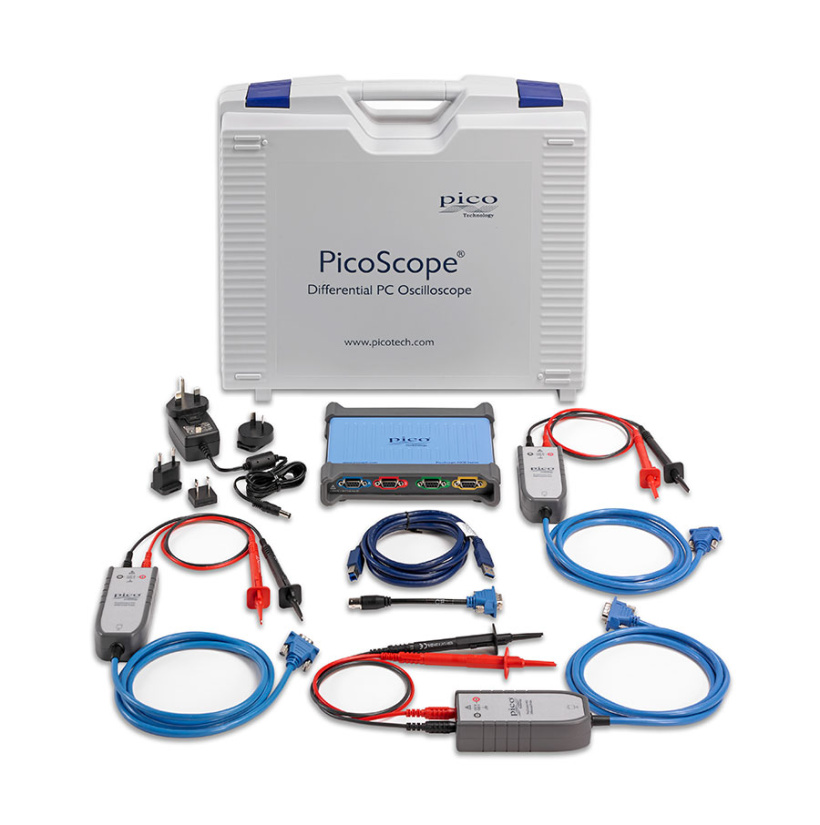 A dedicated 4444 high-voltage kit, not the Standard Kit. Rated probes are essential. Image: Pico Technology.
Pico's 1000 V CAT III measurement setup uses suitable PicoConnect 442 probes. That rating does not transfer to the bare scope or low-voltage probes. High-voltage work requires appropriate training and a correctly rated complete setup. Never disconnect protective earth or float ordinary equipment to attempt a measurement.
PicoScope 5000D vs 5000E: FlexRes or native 16-bit?
The key distinction is resolution at the speed and channel count you actually need. The 5000D changes its hardware configuration through FlexRes. Standard 5000E models provide native 16-bit acquisition across four analog channels.
A PicoScope 5444D MSO offers four analog channels and digital inputs, with selectable hardware resolution from 8 to 16 bits. However, 5000D specifications limit 16-bit operation to one analog channel at 62.5 MS/s and 60 MHz bandwidth. Hardware resolution also falls on the smallest input ranges. You cannot combine its 200 MHz headline bandwidth with 16-bit acquisition on four analog channels.
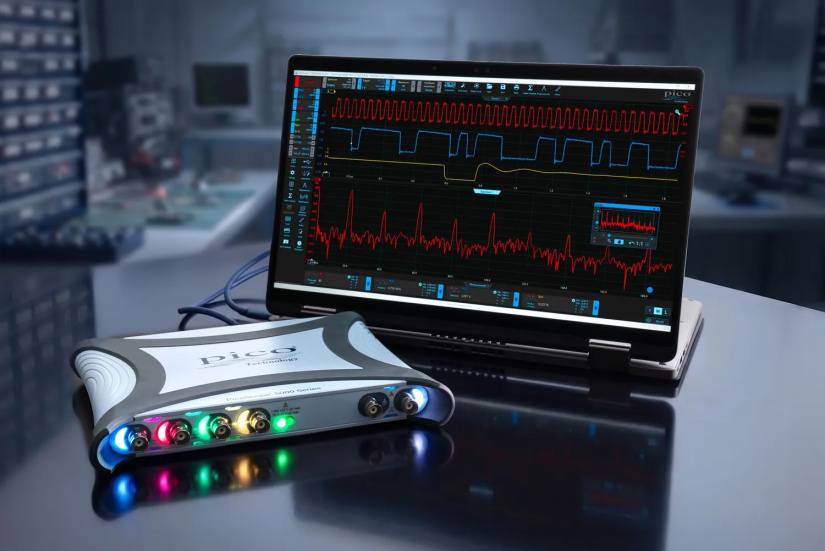
Standard 5000E models retain 16-bit acquisition across four analog channels. Image: Pico Technology.
Standard 5000E choices are the 60 MHz 5462E, 100 MHz 5463E and 200 MHz 5464E. The PicoScope 5464E full kit with probes is the higher-bandwidth example. These scopes reach 2.5 GS/s with one analog channel, 1.25 GS/s with two, or 625 MS/s per channel with three or four. Those figures assume digital ports are disabled. The 1 GS capture memory is shared between enabled inputs.
This makes 5000E worth evaluating for small sensor changes or supply ripple alongside faster transients. Choose 5000D when its available resolution modes and acquisition limits already suit the work. Do not assume that a familiar model's nominal bit count makes the two generations equivalent.
Pico's current 5000E page also covers E+ models. Their high-speed 8-bit modes, 500 MHz maximum bandwidth and larger 8-bit buffer are not specifications of an ordinary 5464E.
PicoScope 3000E vs 5000E: speed or small signal detail?
Compare these families when both fall within your budget. A 3000E prioritizes faster 8-bit acquisition, with higher-bandwidth models reaching 500 MHz. Standard 5000E prioritizes 16-bit acquisition, with models up to 200 MHz. Choose around the signal you need to investigate, then check the actual sample rate with every required input enabled.
When do you need a PicoScope 6000E or sampling scope?
The 6000E range makes sense when bandwidth, deep capture memory or simultaneous high-speed inputs become a defined engineering requirement. It is not the default upgrade for learning Arduino electronics.
The PicoScope 6426E kit illustrates the step up, but its 1 GHz bandwidth applies to 50-ohm inputs. The 1-megohm input bandwidth is 500 MHz. FlexRes models offer 8-, 10- and 12-bit settings, with 12-bit acquisition limited to two analog channels. Compatible MSO pods are separate accessories unless the exact package includes them.
The specialist 6428E-D is different again, with 50-ohm-only inputs and restricted voltage ranges. Check the 6000E model-specific specifications, not just the family headline.
Also distinguish the 9402-05 sampler-extended real-time oscilloscope, or SXRTO. Its 5 GHz input bandwidth does not mean 5 GS/s single-shot acquisition. Pico specifies 500 MS/s real-time sampling and much higher equivalent-time sampling for repetitive signals. It uses PicoSample 4, rather than the ordinary PicoScope 7 workflow. Treat it as a specialist instrument, not a general-purpose buying recommendation.
Why do PicoScope prices vary so much?
You are paying for more than the largest MHz figure. The acquisition hardware, analog front end, resolution at useful speeds, capture memory and number of inputs all affect what an instrument can measure.
A precision scope may cost more than a faster entry model because it addresses a different problem. Similarly, four differential inputs or eight analog inputs add capabilities that a two-channel scope cannot replace through software.
Package labels also matter:
- Scope only: check which cables, supply and adapters are included. Do not assume probes are supplied.
- With probes or full kit: check the exact probe models, quantity, bandwidth and voltage ratings.
- MSO: verify the digital-input hardware and whether its cable and test clips are included.
- D2: in the listed 2204A-D2 and 2205A-D2 packages, this identifies the versions without probes.
- +CERT: a calibration-service option, not an upgrade to acquisition performance.
Include your host computer, USB connection, power requirements and probing accessories in the budget. USB-C describes a connector, not a guarantee that a port supplies everything the instrument needs.
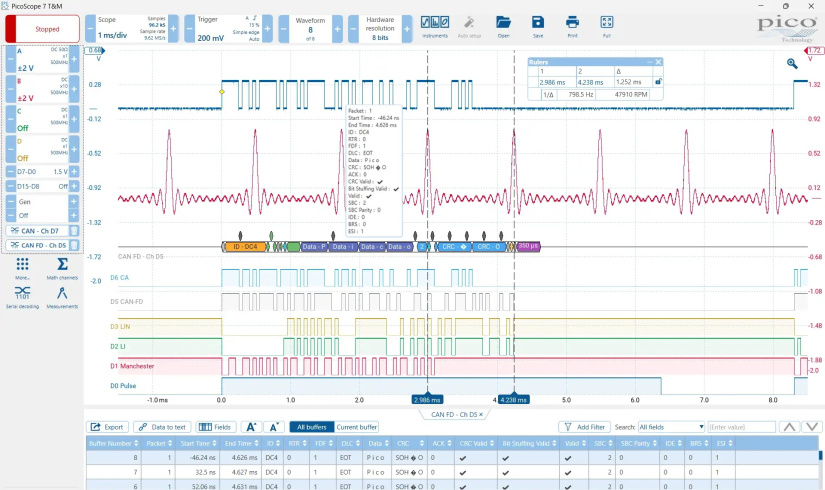
PicoScope 7 provides shared analysis features such as math, serial decoding and fast Fourier transform (FFT) spectrum views. These are not exclusive reasons to buy the most expensive family. An FFT view also does not turn a scope into a dedicated radio-frequency spectrum analyzer.
Which PicoScope fits your project?
Use your hardest required measurement to build a shortlist, then compare the complete packages.
- Learning and basic Arduino or Raspberry Pi circuits: consider 2204A or 2205A for short captures. Look at 2206B when deeper records matter.
- Embedded buses and mixed-signal debugging: compare 3000D and 3000E MSO configurations. Keep enough analog inputs free for the electrical behavior behind a logic error.
- Audio, sensors and power-supply ripple: evaluate 4262 for lower-frequency analog work, or 5000E when higher bandwidth and four-channel 16-bit acquisition are useful.
- Multiple simultaneous analog signals: consider 4000A, particularly 4824A, when eight inputs matter more than high bandwidth.
- Differential or suitable power measurements: consider 4444 with probes rated for the exact task. Do not substitute a low-voltage kit for a mains-rated setup.
- High-speed engineering: evaluate a specific 6000E configuration after defining bandwidth, input impedance, resolution and simultaneous channels.
Frequently asked questions
These details are worth checking before you settle on a model or kit.
What is the difference between PicoScope 2204A and 2205A?
The standard 2205A increases bandwidth from 10 to 25 MHz, doubles shared block memory from 8 to 16 kS, and raises maximum single-channel sampling from 100 to 200 MS/s. Both retain two analog channels and 8-bit hardware resolution.
When is a 2206B worth the upgrade?
Consider it when you need more capture depth as well as bandwidth. Its 32 MS block buffer provides much more room for recording an event and zooming afterward than the entry A models. Check your required duration and sample rate together.
Do I need MSO to decode I2C, SPI or UART?
No. Compatible analog inputs can decode Inter-Integrated Circuit (I2C), Serial Peripheral Interface (SPI) and Universal Asynchronous Receiver/Transmitter (UART) signals. MSO adds logic channels when several connections would otherwise consume your analog inputs. You still need suitable bandwidth, sampling and voltage thresholds.
Is higher bandwidth always better?
No. It matters when you need faster waveform detail, but higher bandwidth does not replace resolution, capture memory or the right inputs. Compare noise using the same measurement bandwidth and setup rather than unrelated headline figures.
Are PicoScope inputs isolated?
Do not assume so. Ordinary ground-referenced inputs, differential inputs and galvanic isolation are different things. USB powering or a battery-powered laptop does not establish isolation. Check the instrument manual and complete probe setup before connecting to an unfamiliar circuit.
What changes between PicoScope 5000D and 5000E?
5000D uses switchable FlexRes modes with speed and channel trade-offs. Standard 5000E provides native 16-bit acquisition across four analog inputs at substantially higher sample rates than 5000D's 16-bit mode. E+ specifications belong to separate models.
Can I use a PicoScope with a Mac, Linux or Raspberry Pi host?
PicoScope 7 supports Windows, macOS and Linux, with native ARM64 support for compatible devices. Not every scope is supported by that ARM64 release. The 4262 is specifically excluded. For a Raspberry Pi host, verify the exact device, OS architecture and available package through Pico's downloads selector. Measuring a Pi's signals does not require running the scope software on the Pi itself.
Do all PicoScope kits include probes?
No. Scope-only and no-probe packages exist alongside probe kits and MSO bundles. Compare the exact part number and contents. A photograph showing accessories is not proof that every item is included.
Choose around the measurement you need to make
List the signals you need to see, how long you need to record them, and how many must be captured together. Then explore the Electromaker PicoScope range and compare the relevant models, probes and packages. The useful upgrade is the one that lets you answer your next measurement question.

Residing on the south coast of England, Rich has spent the last few years building Electomaker.io from the ground up. He is usually found behind a laptop coordinating the rest of the EM team and occasionally finding time to contribute articles to the blog. When not tapping away at a laptop, he can be found either paddleboarding, at the beach, playing golf (badly), or camping with his family.








Leave your feedback...