





Particle Tachyon: A Supercharged Edge AI Single Board Computer
Hardware innovation rarely slows down, but every so often a product appears that does more than just follow the trend. While most single-board computers evolve through incremental upgrades, a few are designed to challenge what we expect from compact hardware altogether. The Particle Tachyon sits firmly in that second category.
At first glance, it may appear to be just another SBC, but that assumption does not last long. This is not a board built to tinker at the edges of possibility or stretch consumer hardware a little further than intended. It is a platform designed from the outset for serious edge computing, where connectivity, local intelligence, and real-world deployment matter more than hobbyist convenience.
Tell us in the YouTube comments what you would build with this board for a chance to win. Best comment wins. Winner announced soon.
Where many familiar boards focus on being affordable general-purpose computers, the Particle Tachyon takes a very different path. It is unapologetically powerful, unapologetically connected, and clearly aimed at engineers and developers who need far more than a lightweight Linux box.
What Is the Particle Tachyon?
The Particle Tachyon is an edge single board computer designed to bring serious computing power, AI acceleration, and mobile connectivity into a compact, deployable form. Rather than targeting general-purpose computing or desktop-style workloads, it is built specifically for environments where data is generated, processed, and acted upon at the edge, close to the source.
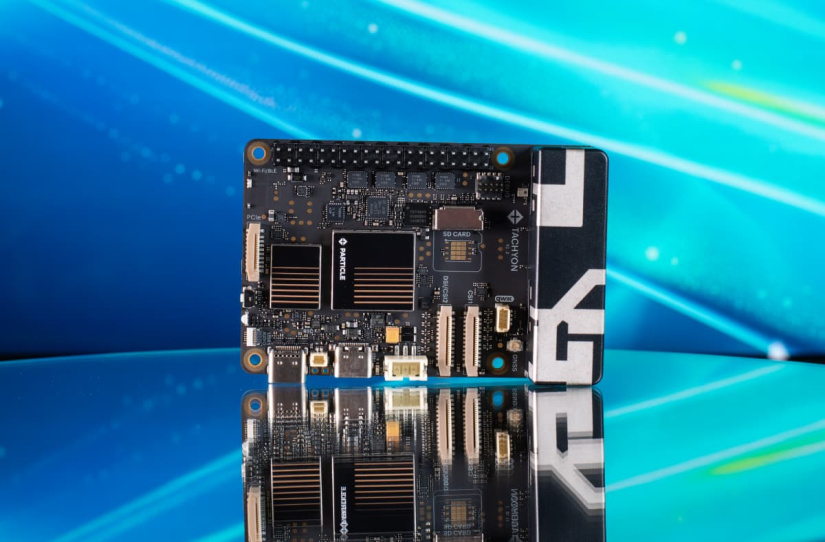
As an edge AI and IoT platform, the Tachyon is designed to run full operating systems while also supporting local AI inference workloads. In practical terms, edge AI means analysing data such as images, video, or sensor input directly on the device, without relying on constant cloud access. This approach reduces latency, improves reliability, and allows systems to continue operating even when network connectivity is limited or unavailable.
The result is a platform that sits between traditional embedded systems and cloud infrastructure. It offers the flexibility of modern software, the performance needed for real-time decision making, and the connectivity required for deployment in the field, making it well suited to advanced IoT, automation, and intelligent edge applications.
Why the Particle Tachyon Is Not Just Another SBC
Most single board computers are designed to be broadly useful, affordable, and approachable. That makes them excellent learning tools and capable general-purpose machines, but it also places clear limits on performance, connectivity, and how far they can be pushed in real-world deployments. When workloads move beyond basic processing and into AI, vision, or always-connected systems, those limits appear very quickly.
The Particle Tachyon takes a different approach. Instead of spreading resources thinly to serve as a lightweight desktop replacement, it concentrates its capabilities into a dense, purpose-built platform. High-performance processing, dedicated AI acceleration, and advanced wireless connectivity are treated as core features rather than optional extras.
You could think of it as what happens when an edge-focused engineer looks at familiar SBC designs and decides they are simply not enough. The result is a board that feels less like a general computing experiment and more like a serious piece of edge infrastructure, designed to handle demanding workloads without compromise.
Core Hardware Architecture and Performance
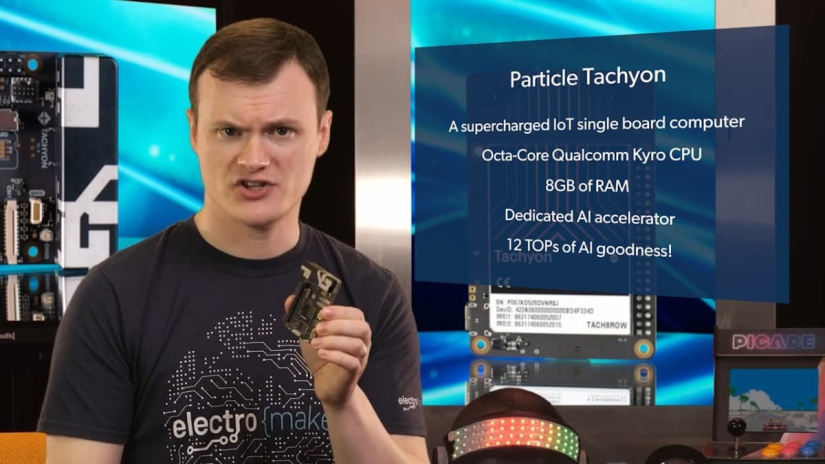
At the heart of the Particle Tachyon is a hardware platform designed to handle workloads that would overwhelm most compact systems. Every major component has been selected to support high-performance edge computing, balancing raw processing power with efficient AI acceleration and fast local storage.
- Processor: Octa-core Qualcomm CPU with tiered clock speeds up to 2.7 GHz, allowing performance and efficiency cores to handle different workloads effectively
- Memory: 8 GB of RAM, providing the headroom needed for operating systems, AI models, and concurrent edge applications
- Storage: 128 GB of built-in UFS storage, offering faster data access and greater reliability than typical removable media
- AI acceleration: Dedicated AI accelerator capable of up to 12 TOPS, enabling real-time inference for vision and machine learning tasks
- Graphics and AI processing: Integrated GPU supporting accelerated AI workloads and image processing at the edge
AI Acceleration and Edge Intelligence
The defining strength of the Particle Tachyon lies in its ability to perform local AI inference directly on the device. Its dedicated AI accelerator allows complex tasks such as image processing, object detection, and pattern recognition to run in real time without relying on remote servers. This capability is especially valuable in edge environments where latency, bandwidth, or connectivity constraints make cloud-based processing impractical.
While it is not intended to replace data centre-scale infrastructure, the Tachyon is capable of running modern AI models at the edge, including compact language and vision models tailored for inference rather than training. By processing data locally and sending only results or insights upstream, systems built on the Tachyon can respond faster, operate more reliably, and reduce both operational costs and data exposure.
Connectivity That Matches the Compute Power
High-performance edge computing only makes sense if the system can stay reliably connected. The Particle Tachyon is designed for deployment beyond the lab, with wireless capabilities that support real-world, always-on operation in mobile and distributed environments.
- 5G Sub-6 cellular connectivity for high-speed, low-latency data transfer in locations where wired networking is impractical
- Wi-Fi 6E support for faster throughput, lower congestion, and improved performance in dense network environments
- Always-on networking that allows edge systems to remain connected for monitoring, updates, and data exchange without constant user intervention
Cameras, Displays, and Expansion
The Particle Tachyon is built to interface directly with the physical world, supporting a wide range of input, output, and expansion options without turning the board into a maze of connectors. Its I/O design reflects its role as an edge AI platform, with particular attention given to vision workloads, high-speed peripherals, and flexible hardware integration.
- Dual CSI camera lanes enabling connection of multiple cameras for computer vision and image processing applications
- USB-C connectors providing USB 3.1 data transfer alongside DisplayPort support for external displays
- PCIe lanes available for high-speed expansion and custom hardware integration
- 40-pin GPIO header offering compatibility with many Raspberry Pi HAT-style accessories for prototyping and I/O expansion
Security and System Integrity
Security is a core consideration in edge deployments, especially when systems process sensitive data or operate outside controlled environments. The Particle Tachyon integrates hardware-backed security features that support encrypted boot and encrypted file systems, helping ensure that both the operating system and stored data remain protected. By enabling secure, local processing of information such as video, audio, or sensor data, the platform reduces reliance on transmitting raw data to external servers, making it well suited to enterprise, industrial, and privacy-sensitive edge AI workflows.
What Can You Actually Build With the Particle Tachyon?
The Particle Tachyon is designed for projects where performance, connectivity, and real-time intelligence are non-negotiable. Its combination of local AI processing and robust I/O makes it suitable for applications that go well beyond experimentation and into deployment-ready systems.
- Edge computer vision systems for tasks such as object detection, recognition, and spatial analysis using camera inputs
- Smart security and monitoring platforms that analyse data locally while maintaining constant connectivity
- Privacy-sensitive AI applications where raw data is processed on-device and only results are transmitted
- Autonomous robotics and machinery requiring low-latency decision making and direct hardware control
- Industrial and warehouse systems for automation, tracking, and real-time operational intelligence
Why Local AI Processing Matters
Processing data locally at the edge fundamentally changes how systems handle sensitive information. By analysing inputs such as video, audio, or sensor data on the device itself, the Particle Tachyon reduces the need to stream large volumes of raw data to remote servers. This approach lowers exposure risk, minimises bandwidth usage, and allows systems to continue operating even when connectivity is limited or intermittent.
Instead of transmitting raw content, edge AI systems can send structured results, alerts, or metadata, which is far less sensitive and easier to secure. Combined with encrypted boot, protected file systems, and reliable wireless connectivity, this model supports secure, low-latency deployments that are better suited to real-world environments than cloud-dependent architectures.
Built for Serious Edge AI, Not Just Experiments
The Particle Tachyon is what happens when edge computing is treated as a serious engineering challenge rather than a side project. Its dense combination of processing power, AI acceleration, and high-speed connectivity reflects a design that prioritises real-world performance over convenience or cost cutting. This is a platform built for developers and engineers who need dependable, low-latency intelligence at the edge, whether that means deploying autonomous systems, processing vision data in real time, or running complex workloads far from the cloud. It is ambitious in capability, but practical in execution, designed to be used rather than admired.

Quick Specifications Recap
| Specification | Details |
|---|---|
| Processor | Octa-core Qualcomm CPU |
| Memory | 8 GB RAM |
| Storage | 128 GB UFS onboard storage |
| AI acceleration | Dedicated AI accelerator up to 12 TOPS |
| Wireless connectivity | 5G Sub-6 cellular, Wi-Fi 6E |
| Camera support | Dual CSI camera lanes |
| Expansion | PCIe lanes, 40-pin GPIO header |
| USB and display | USB-C with USB 3.1 and DisplayPort |
| Security | Encrypted boot and encrypted file system |
Final Thoughts
The Particle Tachyon stands apart by focusing squarely on what modern edge systems actually need. It combines high-performance computing, dedicated AI acceleration, and reliable connectivity in a form factor that is built for deployment rather than experimentation. By enabling local intelligence, secure processing, and real-time response, it offers a practical foundation for advanced edge AI and IoT applications. This is not a board designed to stretch hobby hardware to its limits, it is a platform designed from the ground up to operate confidently at the edge.

Alex is a skilled journalist specializing in electronics and technology, with a passion for exploring emerging trends and innovations. With years of experience, he brings insightful analysis and industry knowledge, covering the latest developments in consumer electronics, AI, and tech advancements.











Leave your feedback...