





Rp2350 Gpio Expansion Card For Framework Laptops
About the project
Framework Expansion Card based on RP2350 providing GPIO to mainboards (OSHWA UID: IT000024)
Project info
Difficulty: Moderate
Platforms: Raspberry Pi, KiCad
Estimated time: 1 hour
License: Creative Commons Attribution CC BY version 4.0 or later (CC BY 4+)
Items used in this project
Hand tools and fabrication machines

Story
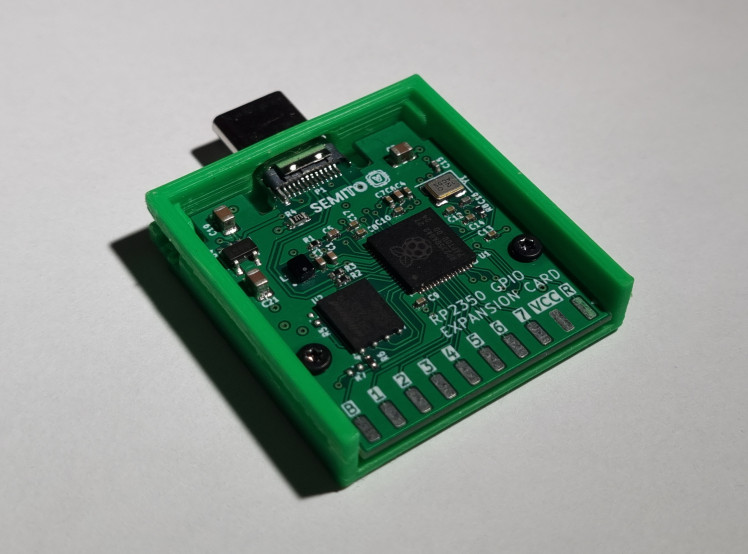
Expansion Card circuit based on RP2350 for Framework mainboards providing GPIO to the computer. Circuit is based on Expansion Card template and RP2350A Minimal board. Designed in KiCad.
Circuit is based on Expansion Card template and RP2350A Minimal board. Expansion Card outline is modified to be more square and TYPE-C footprint is changed house XUNPU TYPEC-950-ARP24 instead of MOLEX to make it easier to do v-cut and produce/assemble. It has 16MB flash memory and crystal clock that can be overclocked up to 250MHz. It has 20 reachable 2.54mm SMD pin pads which makes it easy to solder regular THT maker-friendly headers and cables horizzontally. The design is fully functional. Its tested and it works as intended.
Gallery
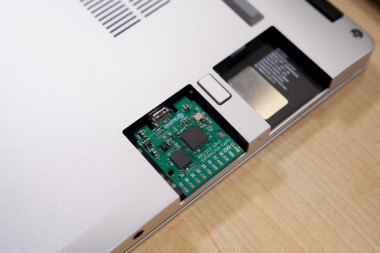
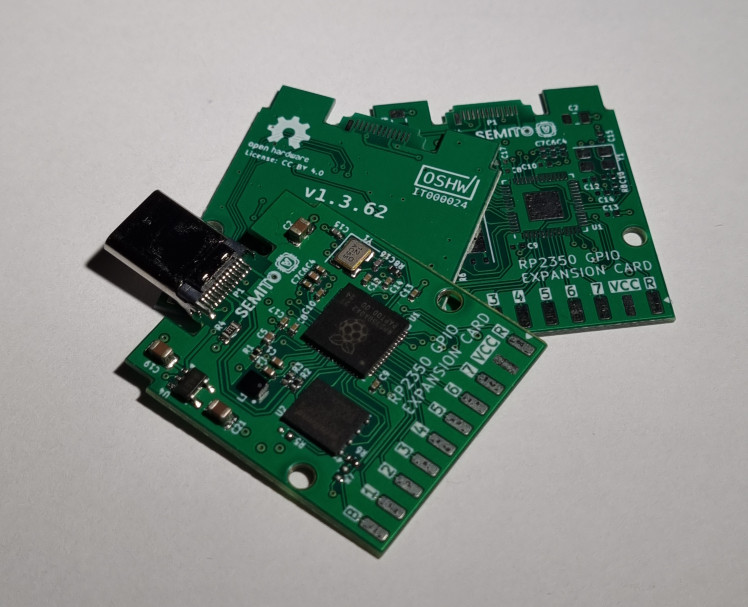
- Real photos of card with TYPEC-950-ARP24 produced by NextPCB
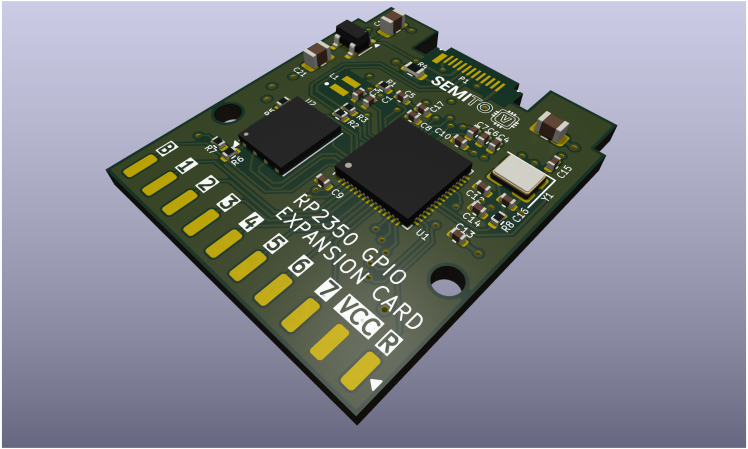
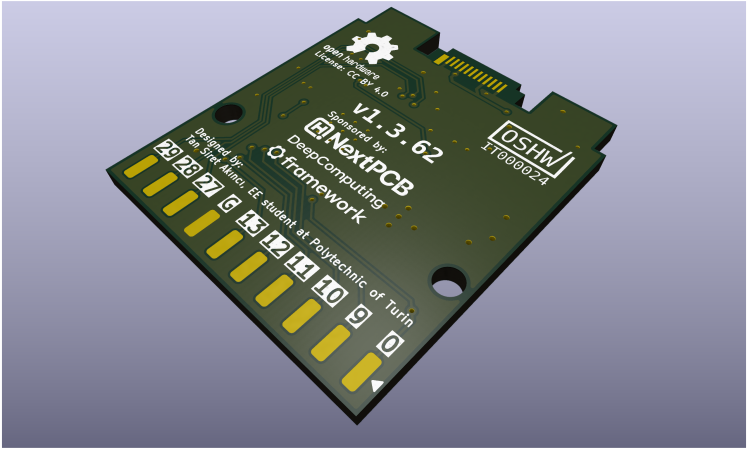
- Render of card with TYPEC-950-ARP24 (Framework template redesigned for that model of TYPE-C)
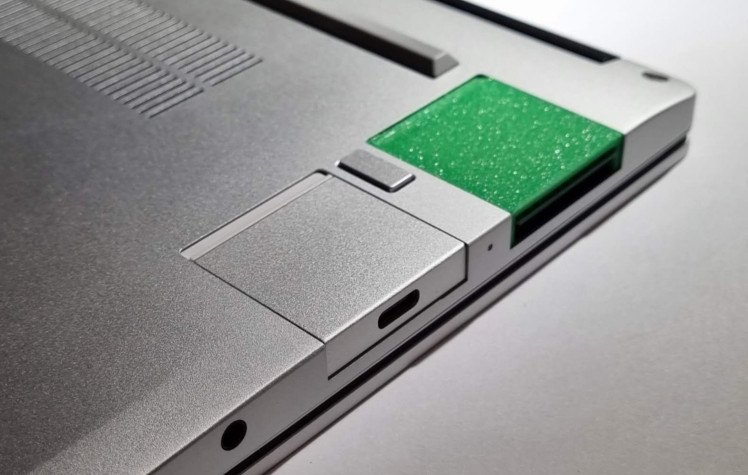
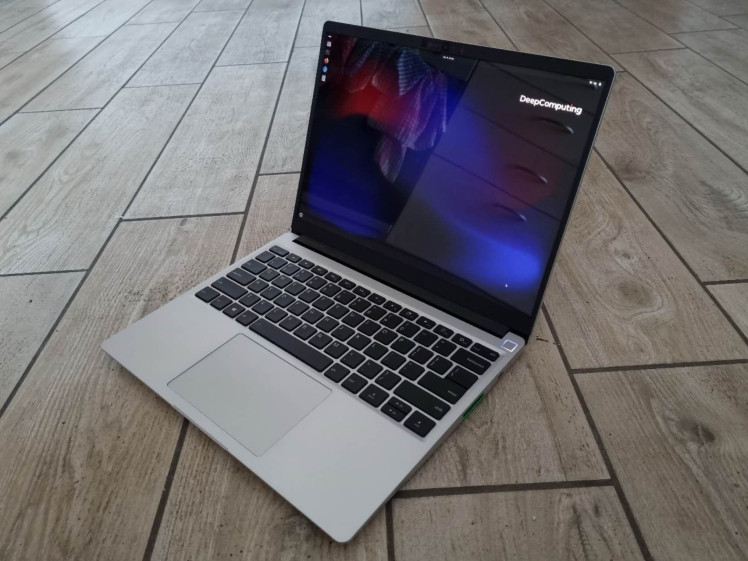
- Real photos of card in 3D case and inside Framework
 Materials Required
Here is the full list of materials:
1 × RP2350A0A2
1 × XUNPU TYPEC-950-ARP24
4 × Capacitor (CL05A475MP5NNNC)
9 × Capacitor (CL05B104KOSNNNC)
2 × Capacitor (CL05C150JB5NNNC)
3 × Capacitor (CL21A106KAYNNNE)
1 × Inductor (AOTA-B201610SSR3-101-T)
1 × 16MB IC Flash Memory (W250128JVPlQ)
1 × 3.3V Linear Voltage Regulator Diode (AP2127K-3.3TRG1)
1 × Crystal Oscillator (ABM8-272-T3)
1 × Resistor (RC0402FR-0733RL)
2 × Resistor (RC0402FR-0727RL)
1 × Resistor (0603WAF5101T5E)
1 × Zero-Ohm Link/Resistor (0402WGF0000TCE)
1 × Resistor (0402WGF1001TCE)
1 × PCB board
1 × Electronic Components / Misc. Electronic Components
1 × Any 2.54mm Pin Headers (optional, anything to fill 10x2 pins)
1 × Framework Computer (optional)
Hardware
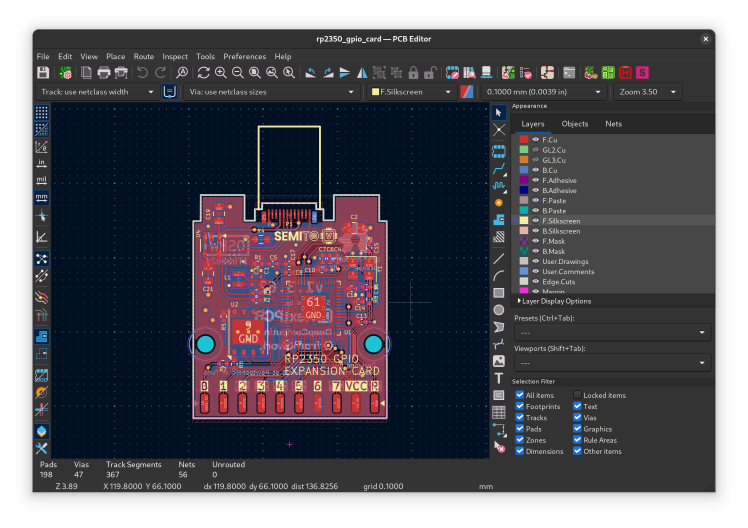
PCB is designed in KiCad. All of the source files are available in our GitHub repo and KiCadProjects website! You can get the board produced fairly in any PCB manufacturer and assembler as I have simplified the expansion card layout to fit most manufacturers' most basic production capabilities to get it done for cheaper. We have got the boards produced and assembled at NextPCB which turned out great. They have sponsored it as this is a non profit school project/prototype. Their engineers have helped us with issues and suggestions during production process, and they have shipped it very fast when we contacted them that its needed urgently for Maker Faire Rome 2025.
The PCB is made specifically for Framework laptops that have hot-swappable components and expansion card slots for designs like ours, but in practice it works with any device (even phones) that has TYPE-C port and supports UART.
Software
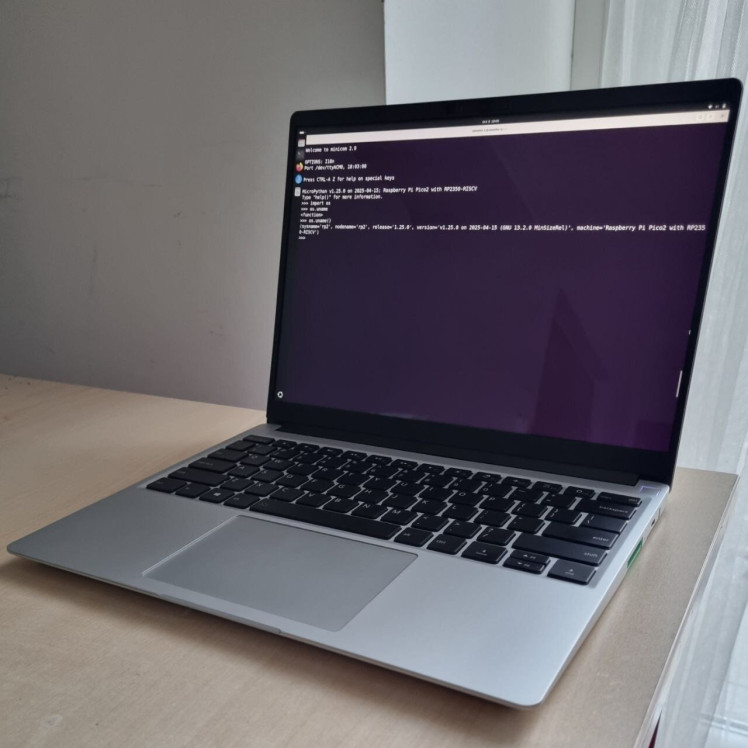
Any firmware written for Raspberry Pi Pico 2 just works! We have a library for PC Python called MCL, which allows you to write Micropython code within regular PC Python and use the card as a GPIO expansion if you also install Micropython firmware to the card as well.
We have primarily tested it on DeepComputing's DC-ROMA RISC-V Mainboards and it works pretty well once default Ubuntu distro build is unminimized and cdc_acm is compiled as a module in kernel.
Credits
Designed by: Tan Siret AKINCI.
Schematics and footprint are licensed with CC BY 4.0.
Politecnico di Torino name used in this project is © 2025 Politecnico di Torino. The project is sponsored by © 2025 DeepComputing and © 2025 NextPCB.
The project has been certified by OSHWA as Open Source Hardware (UID: IT000024).
Schematics, diagrams and documents
CAD, enclosures and custom parts
Credits
Related products





Leave your feedback...