





Cellular IoT 2025–2026: Best Dev Kits for Reliable Connectivity

The Internet of Things now spans everything from smart meters and industrial sensors to asset trackers, wearables, and environmental monitors. Yet despite major advances in embedded systems, one challenge continues to dominate: keeping devices reliably connected at scale. As deployments grow more diverse and geographically spread out, the limitations of traditional connectivity options become increasingly clear.
The Fragmented Connectivity Landscape
Most IoT projects start with familiar tools. Wi-Fi works well indoors, but step outside and its weaknesses appear quickly: limited range, interference sensitivity, and a lack of wide-area coverage.
Bluetooth helps for peripherals and wearables, but depends on smartphones or gateways to reach the internet. In unattended deployments, that dependency becomes a point of failure.
LoRa and other LPWANs offer excellent range with low energy use, but relying on regional networks, proprietary gateways, or inconsistent global coverage introduces new constraints. Roaming varies by country, and long-term reliability often depends on third-party infrastructure.
The result is a fragmented landscape where each technology solves part of the problem, but none delivers universal coverage, mobility, and resilience. For large-scale deployments that span cities or continents, these gaps introduce real operational and maintenance risks.
What Cellular IoT Actually Solves
Cellular IoT changes this dynamic. Technologies such as LTE-M and NB-IoT, and soon reduced capability 5G (RedCap), extend the reach and reliability of mobile networks to embedded devices. Instead of relying on local gateways, devices connect anywhere covered by licensed cellular networks, often nationwide and increasingly global.
With seamless mobility, operator-grade uptime, and proven infrastructure, cellular shifts the burden away from building custom networks and toward refining application logic, power strategy, and scale. For devices that need wide-area, low-maintenance connectivity, it’s becoming the natural foundation.
This is where modern cellular IoT development kits come in: giving engineers hands-on tools to evaluate real-world performance and build hardware that’s genuinely deployment-ready.
Watch the full breakdown of modern cellular IoT dev kits.
Must-Haves for Next-Generation Cellular IoT Devices
Designing a modern cellular IoT device is no longer just a matter of selecting a modem and attaching an antenna. As networks evolve, security expectations rise, and global deployments become the norm, the requirements for next-generation hardware have shifted dramatically. Below, we break down the essentials every engineer should consider when architecting a future-proof connected product.
Future-Proof Network Support
The global phase-out of 2G and 3G is well underway, meaning products launched today must be designed with long-term network compatibility in mind. Modern cellular IoT relies on three core technologies:
- LTE-M – Excellent balance of power efficiency, mobility, and coverage.
- NB-IoT – Ultra-low power consumption, deep indoor penetration, and low-bandwidth optimisation.
- 5G RedCap – The upcoming reduced capability profile of 5G designed specifically for IoT.
Any “future-proof cellular IoT hardware” should ideally support at least LTE-M and NB-IoT today, with a roadmap toward RedCap as networks expand. Building on outdated network standards risks premature obsolescence and costly redesigns.
Integrated GNSS and Location Services
Location awareness is now a core requirement across many IoT verticals. Whether you’re building fleet trackers, logistics sensors, micromobility systems, or cold-chain monitors, integrated GNSS/GPS is no longer a luxury—it’s an expected standard.
Onboard GNSS reduces the need for additional hardware, simplifies PCB design, and ensures your device can determine its position accurately without external dependencies. As asset-tracking markets continue to grow, integrated location support has become one of the strongest differentiators in modern modem and SoC selection.
Power Efficiency and Battery Life
The vast majority of IoT devices run on batteries, often deployed in remote locations and expected to operate for years at a time. That makes power management one of the most critical design factors. Features to look for include:
- Deep sleep modes with ultra-low current draw
- Efficient wake-up and reconnection behaviour
- Optimised data transmission and paging cycles
- Modem architectures designed for low-power LTE-M and NB-IoT
Every milliamp-hour counts when you’re targeting multi-year operation. Low power IoT design principles must be considered from the hardware block diagram to the cellular firmware itself.
Cost, Scale, and Total Cost of Ownership
When your deployment involves tens of thousands of devices, decisions that seem small at the prototype stage can have massive financial impact later. Engineers need to think not just in terms of BOM cost, but in terms of total cost of ownership (TCO)—including energy usage, maintenance, and long-term support.
Efficient networking reduces data costs. Lower power consumption means fewer battery replacements. And well-supported chipsets reduce development cycles and time-to-market. The best cellular IoT designs strike the balance between performance, scalability, and long-term affordability.
Security and Supply Chain Considerations
With billions of connected devices now online, security is non-negotiable. Modern cellular IoT solutions must implement:
- Encrypted communication
- Secure boot to prevent firmware tampering
- OTA firmware updates for long-term security patching
Beyond cybersecurity, supply chain stability has become a major factor. International regulations and geopolitical tensions have already led to restrictions—and in some cases outright bans—on hardware sourced from certain regions. Choosing a reputable silicon partner with transparent manufacturing, proven reliability, and long-term availability is now a strategic requirement, not just a procurement detail.
This backdrop sets the stage for why platforms such as Nordic Semiconductor’s cellular IoT solutions are so highly regarded—combining trusted supply chains with low-power performance and global network support. In the next section, we’ll explore the kits and modules shaping the future of cellular-connected products.
Top Cellular IoT Dev Kits and Modules: Quick Comparison
With so many LTE-M, NB-IoT, and hybrid cellular modules available, choosing the right platform can significantly influence your development speed, power budget, and long-term scalability. Below is a high-level comparison of the most relevant cellular IoT development kits featured in this guide, giving you a fast way to compare capabilities before diving into the detailed profiles that follow.
| Product | Best Use Case | Cellular / Wireless | GNSS | MCU / Resources | Cloud / Ecosystem | Difficulty Level | Buy Now |
|---|---|---|---|---|---|---|---|
| Nordic nRF9151 DK | Full-scale IoT products, asset tracking, ultra-low power deployments | LTE-M, NB-IoT, DECT NR+ | Integrated GNSS | ARM Cortex-M33 @ 64 MHz, 1 MB Flash, 256 KB RAM | Nordic nRF Connect SDK, global certifications | Intermediate–Advanced | Buy → |
| Blues Wireless Notecard (Cellular + Wi-Fi) | Rapid prototyping, easy cloud routing, low-code IoT | LTE-M / NB-IoT + Wi-Fi | Integrated GPS | External MCU required (M.2 module) | Notehub.io cloud pipeline | Beginner | Buy → |
| Particle M404 (M-Series SOM) | Programmable IoT deployments with multi-radio connectivity | LTE-M, 2G, Wi-Fi, Bluetooth | Integrated GNSS | Realtek RTL8722DM, Cortex-M33 @ 200 MHz, 16 MB Flash, 4.5 MB RAM | Particle Cloud, OTA, fleet tools | Intermediate | Buy → |
| AVR IoT Cellular Mini | Beginner IoT, education, simple prototypes | LTE (GM02S) with bundled SIM/data | No GNSS | AVR128DB48, 8-bit MCU, Crypto chip, Temp sensor | Arduino IDE, Microchip cloud tools | Beginner | Buy → |
| MikroE LTE IoT 15 Click | Adding cellular to existing Click/MikroBUS projects | LTE-M, NB-IoT (u-blox UBX-R2) | No GNSS | Depends on host MCU (Click add-on module) | MikroE libraries & examples | Intermediate | Buy → |
This table provides a quick snapshot of each platform’s capabilities—ideal for identifying which dev kit matches your power needs, network requirements, or deployment scale. In the next section, we’ll dive deeper into the strengths, limitations, and ideal use cases for each module.
Detailed Cellular IoT Dev Kit Profiles
With so many connectivity modules and development boards available, choosing the right platform means looking far beyond raw modem specs. Power budgets, GNSS integration, security features, certification coverage, and long-term vendor support all influence whether a device will actually succeed at scale. Below, we break down the top development kits using a consistent, engineering-focused format to help you match hardware capabilities to real-world IoT needs.
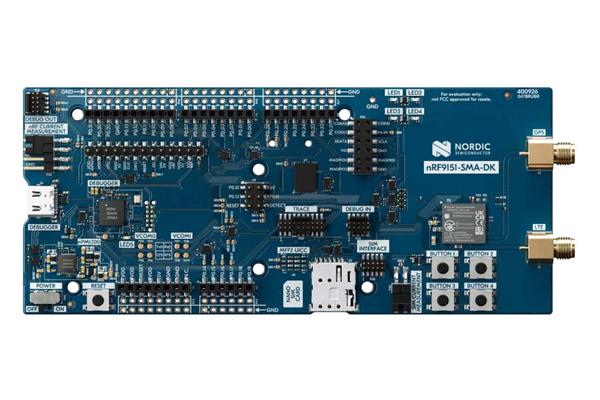
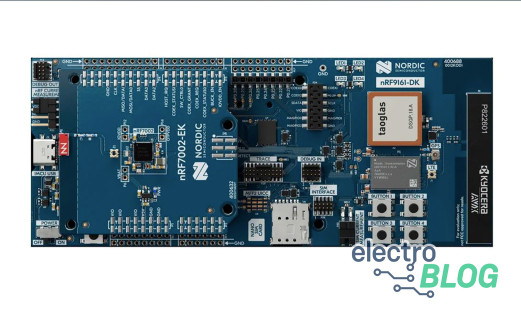
Nordic nRF9151 DK – The Benchmark Cellular IoT Dev Kit

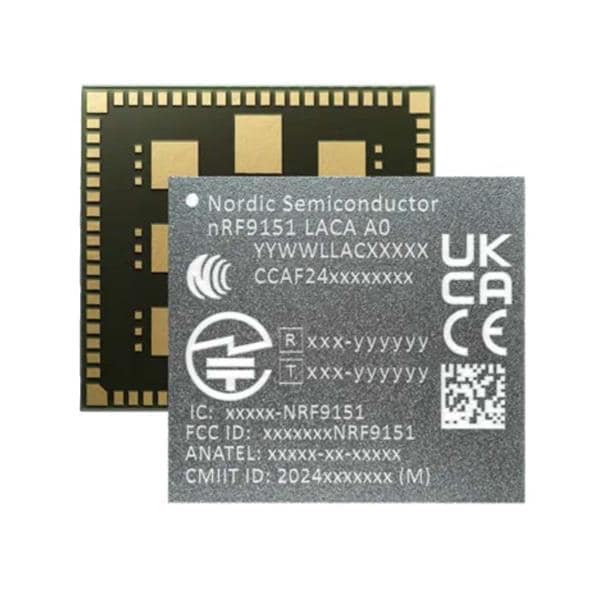
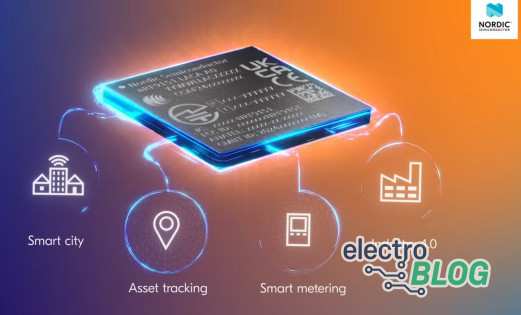
What it is: A multi-mode cellular IoT development kit built around Nordic’s nRF9151 system-on-chip. It’s designed for production-ready LTE-M, NB-IoT, and DECT NR+ devices, making it a top choice for asset tracking, industrial sensing, and long-term remote monitoring.
Connectivity & Bands:
- LTE-M and NB-IoT support
- Integrated DECT NR+ modem for emerging non-cellular NR+ networks
- 700–2200 MHz LTE coverage + 1.9 GHz NR+ bands
- Fully certified for global operation (EU / US / Asia)
Location & Power:
- Built-in GNSS receiver (no external IC required)
- Ideal for trackers, logistics, and mobility devices
- Ultra-low-power design aligned with Nordic’s long-standing reputation
Compute Resources:
- ARM Cortex-M33 @ 64 MHz
- 1 MB Flash, 256 KB RAM
- Enough capacity for real applications while maintaining minimal power draw
Why it stands out: Few platforms combine multi-mode cellular, GNSS, efficient power management, and a modern MCU in one cohesive package. Nordic’s SDKs, documentation, and long-term support ecosystem make this the benchmark dev kit for next-generation IoT designs.

Blues Wireless Notecard – Connectivity-First LTE-M + Wi-Fi Module
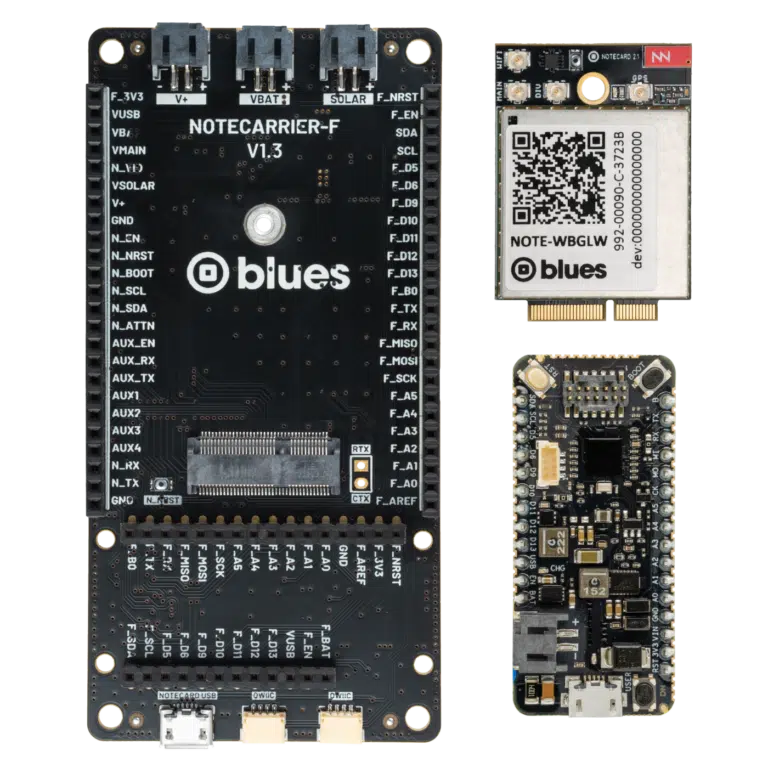
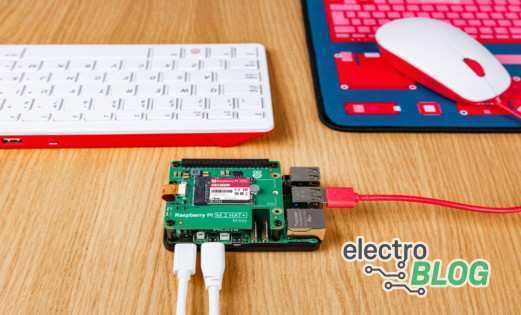
What it is: A communication-focused module combining cellular, Wi-Fi, and GNSS into a ready-to-deploy M.2 card. Built for rapid prototyping and deployment where RF design, antenna tuning, and cloud routing need to “just work.”
Integrated Features:
- LTE-M cellular modem + Wi-Fi radio
- Built-in GNSS for location-aware applications
- Data included out of the box (connectivity bundled)
Hardware Design: Uses an M.2 key format, allowing developers to drop the module into existing carrier boards, easily swap versions, and avoid the complexity of RF layout and antenna matching.
Cloud Workflow: Fully integrated with Notehub.io, a routing pipeline for securely moving IoT data into major cloud platforms or custom servers. JSON-based, developer-friendly, and ideal for remote ingestion.
Limitations:
- Not a standalone MCU – requires an external microcontroller over I²C or serial
- M.2 slot must be part of the hardware design
Best for: Teams wanting plug-and-play connectivity where cellular, Wi-Fi, and cloud routing are fully abstracted away.
Particle M404 – Programmable LTE-M + Wi-Fi + GNSS IoT SOM

What it is: A fully programmable cellular IoT SOM combining LTE-M, 2G fallback, Wi-Fi, Bluetooth, and GNSS into a single module. Built for engineers who want application logic and connectivity on one device.
Connectivity Stack:
- LTE-M + 2G cellular
- Wi-Fi 802.11 a/b/g/n (2.4 & 5 GHz)
- Bluetooth for local communication
- GNSS for positioning
Compute Resources:
- Realtek RTL8722DM (ARM Cortex-M33 @ 200 MHz)
- 16 MB Flash, 4.5 MB RAM
- Significant headroom for compute-heavy IoT applications
Programmability & Ecosystem: Runs user applications directly and integrates with the Particle Cloud for OTA updates, fleet management, and secure provisioning. A strong fit for large-scale deployments.
Hardware Notes: Requires a carrier board for power regulation, connectors, and GPIO breakout. Particle offers official development and evaluation boards for rapid prototyping.
AVR IoT Cellular Mini – Beginner-Friendly LTE-M Development Board
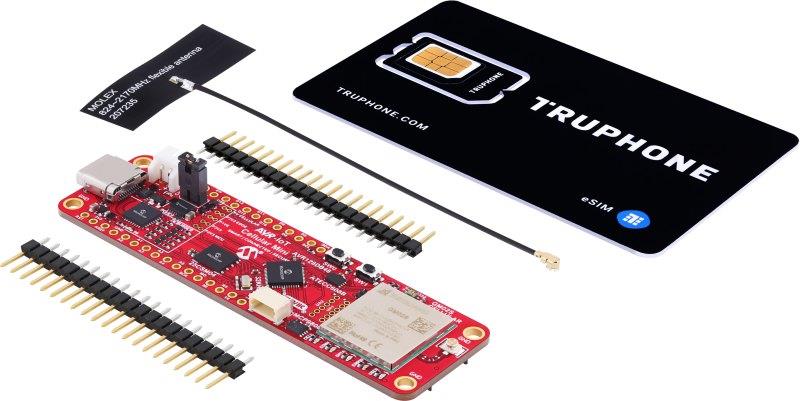
Overview: A compact, low-cost board built around the AVR128DB48 MCU. Designed to make cellular IoT accessible to students, hobbyists, and engineers who want to prototype quickly without complex setup.
Security & Connectivity:
- ATECC608B crypto co-processor for secure authentication
- GM2S cellular modem (824–2170 MHz)
- Includes prepaid SIM data for instant connectivity
Onboard Features:
- Multiple LEDs for debugging
- MCP9808 temperature sensor
- Qwiic/Quick connector for plug-in expansions
- Li-ion/LiPo charger (MCP73830)
Developer Experience: 100% Arduino compatible with dedicated cellular libraries, making it a great entry point for cellular learning or rapid POC builds.
Limitations: No GNSS support and limited 8-bit MCU resources make it unsuitable for heavy processing or long-term industrial deployments.
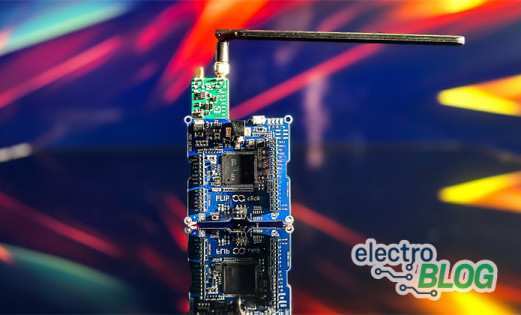
MikroE LTE IoT 15 Click – LTE-M & NB-IoT for Click Ecosystem
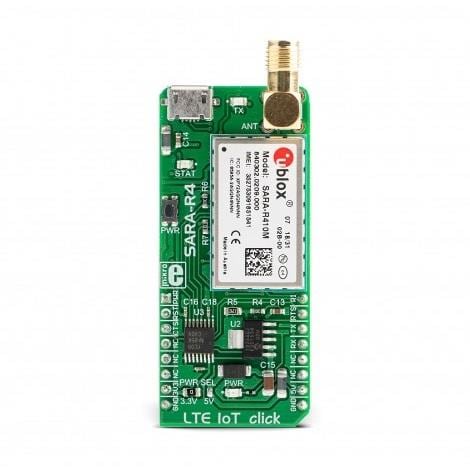
What it is: A plug-and-play LTE-M/NB-IoT add-on module for the MikroElektronika Click ecosystem. Designed to drop cellular connectivity directly into existing Click-based projects.
Hardware & Connectivity:
- u-blox UBX-R5 modem
- LTE-M + NB-IoT
- Supports OTA firmware updates
Click Ecosystem Advantages:
- Extensive driver libraries and examples
- Instant integration with hundreds of Click MCU boards
- Easy to reuse across multiple prototypes
Use Cases: Great for adding cellular IoT to existing designs, quick evaluation of LPWAN technologies, and modular prototyping workflows.
Limitations: Not a standalone solution, no GNSS, and the Click form factor is less suitable for compact final products.
Side-by-Side Takeaways: Which Cellular IoT Platform Should You Pick?
Now that we’ve broken down each platform in detail, it’s worth stepping back and looking at what these development kits actually offer in practice. Cellular IoT can mean very different things depending on whether you’re building battery-powered trackers, industrial hardware, educational tools, or scalable connected products. Below is a clear, engineering-focused summary to help you match the right hardware to the right job.
Why the nRF9151 DK Leads the Pack
When it comes to a balance of power efficiency, global deployment, and long-term reliability, the Nordic nRF9151 DK stands out as the most complete solution in 2025. It combines multi-mode cellular (LTE-M, NB-IoT, DECT NR+) with built-in GNSS, a modern ARM Cortex-M33 core, and global certifications, all from a vendor known for stable supply chains and excellent developer tooling.
For engineers building future-proof asset trackers, industrial sensors, or remote monitoring hardware, this is the strongest all-round choice.
When to Choose Particle M404
The Particle M404 shines when your application needs more than connectivity. With LTE-M, 2G fallback, Wi-Fi, Bluetooth, and GNSS in one module, plus a powerful Cortex-M33 @ 200 MHz and unusually large flash/RAM, it’s built for projects where application logic, cloud communication, and OTA management all run on a single device.
If you want a SOM that handles your firmware + your connectivity + your fleet updates inside one consistent ecosystem, the M404 is the right call.
When Blues Wireless Notecard Makes More Sense
The Blues Wireless Notecard is the best option when you already have a microcontroller and just want to bolt on connectivity without worrying about RF design, modem configuration, SIM selection, or network routing. It bundles cellular + Wi-Fi + GNSS + cloud ingestion (Notehub.io) into a single M.2 card with data included.
If your priority is “connect this MCU to the cloud with the least amount of work”, Notecard wins easily.
Where AVR IoT Cellular Mini Fits
The AVR IoT Cellular Mini is built for education, experimentation, and early proof-of-concept work. It’s Arduino-friendly, beginner-friendly, comes with a prepaid SIM, and includes sensors plus a secure element on board.
If you’re teaching cellular IoT, running workshops, or building a quick demo, this is the lowest-friction entry point.
Ideal Use Cases for MikroE LTE IoT 15 Click
The MikroE LTE IoT 15 Click board is perfect for teams already invested in the MikroElektronika Click ecosystem. It’s a drop-in way to add LTE-M or NB-IoT to existing Click-based projects without redesigning hardware or dealing with complex libraries.
If your workflow revolves around Click boards, this is the logical cellular add-on.
Best-For Summary Table
| Requirement | Recommended Platform |
|---|---|
| Global, long-term asset tracking | Nordic nRF9151 DK |
| Fully programmable SOM with LTE-M, Wi-Fi, Bluetooth, GNSS | Particle M404 |
| Easiest path to connectivity + cloud pipeline | Blues Wireless Notecard |
| Low-cost, Arduino-ready cellular learning | AVR IoT Cellular Mini |
| Drop-in cellular for existing Click projects | MikroE LTE IoT 15 Click |
Designing Cellular IoT for 2026 and Beyond
Building a connected product today means planning for a world where networks, regulations, and hardware expectations evolve quickly. The best cellular IoT devices aren’t just functional on day one, they’re designed to stay reliable, secure, and efficient for years. As we move through 2025 and into 2026, there are several guiding principles every engineer should keep in mind.
Plan for Future-Proof Network Support
The sunset of 2G and 3G is well underway globally, and LTE-M and NB-IoT remain the foundational technologies for low-power cellular IoT. But new standards are rising fast. 5G RedCap offers reduced-complexity 5G for IoT-class devices, while DECT NR+ introduces a non-cellular alternative with long-range, low-power capabilities. Designing hardware with an upgrade path or choosing a module that supports emerging standards is essential for long deployments.
Integrate GNSS Early (Even If You Don’t “Need” It Yet)
Location is becoming a default requirement across industries. Whether it’s asset tracking, safety, fleet management, or simply knowing where a remote sensor was installed, onboard GNSS saves cost and redesign effort later. If there’s even a small chance a future version of your product will need location services, choose a module with GNSS today.
Make OTA and Security Non-Negotiable
Your device will live in the field for years, potentially in large fleets. That means:
- Secure boot
- Encrypted communication
- Regular OTA firmware updates
These shouldn’t be “add-ons”. They are fundamental requirements for a world where threats evolve as fast as networks do.
Choose Vendors With Stable Supply Chains and Real Ecosystems
As global regulations tighten and sourcing scrutiny increases, vendor provenance matters. Look for partners with:
- Long-term availability commitments
- Strong documentation and SDK support
- Transparent supply chains
This is a major reason why platforms like the Nordic nRF9151 DK stand out as modern reference designs, and why modular, ecosystem-driven solutions (Particle, Blues Wireless, MikroE Click) help reduce project and sourcing risk during early development.
Your Next Steps
If you’d like a deeper dive into all the dev kits discussed in this guide, you can watch the complete Behind the Tech episode below:
Have a project in mind? Share it with the Electromaker community, ask questions, or get feedback from developers building the next generation of connected devices. The future of cellular IoT is just getting started, and we’re excited to see what you build with it.

Matt Walker is a key contributor at Electromaker. With extensive experience in digital marketing, he crafts high-impact strategies that boost visibility for tech brands. His campaigns help businesses stay ahead in the fast-moving world of electronics and embedded systems.












Leave your feedback...