





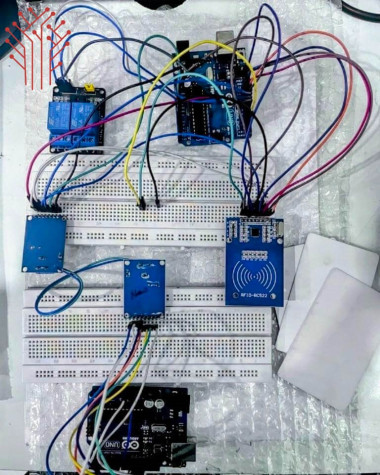
Smart Security System Using Arduino, Rfid & Pir Sensor

Made by chanchaldada / IoT
About the project
In this project, I'll show how I built a Smart Security System using Arduino, RFID, and a PIR sensor.
Project info
Items used in this project
Hardware components



View all
Story
In every public place like home, malls, offices and small and big businesses they all have basic needs which is security. With an Arduino, an RFID reader, and a PIR motion sensor, it's possible to build a reliable and affordable smart security solution that allows authorized access while detecting unauthorized movement.
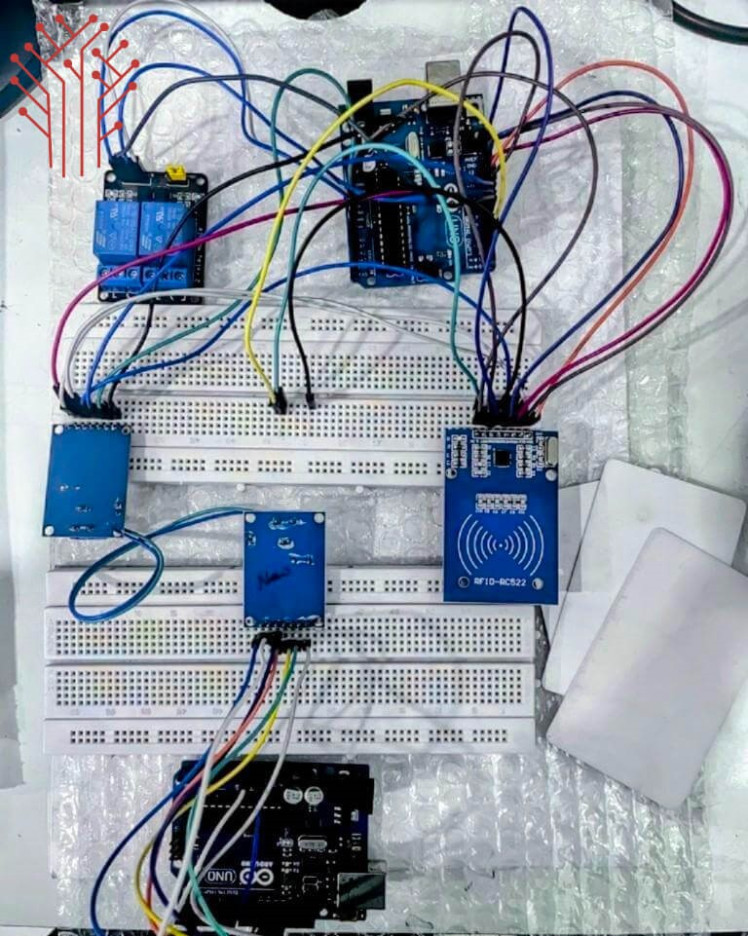
In this project, I'll show how I built a Smart Security System using Arduino, RFID, and a PIR sensor. The system verifies users through RFID cards and continuously monitors the protected area for motion. When unauthorized movement is detected, the system immediately activates an alarm, making it suitable for homes, laboratories, server rooms, offices, and workshops.
Project Features RFID-based secure access control PIR motion detection for intruder monitoring Buzzer alarm for unauthorized movement LED status indicators Low-cost and easy to build Expandable for IoT and cloud monitoring Suitable for residential and commercial applications
How the System Works
The Arduino continuously waits for an RFID card to be presented to the RC522 reader.
When a registered RFID card is scanned:
The green LED turns ON.
Access is granted.
Motion monitoring is temporarily disabled for the authorized user.
If an unregistered card is detected:
The red LED lights up.
The buzzer sounds.
Access is denied.
After the system returns to monitoring mode, the PIR sensor continuously checks for movement. If motion is detected without prior authorization, the Arduino immediately triggers the alarm, warning nearby users of a possible intrusion.
This dual-layer authentication makes the system more secure than a standalone RFID or motion detection project.
Wiring Overview
RC522 RFID Module
SDA → D10
SCK → D13
MOSI → D11
MISO → D12
RST → D9
3.3V → 3.3V
GND → GND
PIR Sensor
VCC → 5V
OUT → D2
GND → GND
Buzzer
Positive → D8
Negative → GND
LEDs
Green LED
Positive → D6
Negative → GND through 220Ω resistor
Red LED
Positive → D7
Negative → GND through 220Ω resistor
Arduino ProgramThe firmware performs three primary tasks:
Read RFID card UID.
Compare it against stored authorized IDs.
Monitor the PIR sensor and activate the alarm whenever unauthorized motion is detected.
Power the Arduino.
Scan a registered RFID card.
Verify that the green LED turns ON.
Scan an unauthorized card.
Confirm the red LED and buzzer activate.
Leave the system armed.
Walk in front of the PIR sensor.
The buzzer should immediately trigger, indicating successful motion detection.
Possible ImprovementsESP32 Wi-Fi connectivity
Mobile app notifications
Email alerts
SMS notifications
Fingerprint authentication
Face recognition
Camera integration
Cloud dashboard
Event logging using SD card
Smart lock control
Home Security
Office Access Control
Server Rooms
Research Laboratories
Warehouses
Smart Buildings
Educational Institutes
Maker Projects
Industrial Equipment Protection
The code is modular, making it easy to add multiple RFID cards or integrate Wi-Fi, GSM, or cloud notifications in future upgrades.
Testing the ProjectAfter uploading the program:
This project can be expanded with several advanced features:
Arduino provides an excellent platform for rapid prototyping because of its extensive library support and beginner-friendly development environment. Combined with RFID authentication and PIR motion sensing, it becomes a powerful solution for developing practical embedded security applications.
Organizations looking to build customized embedded products often choose to hire arduino programmer professionals who can design secure hardware, develop optimized firmware, and integrate additional communication technologies such as Wi-Fi, Bluetooth, GSM, or LoRa.
Final ThoughtsThis Smart Security System demonstrates how simple electronic components can be combined to create an effective access control and intrusion detection solution. By integrating RFID authentication with PIR-based motion sensing, the project provides both convenience and security while remaining affordable and easy to customize.
Whether you're learning embedded systems, building a prototype, or developing a commercial security solution, this project offers a strong foundation that can easily evolve into a complete IoT-enabled security platform.
Schematics, diagrams and documents
Credits
chanchaldada
Chanchal Dada is an IoT developer at DigitalMonk, focused on building smart embedded systems using Arduino and ESP32. She specializes in IoT-based automation, smart monitoring solutions, and real-world hardware-software integration for practical applications.
Related products





Leave your feedback...