





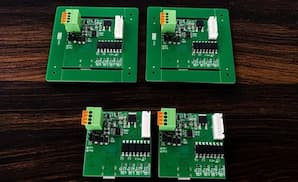
Case Study: Esp32-s3 Smart Curtain Automation Controller

Made by chanchaldada / IoT
About the project
A European window treatments company came to us with a problem. Their motorized curtain line worked fine as a standalone product, but customers kept asking for app control, voice assistant support, and scheduling.
Project info
Story
We took the project from schematic to shipped prototype in fourteen weeks. Here's how it went.
The HardwareThe obvious choice for Wi-Fi plus BLE in a consumer product is the ESP32 family, and we went with the ESP32-S3. The S3 gives us a dual-core Xtensa LX7 at 240 MHz, 512 KB of internal SRAM, and native USB OTG. That last part mattered — we used USB for factory provisioning and firmware updates, which saved us a UART-to-USB bridge chip and a connector on the board.
Around the ESP32-S3 we built:
Motor driver: DRV8848 dual H-bridge, driving a 12V brushed DC gear motor with quadrature encoder feedback. The encoder runs into the ESP32-S3's PCNT peripheral, so position tracking happens in hardware with zero CPU overhead.
Power: 12V DC input stepped down through an MP2315 buck converter to 5V, then an AP2112 LDO to 3.3V for the radio and logic. We kept the motor rail separate and star-grounded the analog sections.
Sensing: An OPT3001 ambient light sensor over I2C, plus a current shunt on the motor driver for stall detection. If the curtain hits an obstruction, the firmware sees the current spike and stops within 40 ms.
User interface: Two capacitive touch pads on the enclosure, handled by the ESP32-S3's built-in touch peripheral. No mechanical buttons, no debounce code.
Memory: 8 MB octal SPI PSRAM and 16 MB flash. The PSRAM gave us room for TLS buffers and OTA staging without squeezing the application.
The PCB is a 4-layer design, 62 mm × 38 mm, done in KiCad. We kept the antenna keep-out area clean and matched the 50-ohm feed to the onboard PCB antenna. Conducted and radiated pre-compliance testing passed on the first spin, which is not something we get to say often.
The SoftwareThe firmware runs on Zephyr RTOS. We chose Zephyr over ESP-IDF's native FreeRTOS setup for a few reasons: the device tree makes pin mapping explicit, the build system handles multiple board revisions cleanly, and the networking stack is easier to reason about when you're juggling Wi-Fi, BLE, and MQTT at once.
The software stack breaks down into four layers:
Motor control. A closed-loop position controller runs on the encoder counts, with trapezoidal velocity profiling for smooth starts and stops. Curtains are heavy and the fabric has slack, so we tuned acceleration ramps per motor variant and stored the profiles in flash. Calibration is automatic — the controller drives to both limits on first boot, records the travel range, and saves it.
Connectivity. Wi-Fi for cloud and local network control, BLE for onboarding. Provisioning uses the Espressif provisioning protocol with a custom security scheme, so the customer's phone passes Wi-Fi credentials over an encrypted BLE channel. Once on the network, the device speaks MQTT to our backend and also exposes a local REST API over mDNS for integrations that don't want cloud dependency.
Matter. This was a hard requirement. The client wanted the curtain to work with Apple Home, Google Home, and Alexa without three separate integrations. We implemented Matter over Wi-Fi using the connectedhomeip SDK, exposing the device as a Window Covering cluster. Commissioning works through the standard Matter QR code on the label. Getting Matter to fit alongside MQTT and the local API on the same radio took some careful task prioritization in Zephyr, but it holds up under load.
OTA updates. Dual-slot A/B updates with rollback. The device downloads the image to the inactive slot, verifies the signature, reboots into it, and confirms health before marking it good. If anything fails, it reverts. We tested this by deliberately corrupting images and pulling power mid-update.
What We ShippedThe client received:
Production-ready KiCad schematics, layout, and fabrication files
Full Zephyr firmware source with CI pipeline
A companion mobile SDK for BLE provisioning
Ten working prototypes, assembled and tested
Test jigs and a production test firmware image
Results
The controller went from breadboard to field trials in fourteen weeks. Power consumption in idle sits at 180 µA with the radio in modem-sleep, which means battery backup during outages is realistic. Position accuracy is within 2 mm over a 3-meter travel. Matter commissioning completes in under 30 seconds on a clean network.
The client's engineering team now owns the codebase. We handed over documentation, ran two training sessions, and stayed on retainer for the first production run.
Why This Matters for Your ProjectThis is the kind of work our embedded development services team does every day — taking a product that works and making it smart, connected, and manufacturable. We handle the full stack: PCB design in KiCad, firmware on Zephyr or bare metal, RF layout, cloud integration, and the mechanical enclosure design. If you're building something with an ESP32, an nRF52, or a chip you haven't picked yet, we can take it from concept to shipped units.
The ESP32-S3 is a strong fit for products that need Wi-Fi, BLE, and Matter in one package. If your design needs ultra-low power instead, we'd point you at the nRF52 series and a different architecture. The right answer depends on your power budget, your wireless requirements, and how much compute you need on-device.
Get in touch if you want to talk through your hardware and software split. We're happy to review a schematic or a spec and tell you what we'd do differently.
Schematics, diagrams and documents
Credits
chanchaldada
Chanchal Dada is an IoT developer at DigitalMonk, focused on building smart embedded systems using Arduino and ESP32. She specializes in IoT-based automation, smart monitoring solutions, and real-world hardware-software integration for practical applications.
Related products



Leave your feedback...