


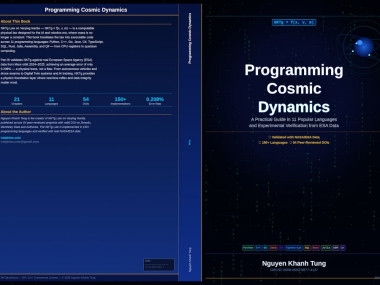
Programming Cosmic Dynamics: Variable Inertia (nktg Law)

Made by NKTgLaw
About the project
Variable Inertia (NKTg Law): real-time physics engine for AI, autonomous systems, and executable simulations.
Project info
Difficulty: Expert
Estimated time: 1 hour
License: GNU Lesser General Public License version 3 or later (LGPL3+)
Items used in this project
Hardware components

Story
For over 300 years, physics has treated inertia as a constant.
But real-world systems are not constant.
Fuel burns
- Fuel burns
Mass changes
- Mass changes
Systems evolve
- Systems evolve
This project explores a different approach:
👉 Variable Inertia
Instead of describing motion, we compute it directly.
🧪 The Core IdeaIntroducing the NKTg Law:
NKTg = f(x, v, m)
Where:
x = position
- x = position
v = velocity
- v = velocity
m = mass
- m = mass
And:
p = m × v
- p = m × v
NKTg₁ = x × p
- NKTg₁ = x × p
NKTg₂ = (dm/dt) × p
- NKTg₂ = (dm/dt) × p
These quantities determine motion tendency in real time.
⚙️ How It WorksUnlike traditional physics engines:
No differential equations
- No differential equations
No numerical solvers
- No numerical solvers
No approximation loops
- No approximation loops
Instead:
Input current state
- Input current state
Compute instantly
- Compute instantly
Output system behavior
- Output system behavior
This makes the system suitable for real-time execution.
💡 What This EnablesAI that reacts like physical systems
- AI that reacts like physical systems
Autonomous vehicles with real-time physics engines
- Autonomous vehicles with real-time physics engines
Simulation that doesn’t approximate — it executes
- Simulation that doesn’t approximate — it executes
Space navigation beyond classical models
- Space navigation beyond classical models
The NKTg Law has been implemented across:
Python (AI / prototyping)
- Python (AI / prototyping)
C++ (performance systems)
- C++ (performance systems)
Assembly (low-level execution)
- Assembly (low-level execution)
Quantum computing (Q#)
- Quantum computing (Q#)
With over 150 language implementations and cross-platform deployment.
🌐 System ArchitectureCore engine (multi-language)
- Core engine (multi-language)
API layer (REST / gRPC)
- API layer (REST / gRPC)
Distributed repositories
- Distributed repositories
DOI-verified datasets
- DOI-verified datasets
Reproducible results across environments
- Reproducible results across environments
🔹 Leanpub
https://leanpub.com/NKTgLawhttps://leanpub.com/NKTgLaw-vihttps://leanpub.com/b/NKTgLaw-global
🔹 Google Play Books
https://play.google.com/store/books/details?id=CNLKEQAAQBAJ&plihttps://play.google.com/store/books/details?id=buDMEQAAQBAJhttps://play.google.com/store/books/series?id=Fa6gHAAAABC0sM
🔹 Amazon
https://www.amazon.com/dp/B0GTSBBRYRhttps://www.amazon.com/dp/B0GHZMSKYBhttps://www.amazon.com/dp/B0D6579Q3G
👉 This Is the ShiftNot better formulas.Not faster simulations.
A new way to build reality in code.
🔑 KeywordsVariable Inertia • NKTg Law • Varying InertiaAI that reacts like physical systemsAutonomous vehicles with real-time physics enginesSimulation that doesn’t approximate — it executesSpace navigation beyond classical models
Schematics, diagrams and documents
CAD, enclosures and custom parts
Code
Credits
NKTgLaw
🚀 PROGRAMMING COSMIC DYNAMICS Physics isn’t broken. It’s just never been programmed. For 300 years, inertia was treated as a constant. What if it isn’t? What if motion can be computed — not just described? Introducing the NKTg Law by Nguyen Khanh Tung: NKTg=f(x,v,m)NKTg = f(x, v, m)NKTg=f(x,v,m) 🧪 Not a theory. A system. Built across 11 programming languages • Tested with real data from the European Space Agency • Error margin: 0.208% 💡 What this unlocks AI that reacts like physical systems Autonomous vehicles with real-time physics engines Space navigation beyond classical models Simulation that doesn’t approximate — it executes ⚙️ From Python to Assembly From AI to Quantum Computing. One law. One engine. Infinite applications. 🌍 Get the book (choose your language)
Related products




Leave your feedback...