





Gps Tracker Using Heltec Wifi Lora 32 V4 And Reyax Rys352a G

Made by play-with-circuit / Displays
About the project
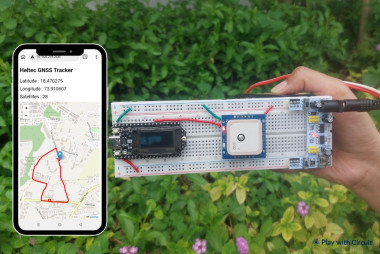
Build a browser-based GPS tracker using the Heltec WiFi LoRa 32 V4 and REYAX RYS352A Multi-GNSS module. This project visualizes real-time location and travelled routes on OpenStreetMap while hosting the tracking interface directly on the ESP32—no third-party cloud platform required.
Items used in this project
Hardware components



Story
This project demonstrates a lightweight alternative by hosting the tracking interface directly on the ESP32 development board.
Using the Heltec WiFi LoRa 32 V4 and the REYAX RYS352A Multi-GNSS module, this browser-based GPS tracker receives real-time positioning data from multiple satellite constellations, displays latitude, longitude, and connected satellite count on the onboard OLED display, and visualizes the current location on an interactive OpenStreetMap interface. Since the entire application runs locally on the ESP32, the project eliminates the need for third-party cloud platforms while providing an excellent learning experience for GNSS communication, UART interfaces, embedded web servers, and browser-based visualization.
Key Features
- Browser-based real-time GPS tracking
- Multi-GNSS support including GPS, GLONASS, Galileo, BeiDou, and QZSS
- Interactive OpenStreetMap visualization
- Live latitude, longitude, and satellite count on the onboard OLED
- Embedded web server hosted on the ESP32
- No cloud platform or external server required
- Simple hardware connections
Hardware Requirements
The project requires the Heltec WiFi LoRa 32 V4 development board, a REYAX RYS352A Multi-GNSS module, a breadboard, jumper wires, a USB Type-C cable for programming, a breadboard power supply, and a 12 V lithium battery for portable outdoor testing.
Circuit Connections
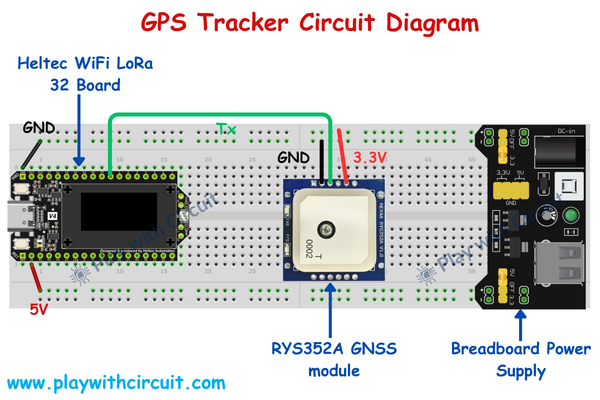
The hardware assembly is intentionally simple. Connect the VCC pin of the REYAX RYS352A to the 3.3 V output of the Heltec board, connect the GND pin to ground, and connect the TX pin of the GNSS module to GPIO38 (UART RX). The Heltec WiFi LoRa 32 V4 also provides a dedicated GNSS connector, allowing the module to be connected with minimal wiring and a cleaner hardware setup.
How the Project Works
After powering the system, the Heltec WiFi LoRa 32 V4 connects to the configured Wi-Fi hotspot and starts an embedded web server. At the same time, the REYAX RYS352A begins receiving positioning data from multiple GNSS satellite constellations and continuously transmits NMEA sentences through its UART interface.
The ESP32 processes the incoming data using the TinyGPS++ library to extract the current latitude, longitude, and connected satellite count. These values are displayed on the onboard OLED display while simultaneously being sent to a browser-based webpage hosted directly on the ESP32.
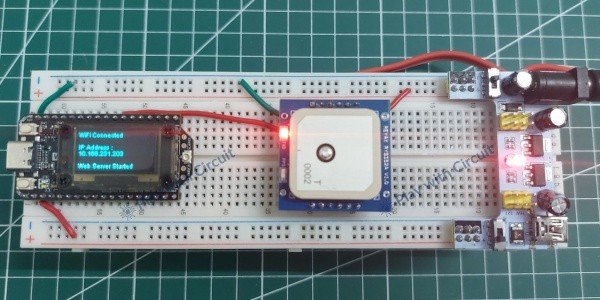
Any smartphone, tablet, or computer connected to the same Wi-Fi network can access the webpage by entering the IP address displayed on the OLED. The browser loads an OpenStreetMap interface that continuously updates the current position and records the travelled route in real time, providing a responsive and intuitive tracking experience without relying on external cloud services.
Testing
The GPS tracker was evaluated during an outdoor field test by installing the hardware inside a moving vehicle. After the GNSS receiver acquired sufficient satellites, the OLED displayed live latitude, longitude, and satellite information while the browser interface continuously updated the vehicle's position on the OpenStreetMap interface.
Throughout the journey, the travelled route was plotted accurately, demonstrating stable communication between the REYAX RYS352A and the Heltec WiFi LoRa 32 V4. The successful field test confirmed that the project is capable of providing reliable local GPS tracking and serves as a strong foundation for future location-based IoT applications.
Applications
This project can be adapted for a variety of real-world applications, including vehicle tracking, fleet management, asset monitoring, robotics, outdoor navigation, educational embedded systems projects, and IoT location monitoring. Its modular design also makes it suitable as a starting point for more advanced systems that incorporate geofencing, cloud connectivity, or long-range wireless communication.
Conclusion
This browser-based GPS tracker demonstrates how Heltec development board and a multi-GNSS receiver can be combined to create a compact, self-hosted tracking solution without relying on external cloud services. By integrating GNSS positioning, UART communication, embedded web servers, and browser-based visualization into a single project, it provides a practical and accessible learning platform for students, hobbyists, and embedded systems developers.
Checkout source code at Play with Circuit: GPS Tracker using ESP32
Schematics, diagrams and documents
Code
Credits
Related products





Leave your feedback...