





Seeed Studio Xiao ESP32C5: Tiny Wi-Fi 6 IoT Board with 5 GHz, Matter, Thread and Zigbee
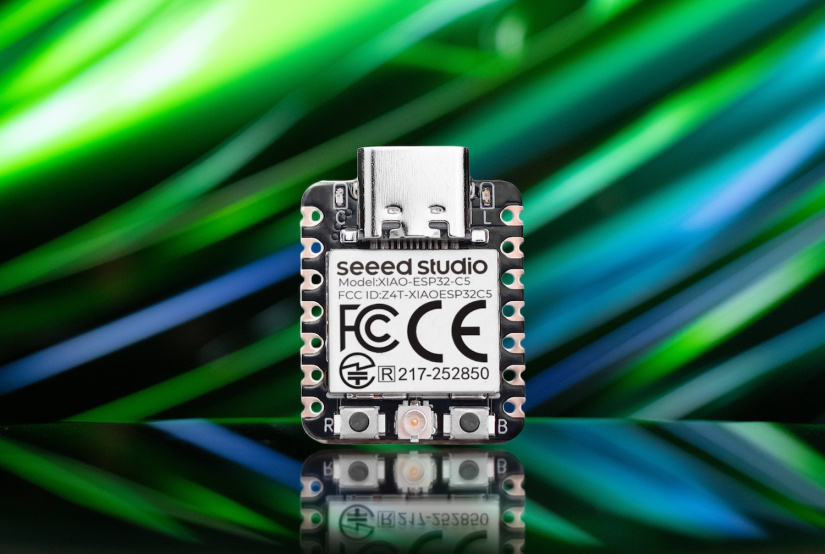
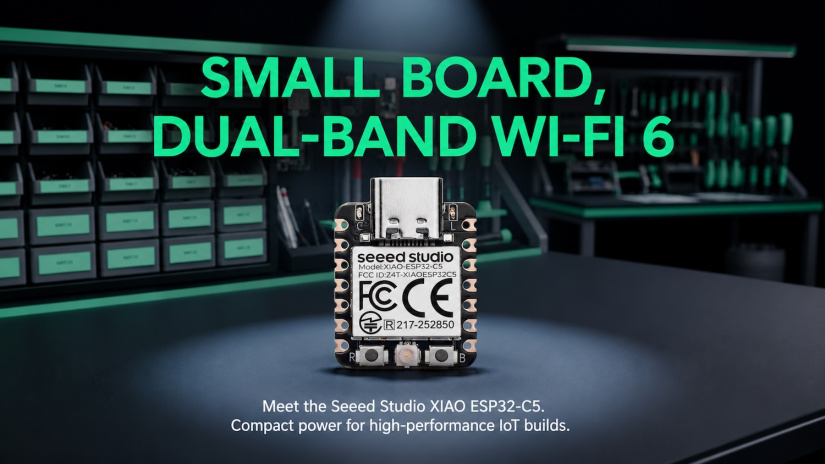
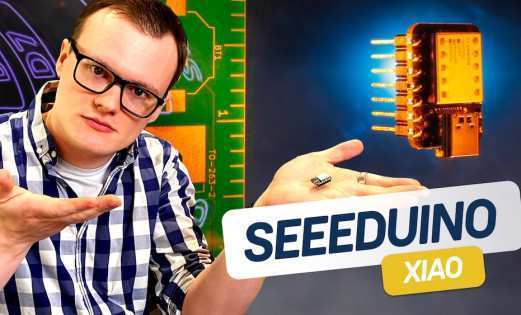
The Seeed Studio Xiao ESP32C5 is a compact wireless development board built for modern IoT devices, smart home products, battery-powered sensors, and embedded systems that need more than basic 2.4 GHz Wi-Fi. It combines Espressif’s ESP32-C5 microcontroller with dual-band Wi-Fi 6, Bluetooth LE, and IEEE 802.15.4 support in the familiar Xiao form factor.
That combination matters because many connected projects now need to work across several wireless ecosystems. A smart home sensor might need Matter support. A building automation device might use Thread or Zigbee. A portable data logger might need Bluetooth LE for setup and Wi-Fi for cloud uploads. The Xiao ESP32C5 gives developers a small board that can support those workflows without adding extra radio modules.
For developers comparing compact ESP32 boards, the main question is simple: is the Seeed Studio Xiao ESP32C5 the right tiny wireless development board for your next IoT, smart home, industrial monitoring, or embedded experiment?
For more Seeed Studio hardware, browse the full Seeed Studio product range on the Electromaker Store. You can also check current Xiao availability through the Electromaker Xiao product search.
What is the Seeed Studio Xiao ESP32C5?
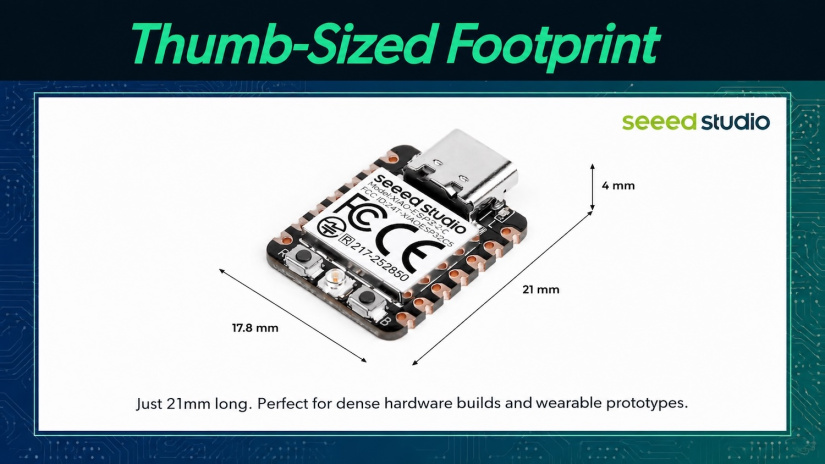
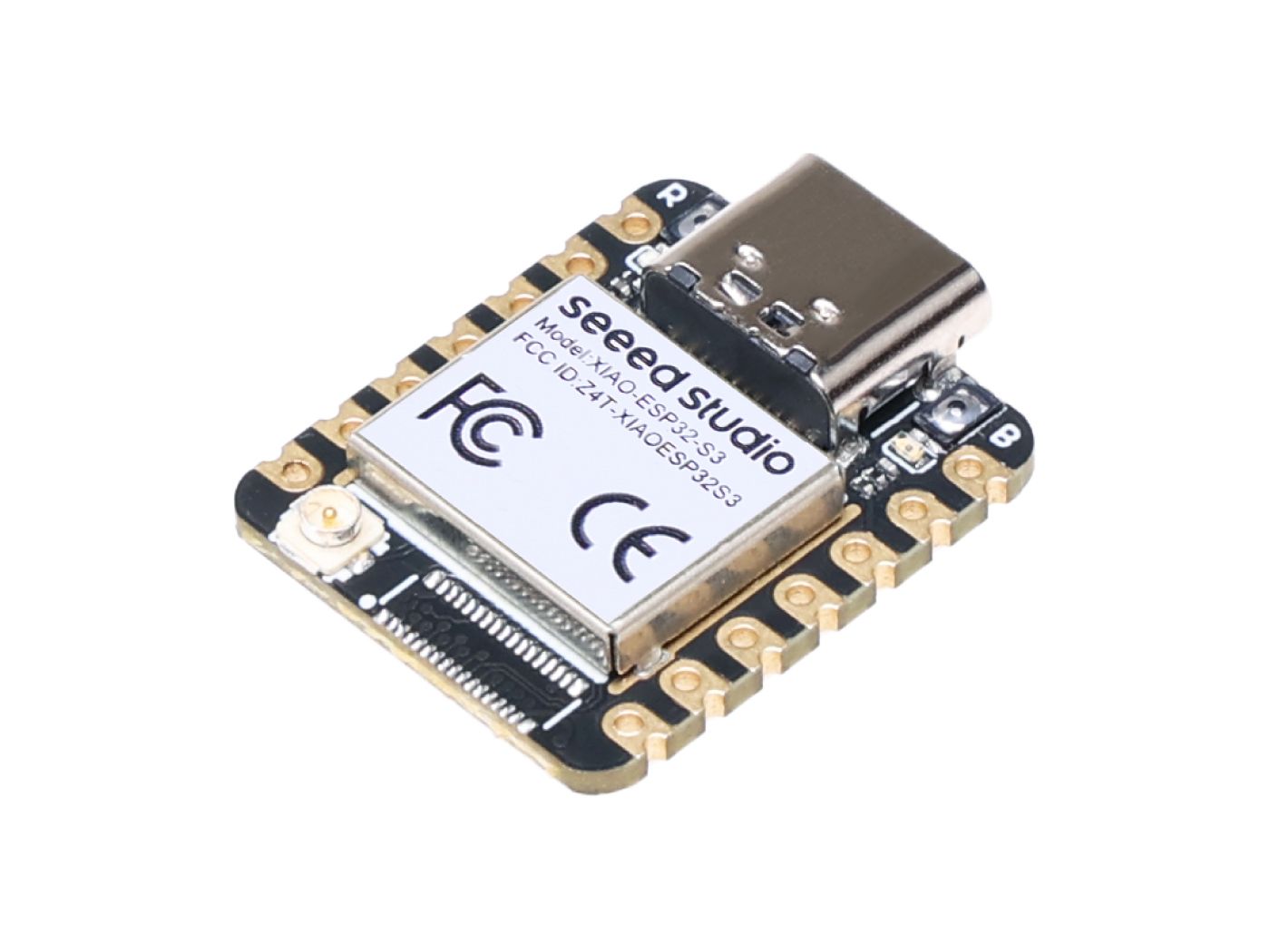
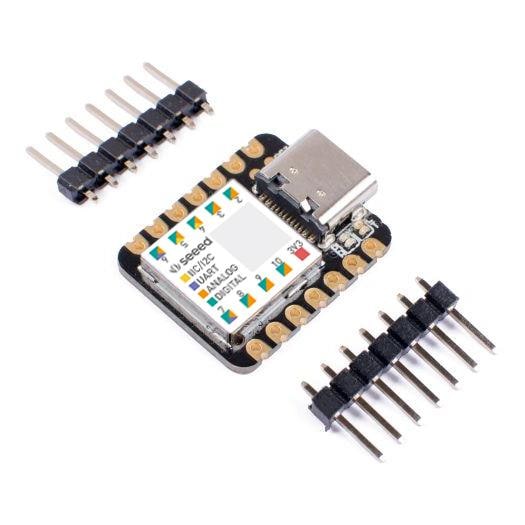
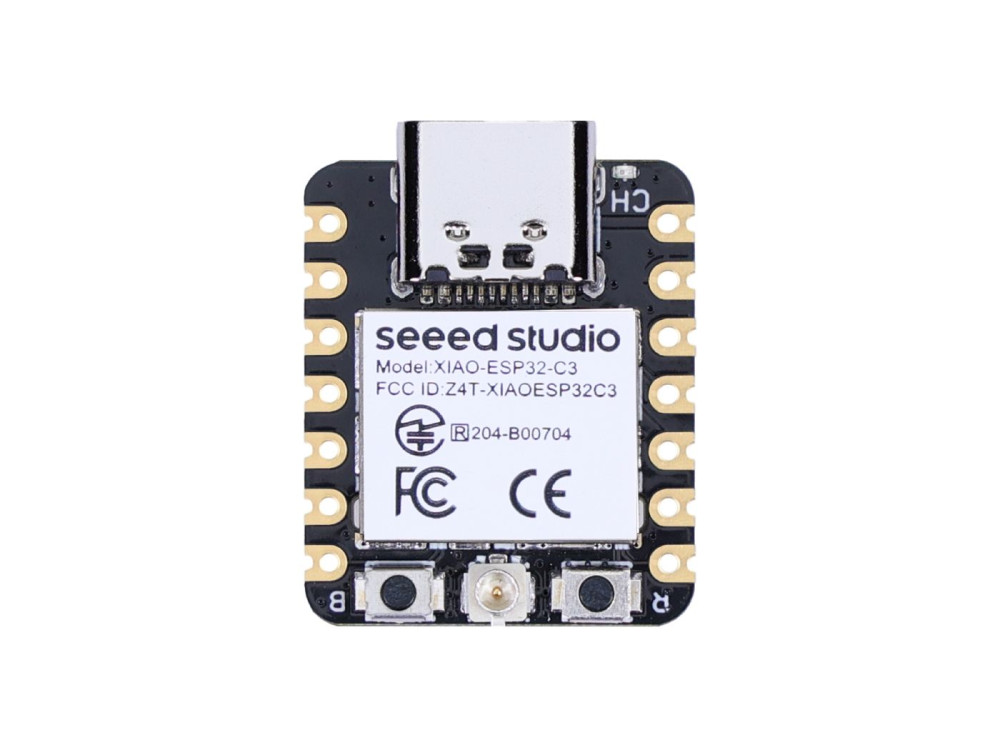
The Seeed Studio Xiao ESP32C5 is an ultra-compact ESP32-C5 development board measuring around 21 mm by 17.8 mm. It is designed for developers who want modern wireless connectivity in a board small enough for embedded products, wearable prototypes, smart home devices, portable sensors, and low-power edge systems.
At the center of the board is Espressif’s ESP32-C5, a 32-bit RISC-V wireless microcontroller running at up to 240 MHz. The chip adds a secondary low-power RISC-V core, 384 KB SRAM, 8 MB flash, and 8 MB PSRAM on the Xiao board. That gives it enough memory for practical IoT firmware, protocol stacks, sensor handling, and local pre-processing tasks.
The Xiao ESP32C5 sits in Seeed Studio’s Xiao family, which is built around small, breadboard-friendly boards with consistent dimensions and a compact pinout. This makes it useful for rapid prototyping, but it is also small enough to be considered for production-style embedded devices where PCB area, enclosure space, and battery life matter.
Why the ESP32-C5 matters for modern IoT development
The ESP32-C5 is important because it brings several wireless standards into one microcontroller platform. Instead of choosing separate boards or add-on modules for Wi-Fi, Bluetooth LE, Thread, or Zigbee experimentation, developers can start from one compact board and evaluate multiple connectivity paths.
The headline feature is dual-band Wi-Fi 6 with both 2.4 GHz and 5 GHz support. Many microcontroller boards still operate only on 2.4 GHz Wi-Fi. That is fine for many sensor projects, but it can be limiting in crowded homes, schools, workshops, offices, apartment buildings, and industrial environments where 2.4 GHz networks are busy.
5 GHz support does not automatically mean better range or better performance in every installation. It does give developers another network option. For projects that sit closer to a router or access point, 5 GHz can help avoid congested 2.4 GHz channels. For devices that must operate over longer distances or through walls, 2.4 GHz may still be the better choice. The advantage is flexibility.

Key features at a glance
The Xiao ESP32C5 is not just a small ESP32 board with a newer chip. Its value comes from the combination of compact size, modern Wi-Fi, 802.15.4 support, low-power operation, battery charging, and familiar development tooling.
| Feature | What it means for developers |
|---|---|
| ESP32-C5 microcontroller | A RISC-V wireless MCU for connected embedded projects, smart home devices, and low-power IoT nodes. |
| Dual-band Wi-Fi 6 | Supports both 2.4 GHz and 5 GHz Wi-Fi, giving projects more network deployment options. |
| IEEE 802.15.4 radio | Enables development paths for Thread and Zigbee applications. |
| Bluetooth LE | Useful for provisioning, nearby device communication, wearables, and mobile app interaction. |
| Matter support | Makes the board relevant for modern smart home development and cross-platform device experiments. |
| LiPo battery support | Simplifies portable and battery-powered prototypes using a 3.7 V lithium polymer cell. |
| Deep sleep operation | Supports low-power sensor nodes that wake periodically, take measurements, transmit data, then sleep again. |
| Xiao form factor | A very small footprint for compact products, wearable prototypes, and space-limited enclosures. |
Processor, memory, and wireless specifications
The Xiao ESP32C5 is based on the ESP32-C5 wireless microcontroller. It uses a 32-bit single-core RISC-V processor running at up to 240 MHz, supported by a low-power RISC-V core for lighter tasks. For IoT development, that split is useful because firmware can be designed around active and sleep states rather than keeping the main processor awake unnecessarily.
| Area | Seeed Studio Xiao ESP32C5 specification |
|---|---|
| Microcontroller | Espressif ESP32-C5 |
| Main CPU | 32-bit single-core RISC-V processor, up to 240 MHz |
| Low-power core | Secondary low-power RISC-V processor for lighter tasks and power-sensitive operation |
| SRAM | 384 KB on-chip SRAM |
| ROM | 320 KB ROM on ESP32-C5 |
| Flash | 8 MB flash on the Xiao ESP32C5 board |
| PSRAM | 8 MB PSRAM on the Xiao ESP32C5 board |
| Wi-Fi | Dual-band Wi-Fi 6, 2.4 GHz and 5 GHz, IEEE 802.11ax compatible |
| Bluetooth | Bluetooth LE support |
| 802.15.4 | IEEE 802.15.4 radio for Zigbee and Thread development |
| Smart home protocols | Matter, Thread, Zigbee, HomeKit, MQTT, and related IoT software workflows where supported by the chosen SDK and firmware stack |
| Form factor | Approximately 21 mm by 17.8 mm Xiao module format |
Wireless connectivity: Wi-Fi 6, 5 GHz, Bluetooth LE, Thread, and Zigbee
Wireless flexibility is the strongest reason to consider the Xiao ESP32C5. It lets developers evaluate several common IoT communication routes on one small board.
| Wireless option | Typical use | Practical notes |
|---|---|---|
| 2.4 GHz Wi-Fi | General IoT connectivity, cloud dashboards, MQTT, local web interfaces, Home Assistant integrations | Good range and broad router compatibility, but often crowded in homes, offices, and workshops. |
| 5 GHz Wi-Fi | Higher-density network environments, short to medium range devices near access points, lab and office deployments | Useful when 2.4 GHz is congested, but range and wall penetration can be weaker than 2.4 GHz. |
| Bluetooth LE | Mobile provisioning, nearby control, wearables, beacons, asset tracking prototypes | Useful for setup flows where users configure Wi-Fi credentials from a phone. |
| Thread | Low-power mesh smart home and building automation devices | Best suited to products designed around IP-based low-power mesh networking. |
| Zigbee | Home automation sensors, lighting devices, control nodes, occupancy sensors | Useful for projects targeting existing Zigbee ecosystems and hubs. |
| Matter | Cross-platform smart home device development | Matter support depends on the software stack, device type, and development framework used. |
GPIO, interfaces, and power management
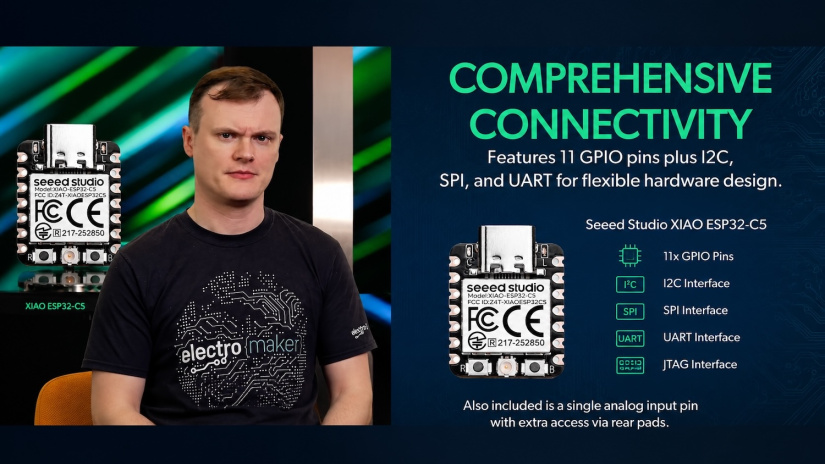
The Xiao ESP32C5 exposes the most important interfaces for compact embedded projects, including GPIO, I2C, SPI, UART, JTAG, USB-C, and battery input. It is not a large development board with every pin broken out, so developers should check pin availability early if a project needs several sensors, buses, buttons, LEDs, or wake sources.
| Interface or feature | Xiao ESP32C5 details |
|---|---|
| GPIO | 11 GPIO pins available on the compact Xiao layout |
| I2C | Useful for environmental sensors, displays, expanders, and low-pin-count peripherals |
| SPI | Useful for faster peripherals such as displays, external memory, and some radio or sensor modules |
| UART | Useful for serial peripherals, debug output, GNSS modules, and industrial interface adapters |
| JTAG | Supports hardware debugging workflows for firmware development |
| Analog input | One analog input pin, with additional access through rear pads for more custom designs |
| USB | USB Type-C for power and programming |
| Battery | 3.7 V LiPo battery input with onboard charging support |
| Low power | Deep sleep current around 15 microamps, depending on board setup, firmware, wake source, and connected peripherals |
| Buttons and indicators | Reset button, boot button, user LED, and charge status LED |
Battery-powered design considerations
The Xiao ESP32C5 is well suited to battery-powered sensor projects, but low-power results depend on the whole design, not only the microcontroller. The board’s 3.7 V LiPo input and onboard charging support make it easier to prototype portable devices, but firmware and peripheral choices still define real battery life.
- Use sleep-first firmware: wake the device, read sensors, connect only when needed, transmit data, then return to deep sleep.
- Choose wake sources carefully: timer wake-up and GPIO wake-up can support different sensor node patterns.
- Watch external components: displays, sensors, pull-up resistors, LEDs, regulators, and attached modules can dominate current draw.
- Reserve debug pins during development: Seeed’s documentation recommends keeping JTAG pins available during low-power development to avoid making firmware recovery harder.
- Test with the final enclosure and battery: wireless range, antenna behavior, charge behavior, and sleep current can change once the prototype is built into a case.
Software support and development platforms
The Xiao ESP32C5 can be developed using familiar ESP32 workflows. For many makers, Arduino IDE support is the easiest way to start. For product teams and more advanced embedded developers, ESP-IDF gives deeper control over networking, tasks, power management, security, and debugging.
| Development route | Best for | Notes |
|---|---|---|
| Arduino IDE | Beginners, makers, quick prototypes, sensor demos, Wi-Fi and MQTT experiments | Good for rapid testing and familiar Arduino-style libraries. |
| ESP-IDF | Production firmware, advanced networking, power optimization, security, Matter and Thread workflows | More complex than Arduino, but better suited to serious embedded development. |
| FreeRTOS | Multitasking firmware, sensor polling, communications tasks, real-time control loops | Part of the broader ESP-IDF development model. |
| MQTT | Home Assistant, telemetry, industrial monitoring, cloud-connected sensors | A practical route for dashboards, alerts, and remote monitoring. |
| Matter, Thread, and Zigbee SDK workflows | Smart home devices, mesh networks, interoperable IoT products | Check the current Seeed Studio and Espressif documentation before starting a production design. |
For the official hardware notes, start with the Seeed Studio Xiao ESP32C5 product page and the Seeed Studio Xiao ESP32C5 getting started guide. For chip-level details, use the Espressif ESP32-C5 product page and the ESP32-C5 datasheet.
Practical developer workflow
A good Xiao ESP32C5 project usually starts by choosing the wireless path first. The board supports several options, but each one leads to different software, test equipment, and integration decisions.
- Define the main connection method: decide whether the device will primarily use Wi-Fi, Bluetooth LE, Thread, Zigbee, or a combination.
- Confirm the software stack: use Arduino IDE for fast tests, or ESP-IDF for deeper control and production-oriented firmware.
- Map the pins early: list every sensor, button, indicator, wake input, and debug connection before committing to a PCB or enclosure.
- Prototype power behavior: measure active current, connection current, and deep sleep current with the real sensors attached.
- Test wireless reliability: validate 2.4 GHz and 5 GHz performance in the environment where the device will actually run.
- Plan firmware recovery: keep access to boot, reset, USB, and debug signals in early prototypes.
Real-world use cases for the Xiao ESP32C5
The Xiao ESP32C5 is strongest when a project needs compact hardware and modern wireless options. It is not the right fit for every embedded system, but it covers a wide range of realistic maker, education, smart home, and industrial workflows.
| Use case | Why the Xiao ESP32C5 fits |
|---|---|
| Smart home sensors | Matter, Thread, Zigbee, Wi-Fi, and MQTT support make it suitable for experimenting with different smart home architectures. |
| Battery-powered environmental monitors | Low-power sleep modes, LiPo support, and a tiny form factor suit compact sensor nodes. |
| Industrial condition monitoring | The board can collect sensor data, process it locally, and send alerts or summaries over Wi-Fi or MQTT. |
| Wireless asset tracking prototypes | Bluetooth LE and Wi-Fi enable compact tracking and proximity experiments. |
| Wearable electronics | The small board size and battery input help with compact prototypes, though enclosure and power testing are essential. |
| Building automation | Thread, Zigbee, Bluetooth LE, and Wi-Fi options support different control and monitoring topologies. |
| Portable telemetry devices | 5 GHz Wi-Fi can be useful in lab or campus networks, while 2.4 GHz remains available for broader coverage. |
Project ideas using the Xiao ESP32C5
The best projects for the Xiao ESP32C5 are those where wireless choice, compact size, and low power all matter. Here are practical ideas that connect directly to the board’s strengths.
- Matter-enabled temperature and humidity sensor: build a compact smart home node for room monitoring and cross-platform automation experiments.
- Thread-based smart lighting controller: prototype a small lighting control board for mesh-based home automation.
- Zigbee occupancy sensor: combine a motion sensor with Zigbee connectivity for home automation and building monitoring.
- Battery-powered plant monitor: read soil moisture, light, and temperature, then transmit periodic updates while spending most of the time asleep.
- Industrial vibration monitor: sample vibration or temperature data, process thresholds locally, and send MQTT alerts only when needed.
- Compact BLE setup device: use Bluetooth LE for phone-based provisioning, then switch to Wi-Fi for normal operation.
- Portable Wi-Fi network scanner: explore nearby 2.4 GHz and 5 GHz networks for lab, education, or troubleshooting projects.
- Wearable notification prototype: combine BLE, battery power, and a small display or haptic driver in a compact enclosure.
ESP32-C5 vs ESP32-C3 vs ESP32-C6 vs ESP32-S3
The Xiao ESP32C5 makes the most sense when dual-band Wi-Fi 6 and multi-protocol IoT support are more important than maximum compute performance or camera-focused edge AI. It is useful to compare it with other common ESP32 choices before selecting hardware.
| Platform | Best fit | Wireless focus | When to choose it |
|---|---|---|---|
| ESP32-C5 | Modern IoT, smart home, wireless sensors, compact multi-protocol devices | Dual-band Wi-Fi 6, Bluetooth LE, IEEE 802.15.4 | Choose it when 5 GHz Wi-Fi, Thread, Zigbee, Matter workflows, and low-power wireless flexibility matter. |
| ESP32-C3 | Simple low-cost Wi-Fi and Bluetooth LE projects | 2.4 GHz Wi-Fi and Bluetooth LE | Choose it when you want a basic RISC-V ESP32 platform and do not need 5 GHz Wi-Fi or 802.15.4. |
| ESP32-C6 | Matter, Thread, Zigbee, and Wi-Fi 6 projects that do not need 5 GHz Wi-Fi | 2.4 GHz Wi-Fi 6, Bluetooth LE, IEEE 802.15.4 | Choose it when 2.4 GHz Wi-Fi 6 and 802.15.4 support are enough for the target design. |
| ESP32-S3 | USB, displays, cameras, edge AI experiments, higher-performance embedded applications | 2.4 GHz Wi-Fi and Bluetooth LE | Choose it when compute, USB, camera, display, or TinyML workflows are more important than 5 GHz Wi-Fi or 802.15.4. |
The short version for hardware selection is this: choose Xiao ESP32C5 for compact multi-protocol wireless IoT. Choose ESP32-C3 for simpler low-cost Wi-Fi devices. Choose ESP32-C6 when you need 802.15.4 but not 5 GHz Wi-Fi. Choose ESP32-S3 when your project needs stronger compute, camera support, display work, or edge AI experimentation.
Who should choose the Xiao ESP32C5?
The Xiao ESP32C5 is a good fit for developers who need a small, low-power ESP32 board with modern wireless options. It is especially useful when you are not yet certain which wireless route your product or prototype will use, because it supports several practical IoT paths on one board.
- Choose it for: smart home prototypes, Matter experiments, Thread and Zigbee development, battery-powered sensors, compact Wi-Fi devices, Bluetooth LE provisioning, industrial monitoring prototypes, and embedded wireless products.
- Think twice if: you need many GPIO pins, several ADC inputs, a large display interface, camera support, or high-performance edge AI workloads.
- Do not buy it only for 5 GHz Wi-Fi: 5 GHz is useful, but the real value is the full wireless mix. If your project only needs basic 2.4 GHz Wi-Fi, a simpler ESP32 board may be enough.
- Validate before production: confirm SDK support, radio behavior, antenna performance, power draw, enclosure effects, and compliance needs before using it in a commercial product.
FAQs
What is the Seeed Studio Xiao ESP32C5?
The Seeed Studio Xiao ESP32C5 is a compact development board based on Espressif’s ESP32-C5 wireless microcontroller. It supports dual-band Wi-Fi 6, Bluetooth LE, and IEEE 802.15.4 for Thread and Zigbee development in a tiny Xiao form factor.
Does the Xiao ESP32C5 support 5 GHz Wi-Fi?
Yes. The Xiao ESP32C5 supports dual-band Wi-Fi 6, including both 2.4 GHz and 5 GHz operation. This gives developers more flexibility when deploying devices in congested wireless environments.
Does the Xiao ESP32C5 support Matter, Thread, and Zigbee?
The ESP32-C5 platform supports IEEE 802.15.4 connectivity for Thread and Zigbee development, and it is positioned for Matter-compatible smart home workflows. Developers should confirm the current SDK, framework, and device-type support before starting a production project.
Is the Xiao ESP32C5 Arduino compatible?
Yes. The Xiao ESP32C5 can be used with Arduino-style development workflows, and more advanced developers can use Espressif’s ESP-IDF for deeper control over networking, power management, debugging, and production firmware.
Is the Xiao ESP32C5 suitable for battery-powered devices?
Yes. The board includes 3.7 V LiPo battery input, onboard charging support, and low-power sleep capability. Real battery life depends on firmware design, connected sensors, wake frequency, wireless usage, and the final hardware design.
How is the ESP32-C5 different from the ESP32-C6?
Both platforms support Wi-Fi 6, Bluetooth LE, and IEEE 802.15.4, but the ESP32-C5 adds 5 GHz Wi-Fi support. The ESP32-C6 is a good option when 2.4 GHz Wi-Fi 6 and 802.15.4 are enough.
When should I choose an ESP32-S3 instead?
Choose an ESP32-S3 board when your project needs stronger compute features, camera support, display work, USB device features, or edge AI experimentation. Choose the Xiao ESP32C5 when compact multi-protocol wireless connectivity is the priority.
Where can I buy Seeed Studio Xiao boards?
You can browse Seeed Studio hardware through the Seeed Studio range on the Electromaker Store or search for Xiao development boards on Electromaker.

Ian Buckley is a writer, musician, and perpetual tinkerer. Commonly found surrounded by hobby electrical components, he's also a keen programmer and likes to build crazy-sounding instruments with microcontrollers. In addition to Electromaker, Ian writes over at MakeUseOf and has bylines at the likes of Online Tech Tips as well as Help Desk Geek.










Leave your feedback...